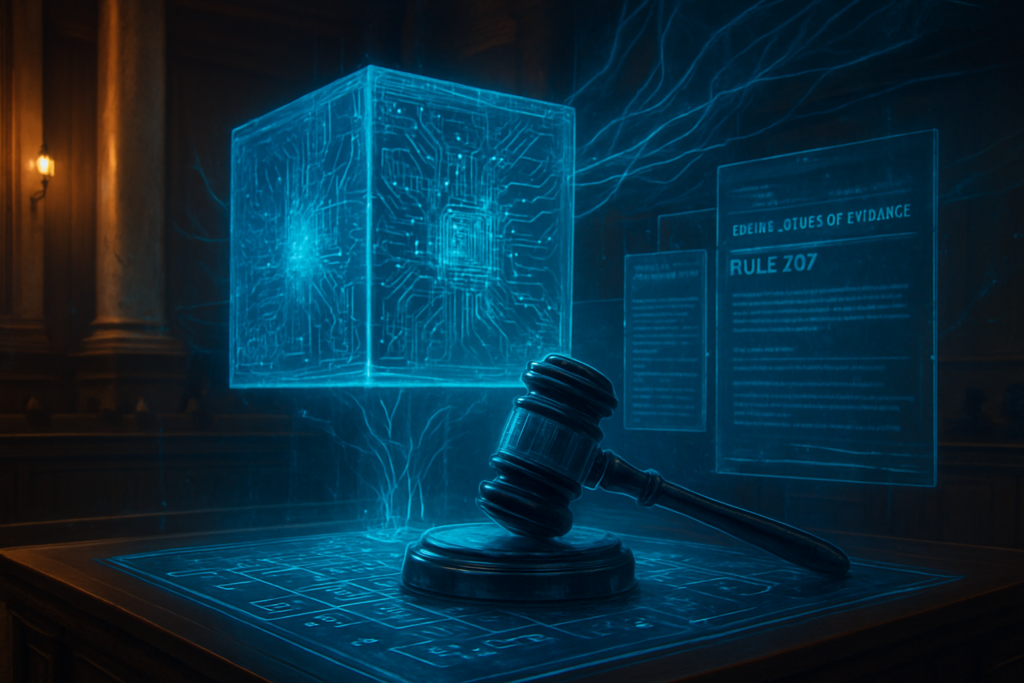
The United States federal judiciary is moving to close a critical loophole that has allowed sophisticated artificial intelligence outputs to enter courtrooms with minimal oversight. As of January 15, 2026, the Advisory Committee on Evidence Rules has reached a pivotal stage in its multi-year effort to codify how machine-generated evidence is handled, shifting focus from minor adjustments to a sweeping new standard: proposed Federal Rule of Evidence (FRE) 707.
This development marks a watershed moment in legal history, effectively ending the era where AI outputs—ranging from predictive crime algorithms to complex accident simulations—could be admitted as simple "results of a process." By subjecting AI to the same rigorous reliability standards as human expert testimony, the judiciary is signaling a profound skepticism toward the "black box" nature of modern algorithms, demanding transparency and technical validation before any AI-generated data can influence a jury.
Technical Scrutiny: From Authentication to Reliability
The core of the new proposal is the creation of Rule 707 (Machine-Generated Evidence), which represents a strategic pivot by the Advisory Committee. Throughout 2024, the committee debated amending Rule 901(b)(9), which traditionally governed the authentication of processes like digital scales or thermometers. However, by late 2025, it became clear that AI’s complexity required more than just "authentication." Rule 707 dictates that if machine-generated evidence is offered without a sponsoring human expert, it must meet the four-pronged reliability test of Rule 702—often referred to as the Daubert standard.
Under the proposed rule, a proponent of AI evidence must demonstrate that the output is based on sufficient facts or data, is the product of reliable principles and methods, and reflects a reliable application of those principles to the specific case. This effectively prevents litigants from "evading" expert witness scrutiny by simply presenting an AI report as a self-authenticating document. To prevent a backlog of litigation over mundane tools, the rule includes a carve-out for "basic scientific instruments," ensuring that digital clocks, scales, and basic GPS data are not subjected to the same grueling reliability hearings as a generative AI reconstruction.
Initial reactions from the legal and technical communities have been polarized. While groups like the American Bar Association have praised the move toward transparency, some computer scientists argue that "reliability" is difficult to prove for deep-learning models where even the developers cannot fully explain a specific output. The judiciary’s November 2025 meeting notes suggest that this tension is intentional, designed to force a higher bar of explainability for any AI used in a life-altering legal context.
The Corporate Battlefield: Trade Secrets vs. Trial Transparency
The implications for the tech industry are immense. Major AI developers, including Microsoft (NASDAQ: MSFT), Alphabet Inc. (NASDAQ: GOOGL), and specialized forensic AI firms, now face a future where their proprietary algorithms may be subjected to "adversarial scrutiny" in open court. If a law firm uses a proprietary AI tool to model a patent infringement or a complex financial fraud, the opposing counsel could, under Rule 707, demand a deep dive into the training data and methodologies to ensure they are "reliable."
This creates a significant strategic challenge for tech giants and startups alike. Companies that prioritize "explainable AI" (XAI) stand to benefit, as their tools will be more easily admitted into evidence. Conversely, companies relying on highly guarded, opaque models may find their products effectively barred from the courtroom if they refuse to disclose enough technical detail to satisfy a judge’s reliability assessment. There is also a growing market opportunity for third-party "AI audit" firms that can provide the expert testimony required to "vouch" for an algorithm’s integrity without compromising every trade secret of the original developer.
Furthermore, the "cost of admission" is expected to rise. Because Rule 707 often necessitates expert witnesses to explain the AI’s methodology, some industry analysts worry about an "equity gap" in litigation. Larger corporations with the capital to hire expensive technical experts will find it easier to utilize AI evidence, while smaller litigants and public defenders may be priced out of using advanced algorithmic tools in their defense, potentially disrupting the level playing field the rules are meant to protect.
Navigating the Deepfake Era and Beyond
The proposed rule change fits into a broader global trend of legislative and judicial caution regarding the "hallucination" and manipulation potential of AI. Beyond Rule 707, the committee is still refining Rule 901(c), a specific measure designed to combat deepfakes. This "burden-shifting" framework would require a party to prove the authenticity of electronic evidence if the opponent makes a "more likely than not" showing that the evidence was fabricated by AI.
This cautious approach mirrors the broader societal anxiety over the erosion of truth. The judiciary’s move is a direct response to the "Deepfake Era," where the ease of creating convincing but false video or audio evidence threatens the very foundation of the "seeing is believing" principle in law. By treating AI output with the same scrutiny as a human expert who might be biased or mistaken, the courts are attempting to preserve the integrity of the record against the tide of algorithmic generation.
Concerns remain, however, that the rules may not evolve fast enough. Some critics pointed out during the May 2025 voting session that by the time these rules are formally adopted, AI capabilities may have shifted again, perhaps toward autonomous agents that "testify" via natural language interfaces. Comparisons are being made to the early days of DNA evidence; it took years for the courts to settle on a standard, and the current "Rule 707" movement represents the first major attempt to bring that level of rigor to the world of silicon and code.
The Road to 2027: What’s Next for Legal AI
The journey for Rule 707 is far from over. The formal public comment period is scheduled to remain open until February 16, 2026. Following this, the Advisory Committee will review the feedback in the spring of 2026 before sending a final version to the Standing Committee. If the proposal moves through the Supreme Court and Congress without delay, the earliest possible effective date for Rule 707 would be December 1, 2027.
In the near term, we can expect a flurry of "test cases" where lawyers attempt to use the spirit of Rule 707 to challenge AI evidence even before the rule is officially on the books. We are also likely to see the emergence of "legal-grade AI" software, marketed specifically as being "Rule 707 Compliant," featuring built-in logging, bias-testing reports, and transparency dashboards designed specifically for judicial review.
The challenge for the judiciary will be maintaining a balance: ensuring that the court does not become a graveyard for innovative technology while simultaneously protecting the jury from being dazzled by "science" that is actually just a sophisticated guess.
Summary and Final Thoughts
The proposed adoption of Federal Rule of Evidence 707 represents the most significant shift in American evidence law since the 1993 Daubert decision. By forcing machine-generated evidence to meet a high bar of reliability, the US judiciary is asserting control over the rapid influx of AI into the legal system.
The key takeaways for the industry are clear: the "black box" is no longer a valid excuse in a court of law. AI developers must prepare for a future where transparency is a prerequisite for utility in litigation. While this may increase the costs of using AI in the short term, it is a necessary step toward building a legal framework that can withstand the challenges of the 21st century. In the coming months, keep a close watch on the public comments from the tech sector—their response will signal just how much "transparency" the industry is actually willing to provide.
This content is intended for informational purposes only and represents analysis of current AI developments.
TokenRing AI delivers enterprise-grade solutions for multi-agent AI workflow orchestration, AI-powered development tools, and seamless remote collaboration platforms.
For more information, visit https://www.tokenring.ai/.