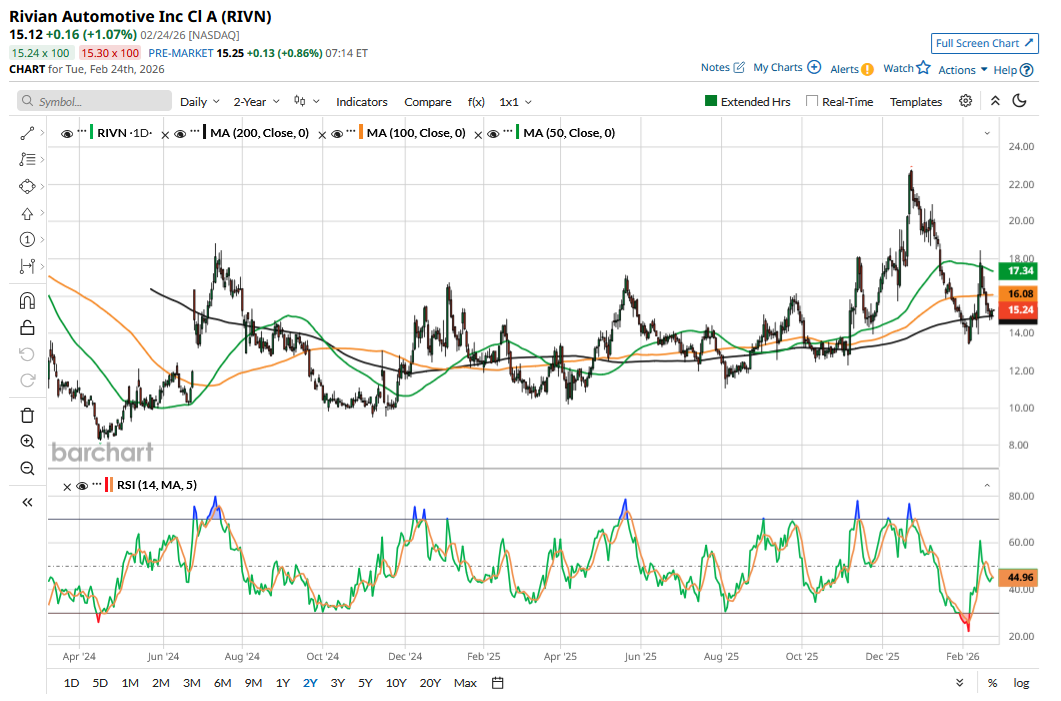
Rivian's (RIVN) stock has looked weak over the last few trading sessions and has pared some of the gains following an impressive Q4 2025 earnings report last week. Electric vehicle (EV) stocks have been out of favor with investors for quite some time, and even Tesla (TSLA) has stopped talking less about electric cars as it positions itself as an artificial intelligence (AI) play.
Rivian, along with Lucid Group (LCID), remains among the rare breed of U.S. EV startups that survived the slump, and most others have either gone out of business or simply become irrelevant. Rivian, which rallied last year, is currently down over 21% for the year. Let's look closer at RIVN’s 2026 forecast, which management sees as an “inflection year” as the company prepares to launch its R2 vehicles in the second quarter of the year.
Rivian Expects Deliveries to Rise Significantly in 2026
Let’s begin by looking at a snapshot of Rivian’s Q4 earnings. It reported revenues of $1.29 billion and an adjusted per-share loss of 54 cents in the quarter, with both metrics coming in better than Street estimates. Its 2025 revenues rose 8% year-over-year (YoY), and importantly, it generated a gross profit of $144 million as compared to a gross loss of $1.2 billion in the previous year.
While Rivian’s core automotive business is still not profitable on a gross profit level, regulatory credit sales and a software partnership with Volkswagen (VWAGY) helped it achieve this feat on a company level.
Meanwhile, Rivian expects the launch of R2 to negatively impact its gross margins in the second and third quarters of this year. It expects things to improve in the final quarter as that model ramps up production. However, regulatory credit sales might remain a headwind as legacy automakers don't necessarily need to buy these following the easing of Corporate Average Fuel Economy (CAFE) standards by the Trump administration.
Rivian sees its 2026 deliveries rising to between 62,000 and 67,000 units, with the top end of the guidance implying a 59% annual increase. A lot, however, would rely on the reception its affordable R2 vehicles receive from buyers, as sales of premium R1 vehicles have sagged.
RIVN Stock Forecast
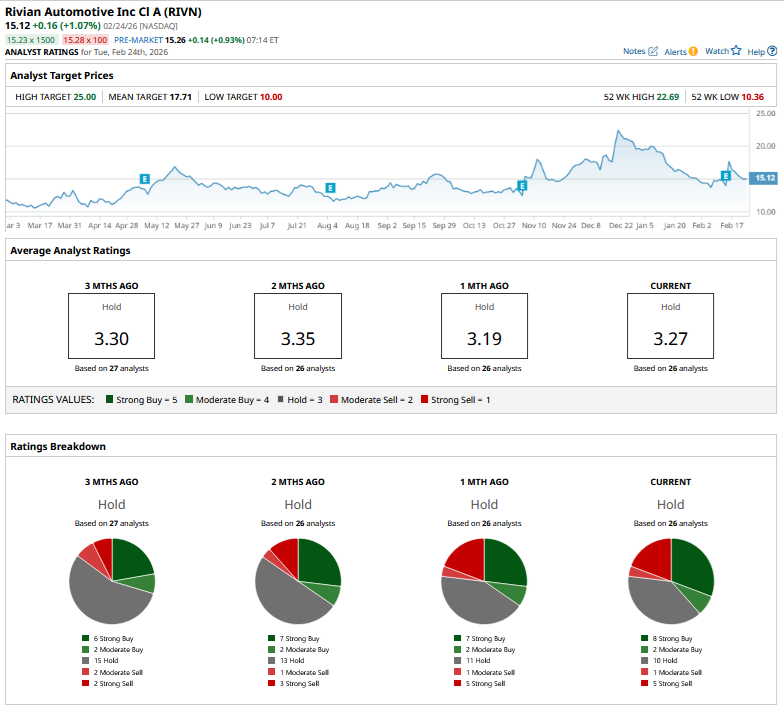
Sell-side analysts had an unusually divergent reaction to Rivian’s Q4 earnings, though. Wells Fargo, TD Cowen, and Stifel raised their target prices, while Piper Sandler lowered its from $20 to $18. Deutsche upgraded RIVN to a “Buy” and raised its target price to $23, while UBS—which had downgraded the stock to a “Sell” in January—upgraded it to a “Neutral” while raising its target price to $16. D.A. Davidson, meanwhile, downgraded the stock from a “Neutral” to “Underperform” while slashing its target price by $1 to $14.
Overall, RIVN stock has a consolidated rating of “Hold” from the 23 analysts polled by Barchart, while its mean target price of $17.71 is over 17% higher than current price levels.
Should You Buy RIVN Stock?
During the Q4 earnings call, CEO RJ Scaringe termed 2025 as a “foundational year” for the company and said that he believes the current year will be an “inflection point for our business.” CFO Claire McDonough, meanwhile, sees 2026 as a “transition year for the Automotive segment's profitability” as the company ramps up R2 production.
While I am not giving up on RIVN stock yet, I capitalized on the rally last year to book profits and trimmed my positions. I continue to believe that Rivian offers a good value proposition to customers, and no wonder Volkswagen chose it as a partner. The German auto giant also bet on Chinese EV company XPeng Motors (XPEV), which has Tesla-like ambitions and has tasted success with its new affordable models.
Rivian is also pivoting to affordable cars, which is not a bad strategy. The problem, however, is that companies across the EV spectrum—from U.S. EV giant Tesla to fellow EV startup Lucid Motors and even legacy automaker Ford (F)—are doing the same thing. Ford is incidentally looking to build a $30,000 electric pickup truck, which would be available in showrooms next year. Importantly, Ford expects the new models to be profitable from the start.
The affordable EV segment in the U.S. might also soon get crowded with multiple models from different automakers. Given the current state of the U.S. EV industry, which is characterized by tepid demand and production overcapacity, I am not too bullish on the sector, especially after the withdrawal of the EV tax credit by the Trump administration.
The U.S. EV industry would need policy support to spur adoption—something we might not see under the current administration. Overall, given the sorry state of affairs in the U.S. EV industry, I remain cautious on the sector, especially as the tech selloff has created attractive opportunities elsewhere.
On the date of publication, Mohit Oberoi had a position in: F , XPEV , RIVN , TSLA . All information and data in this article is solely for informational purposes. For more information please view the Barchart Disclosure Policy here.
More news from Barchart
- Ken Griffin, Ray Dalio, and Warren Buffett All Sold More Apple Stock. Should You?
- As Circle Stock Breaks Through Key Resistance Levels, Should You Chase the CRCL Rally?
- RIVN Stock 2026 Forecast: What to Expect as Rivian Sees ‘Inflection Year’
- Huge Volume in Netflix Call Options Today Shows Investors are Bullish on NFLX Stock