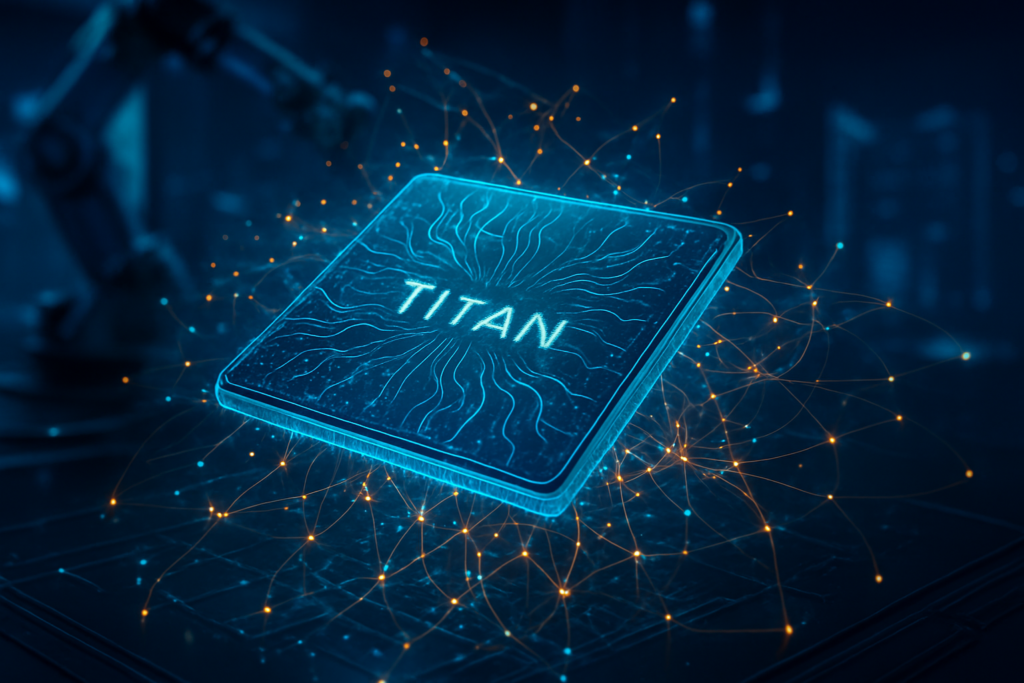
In a decisive move toward vertical integration, OpenAI has officially unveiled the roadmap for its first custom-designed AI processor, codenamed "Titan." Developed in close collaboration with Broadcom (NASDAQ: AVGO) and slated for fabrication on Taiwan Semiconductor Manufacturing Company's (NYSE: TSM) cutting-edge N3 process, the chip represents a fundamental shift in OpenAI’s strategy. By moving from a software-centric model to a "fabless" semiconductor designer, the company aims to break its reliance on general-purpose hardware and gain direct control over the infrastructure powering its next generation of reasoning models.
The announcement marks the formal pivot away from CEO Sam Altman's ambitious earlier discussions regarding a multi-trillion-dollar global foundry network. Instead, OpenAI is adopting what industry insiders call the "Apple Playbook," focusing on proprietary Application-Specific Integrated Circuit (ASIC) design to optimize performance-per-watt and, more critically, performance-per-dollar. With a target deployment date of December 2026, the Titan chip is engineered specifically to tackle the skyrocketing costs of inference—the phase where AI models generate responses—which have threatened to outpace the company’s revenue growth as models like the o1-series become more "thought-intensive."
Technical Specifications: Optimizing for the Reasoning Era
The Titan chip is not a general-purpose GPU meant to compete with Nvidia (NASDAQ: NVDA) across every possible workload; rather, it is a specialized ASIC fine-tuned for the unique architectural demands of Large Language Models (LLMs) and reasoning-heavy agents. Built on TSMC's 3-nanometer (N3) node, the Titan project leverages Broadcom's extensive library of intellectual property, including high-speed interconnects and sophisticated Ethernet switching. This collaboration is designed to create a "system-on-a-chip" environment that minimizes the latency between the processor and its high-bandwidth memory (HBM), a critical bottleneck in modern AI systems.
Initial technical leaks suggest that Titan aims for a staggering 90% reduction in inference costs compared to existing general-purpose hardware. This is achieved by stripping away the legacy features required for graphics or scientific simulations—functions found in Nvidia’s Blackwell or Vera Rubin architectures—and focusing entirely on the "thinking cycles" required for autoregressive token generation. By optimizing the hardware specifically for OpenAI’s proprietary algorithms, Titan is expected to handle the "chain-of-thought" processing of future models with far greater energy efficiency than traditional GPUs.
The AI research community has reacted with a mix of awe and skepticism. While many experts agree that custom silicon is the only way to scale inference to billions of users, others point out the risks of "architectural ossification." Because ASICs are hard-wired for specific tasks, a sudden shift in AI model architecture (such as a move away from Transformers) could render the Titan chip obsolete before it even reaches full scale. However, OpenAI’s decision to continue deploying Nvidia’s hardware alongside Titan suggests a "hybrid" strategy intended to mitigate this risk while lowering the baseline cost for their most stable workloads.
Market Disruption: The Rise of the Hyperscaler Silicon
The entry of OpenAI into the silicon market sends a clear message to the broader tech industry: the era of the "Nvidia tax" is nearing its end for the world’s largest AI labs. OpenAI joins an elite group of tech giants, including Google (NASDAQ: GOOGL) with its TPU v7 and Amazon (NASDAQ: AMZN) with its Trainium line, that are successfully decoupling their futures from third-party hardware vendors. This vertical integration allows these companies to capture the margins previously paid to semiconductor giants and gives them a strategic advantage in a market where compute capacity is the most valuable currency.
For companies like Meta (NASDAQ: META), which is currently ramping up its own Meta Training and Inference Accelerator (MTIA), the Titan project serves as both a blueprint and a warning. The competitive landscape is shifting from "who has the best model" to "who can run the best model most cheaply." If OpenAI successfully hits its December 2026 deployment target, it could offer its API services at a price point that undercuts competitors who remain tethered to general-purpose GPUs. This puts immense pressure on mid-sized AI startups who lack the capital to design their own silicon, potentially widening the gap between the "compute-rich" and the "compute-poor."
Broadcom stands as a major beneficiary of this shift. Despite a slight market correction in early 2026 due to lower initial margins on custom ASICs, the company has secured a massive $73 billion AI backlog. By positioning itself as the "architect for hire" for OpenAI and others, Broadcom has effectively cornered a new segment of the market: the custom AI silicon designer. Meanwhile, TSMC continues to act as the industry's ultimate gatekeeper, with its 3nm and 5nm nodes reportedly 100% booked through the end of 2026, forcing even the world’s most powerful companies to wait in line for manufacturing capacity.
The Broader AI Landscape: From Foundries to Infrastructure
The Titan project is the clearest indicator yet that the "trillions for foundries" narrative has evolved into a more pragmatic pursuit of "industrial infrastructure." Rather than trying to rebuild the global semiconductor supply chain from scratch, OpenAI is focusing its capital on what it calls the "Stargate" project—a $500 billion collaboration with Microsoft (NASDAQ: MSFT) and Oracle (NYSE: ORCL) to build massive data centers. Titan is the heart of this initiative, designed to fill these facilities with processors that are more efficient and less power-hungry than anything currently on the market.
This development also highlights the escalating energy crisis within the AI sector. With OpenAI targeting a total compute commitment of 26 gigawatts, the efficiency of the Titan chip is not just a financial necessity but an environmental and logistical one. As power grids around the world struggle to keep up with the demands of AI, the ability to squeeze more "intelligence" out of every watt of electricity will become the primary metric of success. Comparisons are already being drawn to the early days of mobile computing, where proprietary silicon allowed companies like Apple to achieve battery life and performance levels that generic competitors could not match.
However, the concentration of power remains a significant concern. By controlling the model, the software, and now the silicon, OpenAI is creating a closed ecosystem that could stifle open-source competition. If the most efficient way to run advanced AI is on proprietary hardware that is not for sale to the public, the "democratization of AI" may face its greatest challenge yet. The industry is watching closely to see if OpenAI will eventually license the Titan architecture or keep it strictly for internal use, further cementing its position as a sovereign entity in the tech world.
Looking Ahead: The Roadmap to Titan 2 and Beyond
The December 2026 launch of the first Titan chip is only the beginning. Sources indicate that OpenAI is already deep into the design phase for "Titan 2," which is expected to utilize TSMC’s A16 (1.6nm) process by 2027. This rapid iteration cycle suggests that OpenAI intends to match the pace of the semiconductor industry, releasing new hardware generations as frequently as it releases new model versions. Near-term, the focus will remain on stabilizing the N3 production yields and ensuring that the first racks of Titan servers are fully integrated into OpenAI’s existing data center clusters.
In the long term, the success of Titan could pave the way for even more specialized hardware. We may see the emergence of "edge" versions of the Titan chip, designed to bring high-level reasoning capabilities to local devices without relying on the cloud. Challenges remain, particularly in the realm of global logistics and the ongoing geopolitical tensions surrounding semiconductor manufacturing in Taiwan. Any disruption to TSMC’s operations would be catastrophic for the Titan timeline, making supply chain resilience a top priority for Altman’s team as they move toward the late 2026 deadline.
Experts predict that the next eighteen months will be a "hardware arms race" unlike anything seen since the early days of the PC. As OpenAI transitions from a software company to a hardware-integrated powerhouse, the boundary between "AI company" and "semiconductor company" will continue to blur. If Titan performs as promised, it will not only secure OpenAI’s financial future but also redefine the physical limits of what artificial intelligence can achieve.
Conclusion: A New Chapter in AI History
OpenAI's entry into the custom silicon market with the Titan chip marks a historic turning point. It is a calculated bet that the future of artificial intelligence belongs to those who own the entire stack, from the silicon atoms to the neural networks. By partnering with Broadcom and TSMC, OpenAI has bypassed the impossible task of building its own factories while still securing a customized hardware advantage that could last for years.
The key takeaway for 2026 is that the AI industry has reached industrial maturity. No longer content with off-the-shelf solutions, the leaders of the field are now building the world they want to see, one transistor at a time. While the technical and geopolitical risks are substantial, the potential reward—a 90% reduction in the cost of intelligence—is too great to ignore. In the coming months, all eyes will be on TSMC’s fabrication schedules and the internal benchmarks of the first Titan prototypes, as the world waits to see if OpenAI can truly conquer the physical layer of the AI revolution.
This content is intended for informational purposes only and represents analysis of current AI developments.
TokenRing AI delivers enterprise-grade solutions for multi-agent AI workflow orchestration, AI-powered development tools, and seamless remote collaboration platforms.
For more information, visit https://www.tokenring.ai/.