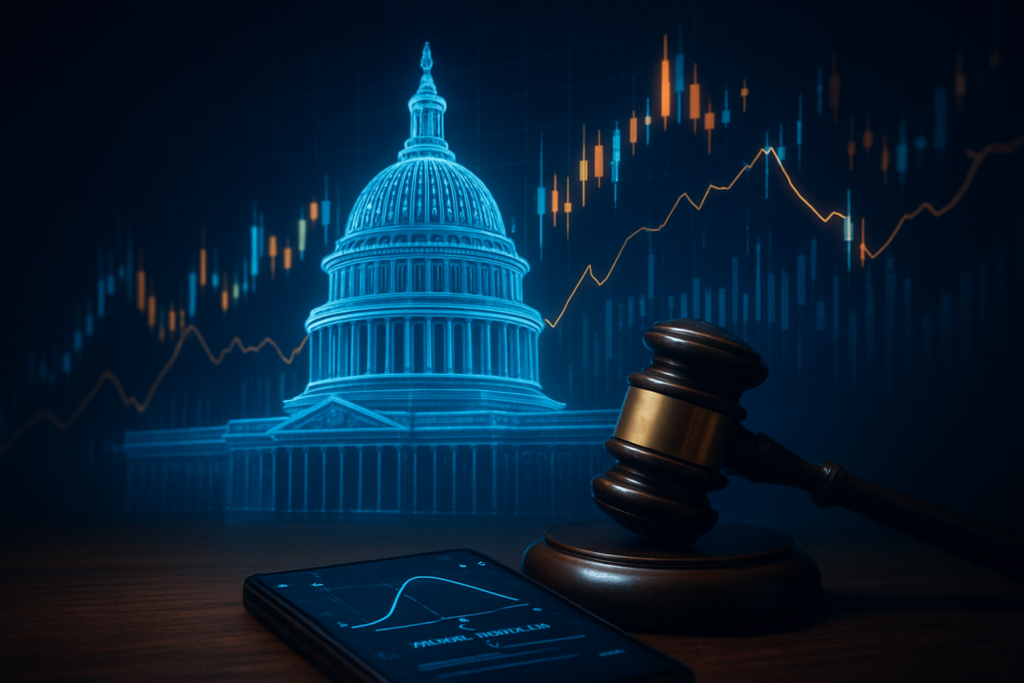
As of January 20, 2026, the prediction market world is grappling with a new reality: the prospect of a federal ban on government employees and politicians trading the very outcomes they influence. Prompted by a suspicious $400,000 windfall on the offshore platform Polymarket, Congressman Ritchie Torres (D-NY) has formally introduced the Public Integrity in Financial Prediction Markets Act of 2026 (H.R. 7004). The bill aims to codify "insider trading" rules for the burgeoning world of "Information Finance," marking the most significant legislative attempt to regulate the space since the 2012 STOCK Act.
Currently, proxy markets on PredictIt and Kalshi suggest that while the public is outraged, the path to legislative victory remains steep. A PredictIt contract tracking the passage of a general ban on congressional trading is currently hovering at a 12% probability, reflecting deep-seated skepticism that a divided Congress will move quickly in a midterm election year. However, interest in the bill is surging as major retail platforms like Robinhood (NASDAQ: HOOD) and Interactive Brokers (NASDAQ: IBKR) pivot to support the legislation, hoping that federal guardrails will finally provide the regulatory certainty needed to fend off aggressive state-level bans.
The Market: What's Being Predicted
The "Torres Bill" market is less a single contract and more a cluster of interconnected wagers across multiple platforms. On PredictIt, the "Will Congress pass a ban on member stock trading?" contract—long used as a barometer for ethics legislation—saw a 4-cent spike following the introduction of H.R. 7004 on January 9, 2026. Meanwhile, on Kalshi, a contract focused on whether the Commodity Futures Trading Commission (CFTC) will adopt new insider trading rules by the end of 2026 has climbed to 20%, suggesting traders believe administrative action may be more likely than a full act of Congress.
Trading volume has been particularly heavy in the "Federal Preemption" markets on Manifold, where the probability that federal law will override state-level bans (like New York’s proposed ORACLE Act) is trading at a staggering 81%. This reflects a consensus that the Torres Bill is being used as a bargaining chip: the industry will accept a ban on "government insiders" in exchange for a federal "safe harbor" that protects platforms from being labeled as illegal gambling by state attorneys general.
The resolution criteria for most of these markets depend on H.R. 7004 being signed into law by December 31, 2026. If the bill stalls in committee or fails to find Republican co-sponsors by the summer recess, the "No" side of these contracts is expected to become the dominant play.
Why Traders Are Betting
The primary driver of the current "No" sentiment (88% on PredictIt) is the historical difficulty of passing any legislation that limits the financial freedom of lawmakers. Traders cite the original STOCK Act’s long gestation period and subsequent weakening as evidence that the Torres Bill faces an uphill battle. "Washington moves at a snail’s pace, but these markets move at the speed of light," says one high-volume trader on Kalshi. "The odds are low not because people hate the bill, but because they don't believe this Congress can agree on what day of the week it is."
However, a "whale" position recently emerged on the "Yes" side, betting that the scandalous nature of the "Maduro Trade" provides a unique political catalyst. In early January 2026, an anonymous Polymarket user bet $32,000 on the capture of Venezuelan President Nicolás Maduro just hours before a U.S.-led operation was announced, netting a nearly 1,200% return. This event has unified public sentiment against "information asymmetry" in a way that dry policy debates never could.
Furthermore, the strategic support from Interactive Brokers (NASDAQ: IBKR) has changed the math. IBKR’s ForecastEx exchange has been a vocal proponent of the bill, arguing that banning insiders is essential for prediction markets to be viewed as "Truth Machines" rather than casinos. This institutional backing suggests that the bill isn't just a progressive pet project, but a necessary step for the industry's survival.
Broader Context and Implications
The Torres Bill represents a pivotal moment in the evolution of prediction markets. For years, these platforms have existed in a legal gray area, frequently clashing with the CFTC. The introduction of H.R. 7004 signals that prediction markets have finally reached a level of cultural and financial significance where they require their own equivalent of the SEC’s Rule 10b-5.
This bill isn't just about ethics; it's about the "financialization" of information. If passed, it would treat political outcomes as material nonpublic information, putting a US Senator on the same legal footing as a corporate CEO. This would likely increase institutional trust in the data produced by these markets, as the fear of "insider manipulation" would be mitigated by the threat of federal prosecution.
The bill also highlights a growing rift between regulated U.S. platforms and offshore entities. While Kalshi and Robinhood (NASDAQ: HOOD) have integrated surveillance tools to identify suspicious activity, offshore platforms like Polymarket remain harder to police. By pushing for federal legislation, U.S. platforms are effectively attempting to "standardize" the market in a way that favors compliant, regulated exchanges.
What to Watch Next
The next 60 days will be critical for the Torres Bill and the associated markets. Traders should monitor the House Committee on Oversight and Government Reform for any scheduled hearings. Testimony from the CEOs of major exchanges or from CFTC officials could cause immediate 10-20% swings in the probability of the bill's passage.
Key dates to watch:
- February 15, 2026: The deadline for the first round of committee reports.
- March 2026: The expected release of the CFTC's semi-annual regulatory agenda, which may indicate if the commission plans to act independently of Congress.
- Summer 2026: The point at which midterm election campaigning traditionally freezes non-essential legislation.
If the bill fails to gain at least five Republican co-sponsors by the end of Q1, the probability of passage will likely crater to the low single digits. Conversely, any new "smoking gun" evidence linking the Maduro Trade to a specific government official would likely send "Yes" odds skyrocketing.
Bottom Line
The Public Integrity in Financial Prediction Markets Act of 2026 is a "growing pain" for a trillion-dollar industry in the making. While the current 12% probability of passage reflects a cynical view of congressional efficiency, the underlying movement suggests that the era of the "unregulated wild west" for prediction markets is drawing to a close.
Whether the Torres Bill passes or the CFTC implements similar rules by fiat, the message from the markets is clear: for prediction platforms to serve as the ultimate "Truth Machine," they must first be purged of the insiders who hold the levers of power. For now, the smartest bet may not be on the bill itself, but on the continued shift of prediction markets toward the regulated, institutionalized core of the American financial system.
This article is for informational purposes only and does not constitute financial or betting advice. Prediction market participation may be subject to legal restrictions in your jurisdiction.
PredictStreet focuses on covering the latest developments in prediction markets.
Visit the PredictStreet website at https://www.predictstreet.ai/.