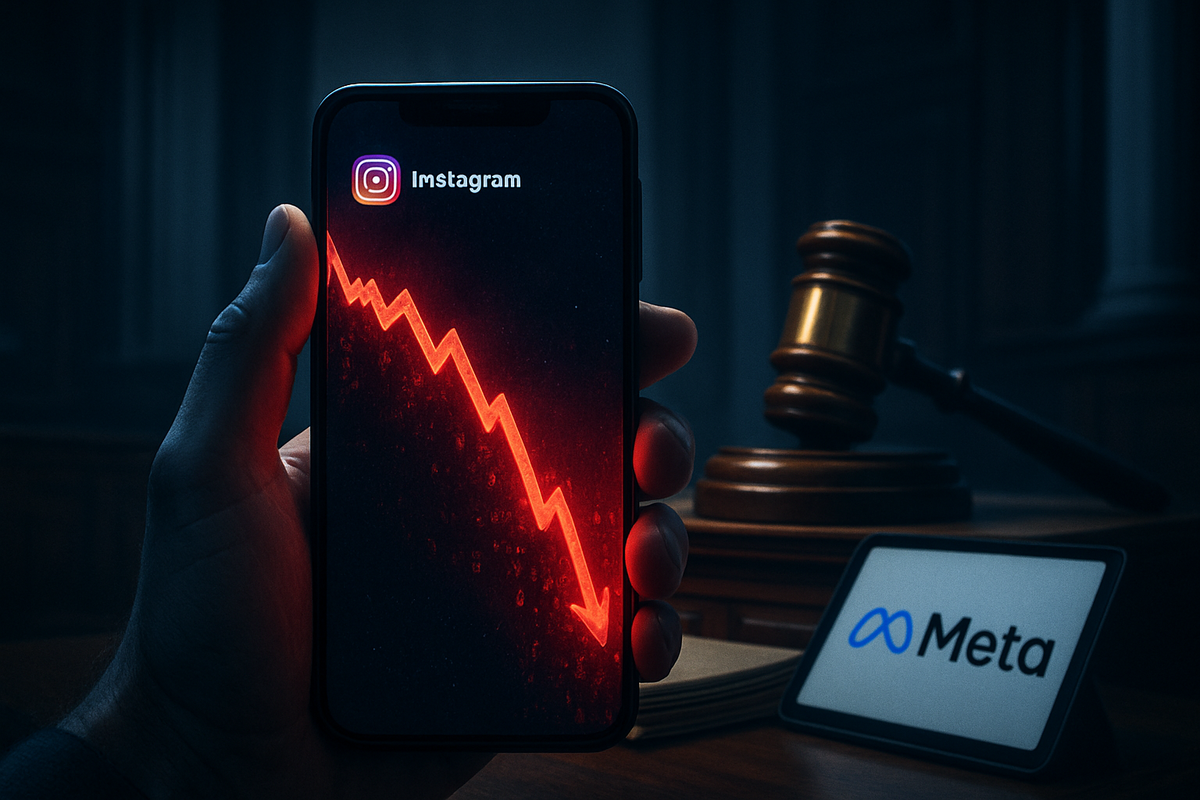
MENLO PARK, CA – March 26, 2026 – Shares of Meta Platforms (NASDAQ: META) experienced their sharpest single-day decline in over two years today, tumbling 6.8% following a historic jury verdict in Los Angeles. The decision found the social media giant liable for "negligent design" and "failure to warn" regarding the addictive nature of its Instagram platform, marking a seismic shift in the legal landscape for Big Tech.
The market reaction was swift and severe, erasing more than $135 billion in Meta’s market capitalization within hours of the verdict. Investors, who had previously largely discounted the threat of social media addiction litigation, are now grappling with a new reality where the industry’s long-standing legal shield, Section 230 of the Communications Decency Act, appears increasingly porous against claims of defective product design.
The Verdict that Shook Silicon Valley
The plunge was triggered by the conclusion of KGM v. Meta Platforms, a bellwether trial in the California Judicial Council Coordinated Proceedings (JCCP). The jury awarded $6.2 million in compensatory damages to the family of a minor who developed severe clinical depression and suicidal ideation, which medical experts testified were "proximately caused" by compulsive use of Instagram. Crucially, the jury found that Meta’s use of "infinite scroll," "notification clustering," and "ephemeral content" (Stories) were deliberate design choices intended to bypass adolescent self-regulation.
Leading up to this moment, Meta had successfully fended off dozens of similar claims by citing Section 230, which protects platforms from liability for third-party content. However, the presiding judge in the Los Angeles Superior Court allowed the case to proceed on the theory that the features of the app—not the content—constituted a "defective product." This legal maneuver effectively bypassed traditional internet immunity, a strategy that plaintiffs' attorneys have been refining since the massive consolidation of social media addiction cases (MDL 3047) began in 2022.
Stakeholders, including major institutional investors and consumer advocacy groups, are calling the verdict a "watershed moment." The trial revealed internal Meta documents, collectively referred to by whistleblowers as the "Project Mercury" files, which allegedly showed that the company’s own researchers warned executives in 2020 that certain algorithmic "loops" were causing measurable psychological harm to teenage girls but were kept in place to meet engagement targets.
Assessing the Market Fallout: Winners and Losers
The immediate impact on Meta’s market weight is substantial. As a cornerstone of the S&P 500 and the Nasdaq-100, the 6.8% drop dragged the broader tech indices lower, even as other sectors remained stable. Analysts from JPMorgan (NYSE: JPM) and Goldman Sachs (NYSE: GS) have already begun re-evaluating their 2026 price targets for Meta, citing "unquantifiable tail risk" from the thousands of pending cases that will now use today’s verdict as a roadmap.
Meta Platforms (NASDAQ: META) is clearly the primary loser, facing not only the prospect of billions in future settlements but also a potential forced redesign of its most profitable engagement tools. The company’s "Year of Efficiency" gains in 2023 and its subsequent AI-driven rally in 2024–2025 are now being tested by a legal environment that threatens its core business model.
Alphabet Inc. (NASDAQ: GOOGL) and Snap Inc. (NYSE: SNAP) also saw their shares decline by 4.2% and 5.5%, respectively, on Thursday. Both companies are co-defendants in the broader multidistrict litigation and utilize similar design features, such as YouTube’s "Up Next" autoplay and Snap’s "Snapstreaks." The "contagion effect" suggests that the market no longer views these features as neutral tools, but as potential liabilities.
Conversely, companies focusing on digital well-being and parental control technology, such as Bark Technologies (NASDAQ: BRKK) and specialized cybersecurity firms like CrowdStrike (NASDAQ: CRWD), which helps manage platform safety protocols, saw a modest uptick in trading volume. Investors are betting that tech giants will be forced to outsource more of their safety and monitoring infrastructure to third-party "guardians" to mitigate future liability.
A Fundamental Shift in Big Tech Accountability
Today’s event fits into a broader global trend of "algorithmic accountability." For decades, the tech industry operated under the assumption that they were merely the "pipelines" for information. This verdict officially classifies them as "manufacturers" of a digital experience. The shift from "service provider" to "product manufacturer" has profound regulatory implications, potentially bringing social media apps under the oversight of bodies like the Consumer Product Safety Commission (CPSC).
The legal precedent set today draws frequent comparisons to the 1998 Big Tobacco Master Settlement Agreement. Just as tobacco companies were held liable for the addictive properties of nicotine despite the legality of the product, Meta and its peers are now being judged on the addictive properties of their code. This "Big Tobacco moment" for tech could lead to a massive, industry-wide settlement that might include mandatory "warning labels" on apps, strict age verification, and a ban on certain engagement-maximizing features for users under 18.
Furthermore, the verdict comes at a time when Meta is navigating the complexities of the EU AI Act, which takes full effect later in 2026. The combination of U.S. jury awards and EU regulatory fines creates a "pincer movement" that could permanently suppress the high valuation multiples tech companies have enjoyed for the last decade.
The Road Ahead: Strategic Pivots and Scenarios
In the short term, Meta is expected to appeal the KGM verdict, likely taking the case to the California Supreme Court or even the U.S. Supreme Court to challenge the "product defect" interpretation of Section 230. However, the reputational damage is already done. Strategic pivots are likely already underway in Menlo Park. We may see Meta accelerate its transition toward "Meta AI" as a utility-based tool—such as AI-driven shopping and productivity—to distance itself from the "addictive social feed" narrative that is currently under fire.
Long-term, the company faces a difficult choice: fight every case in court and risk "nuclear verdicts" or enter into a multi-billion dollar global settlement. Analysts suggest that a settlement could range from $20 billion to $50 billion over ten years, a figure that, while manageable for a company with Meta's cash flow, would severely limit its ability to fund its ambitious Reality Labs and Metaverse projects.
Market opportunities may emerge for platforms that prioritize "slow social" or "mindful design." If the verdict leads to a mandatory removal of infinite scroll or autoplay features, the competitive landscape could level, allowing smaller, less "addictive" platforms to gain market share among Gen Z and Gen Alpha users whose parents are increasingly wary of Big Tech's influence.
Final Reflections for Investors
The 6.8% plunge in Meta shares is more than just a bad day on the markets; it is the first crack in the legal fortress that has protected the social media business model for thirty years. Investors should watch for the outcome of the next three bellwether trials scheduled for late 2026, as these will determine if the KGM verdict was an anomaly or the start of a trend.
As we move toward the second half of 2026, the market will likely reward transparency and safety over raw engagement metrics. Meta’s ability to maintain its market weight will depend on how successfully it can reinvent its platforms as "safe by design" while preserving the advertising efficacy that has made it a trillion-dollar powerhouse. For now, the "product defect" theory is the single greatest threat to the social media industry, and the era of unregulated engagement is officially coming to a close.
This content is intended for informational purposes only and is not financial advice.