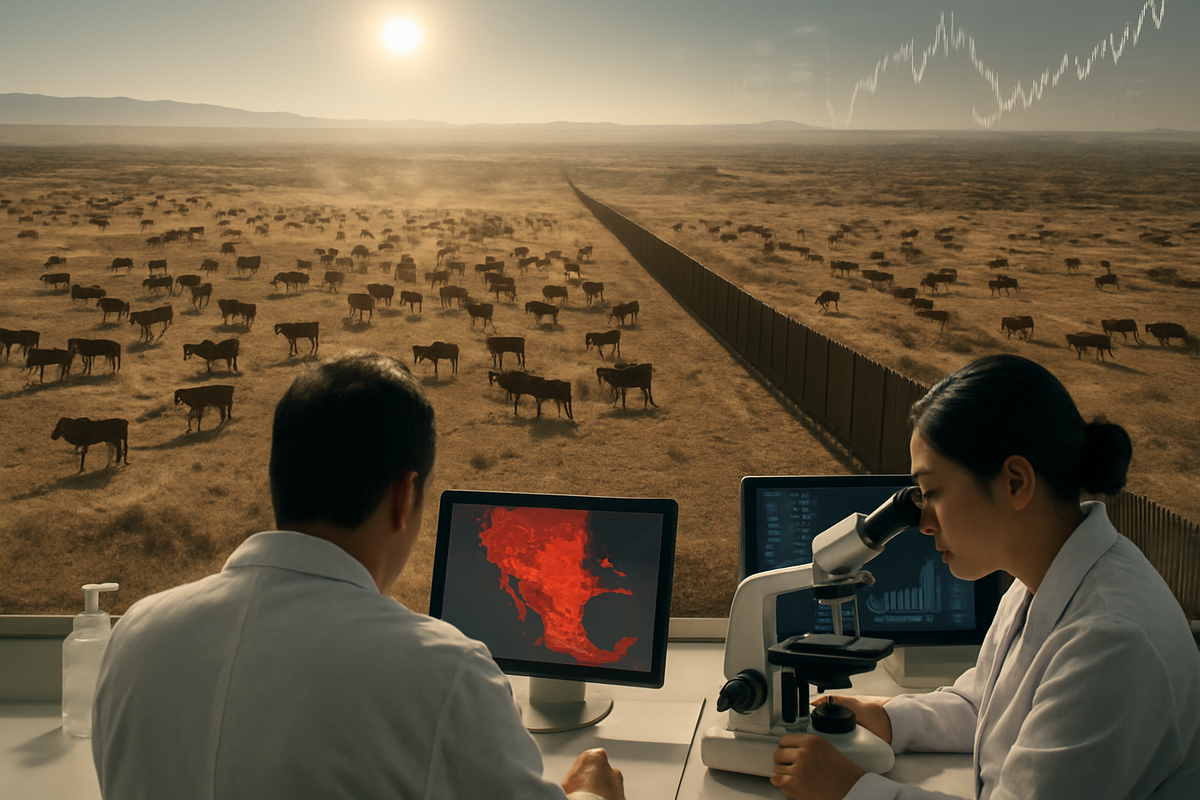
In a high-stakes move to protect the backbone of American agriculture, the United States Department of Agriculture (USDA) has officially launched a $100 million "Grand Challenge" aimed at halting the northward advance of the New World screwworm (NWS). Announced on January 21, 2026, by U.S. Secretary of Agriculture Brooke L. Rollins, the initiative is a desperate bid to prevent the catastrophic re-establishment of the parasite in the United States. The fly, which lays eggs in the open wounds of warm-blooded animals, has migrated through Mexico and was recently confirmed in the state of Tamaulipas—a mere 197 miles from the Texas border.
The immediate implications for the market are severe. With the U.S. cattle inventory already at a 75-year low due to persistent droughts, the screwworm threat has triggered a fresh wave of volatility in the livestock futures markets. The USDA’s decision to maintain a total ban on live cattle imports from Mexico has removed over 1.2 million head from the domestic supply chain, sending feeder cattle prices to record highs and placing immense pressure on the nation’s largest meatpackers.
The Frontline: A $100 Million Biological Barrier
The New World Screwworm Grand Challenge, administered by the Animal and Plant Health Inspection Service (APHIS), represents an unprecedented investment in biological defense. The program is designed to fund rapid innovations in four key areas: scaling the "Sterile Insect Technique" (SIT), developing next-generation traps and lures, advancing animal therapeutics, and strengthening border preparedness. This follows a broader $750 million commitment made in mid-2025 to construct the first domestic sterile fly production facility in Edinburg, Texas.
The timeline of this crisis has been swift and alarming. After breaching the historical biological barrier in the Darien Gap of Panama in late 2024, the NWS moved rapidly through southern Mexico. By May 2025, APHIS was forced to suspend imports of Mexican cattle as cases were detected in Oaxaca and Veracruz. Despite intense coordination between the USDA and Mexico’s SENASICA (the National Service of Health, Food Safety and Quality), the parasite has continued its northward march. A brief market panic ensued in mid-January 2026 when rumors of a detection in New Mexico—later debunked—caused Feeder Cattle futures to plunge $8.10 in a single session.
Corporate Fallout: The "Packer Margin Squeeze" Intensifies
The biological threat is exacerbating a "perfect storm" for the U.S. meatpacking industry. Tyson Foods (NYSE: TSN) recently underscored the severity of the crisis by announcing the closure of its major beef processing facility in Lexington, Nebraska. The company cited the "acute shortage of cattle" and the rising cost of procurement as primary drivers, projecting an adjusted operating loss in its beef segment of between $400 million and $600 million for the fiscal year. Tyson’s stock has faced significant headwinds as investors digest the reality of a shrinking domestic herd and the loss of Mexican imports.
Similarly, JBS (OTC: JBSAY) has been forced to scale back operations, shuttering its Riverside plant in California and reducing shifts across its Midwestern footprint. While JBS has managed to partially offset U.S. losses through its global diversification in Brazil and Australia, its North American margins have turned sharply negative. Private giants like Cargill and National Beef have also been caught in the "packer margin squeeze," where the price of live animals—driven up by scarcity—has risen far faster than the wholesale price of boxed beef.
Wider Significance: Biosecurity and the $35 Billion Risk
This event marks a critical turning point in global agricultural policy. For decades, the U.S. relied on a "buffer zone" in Central America that has now effectively collapsed. The USDA's pivot toward a $100 million innovation challenge suggests that traditional methods of eradication are no longer sufficient in an era of shifting climate patterns and globalized trade. The broader industry trend is one of extreme supply contraction; the loss of Mexican feeder cattle represents a 3.3% reduction in the total U.S. calf crop, a gap that cannot be easily filled by domestic expansion given current drought conditions.
Furthermore, the surge in beef prices has triggered political and regulatory scrutiny. The Department of Justice (DOJ) has intensified its investigations into the "Big Four" meatpackers, looking for evidence of price manipulation amidst the supply crunch. Historically, the last time the U.S. faced a screwworm crisis of this magnitude was in the 1960s, prior to the successful implementation of the sterile fly program. However, the modern livestock industry is far more integrated and fragile, with Texas Agriculture Commissioner Sid Miller estimating that an established NWS population in the U.S. could inflict $30 billion to $35 billion in annual economic damage.
Looking Ahead: The Battle for the Border
In the short term, market participants should expect continued extreme volatility in CME Live Cattle (LE) and Feeder Cattle (GF) futures. Any confirmed detection of NWS on U.S. soil would likely trigger immediate export bans from international trading partners, potentially causing a domestic supply glut and a price crash in the short term, followed by long-term industry devastation. Strategic pivots are already underway, with feedlots increasingly looking toward technology and precision agriculture to manage smaller, higher-value herds.
Long-term, the success of the USDA’s $100 million challenge will determine the viability of the U.S. beef industry for the next decade. If the "Grand Challenge" yields a more efficient sterile fly or a breakthrough vaccine, the U.S. may be able to push the biological front back into southern Mexico. If it fails, the industry may be forced to move away from the massive, centralized feedlot model that has dominated for fifty years, shifting toward more localized, biosecure operations.
Investor Wrap-Up: A Crucial Quarter for Cattle
The USDA's $100 million initiative is more than just a biosecurity measure; it is an emergency life-support system for a livestock industry on the brink. The core takeaway for investors is that the supply side of the beef market is under unprecedented pressure from both biological and environmental factors. While record-high cattle prices may benefit some ranchers in the short term, the systemic risk posed by the screwworm threatens the entire value chain, from feedlots to retail meat counters.
Moving forward, the market will be hyper-sensitive to APHIS's weekly trapping reports and any updates on the Edinburg facility’s production capacity. Investors should watch for further plant consolidations among major packers and potential shifts in consumer behavior as retail beef prices reach all-time highs. The coming months will be a test of whether American innovation can outpace a primitive but devastating parasite.
This content is intended for informational purposes only and is not financial advice.