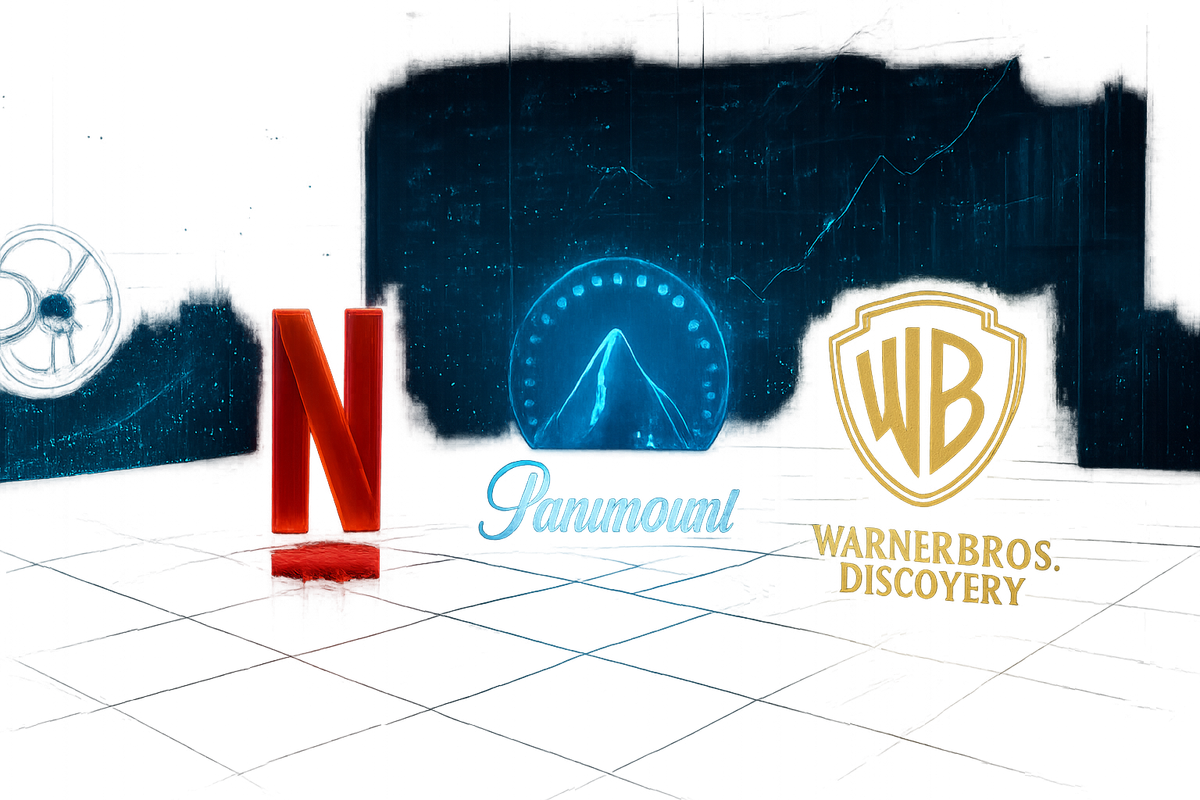
As the sun sets on 2025, the media landscape is unrecognizable from the fractured streaming wars of the early decade. This Christmas, the industry is transfixed by a high-stakes corporate chess match that promises to culminate in a seismic consolidation in 2026. At the center of the storm is Warner Bros. Discovery (Nasdaq: WBD), which has become the ultimate prize in a bidding war that pits the streaming dominance of Netflix (Nasdaq: NFLX) against the legacy-meets-tech ambition of the newly formed Paramount Skydance Corporation (Nasdaq: PSKY).
The immediate implications are staggering. If Netflix succeeds in its $82.7 billion bid for WBD’s premium assets, it would represent the final surrender of the "Old Hollywood" studio model to the Silicon Valley disruptor. Conversely, a hostile takeover by Paramount Skydance would create a consolidated "mega-major" studio capable of rivaling Disney in scale. For the market, these maneuvers signal that the era of experimental growth is over; 2026 is officially the year of the "Big Three" consolidation, where only the most vertically integrated giants will survive.
The Three-Way War for Content Supremacy
The current chaos reached a fever pitch in early December 2025, when Warner Bros. Discovery announced a definitive agreement to sell its "crown jewels"—Warner Bros. Studios, HBO, and the Max streaming service—to Netflix for approximately $82.7 billion. Under the terms of this deal, WBD would spin off its linear cable networks, including CNN, TNT, and Discovery, into a standalone entity called "Discovery Global" by the third quarter of 2026. This move was designed to clean up WBD’s balance sheet while giving Netflix the prestige library it has long craved to cement its lead in the ad-tier market.
However, the "done deal" was quickly upended by a massive hostile counter-offer. Paramount Skydance Corporation, which only recently finalized its own merger on August 7, 2025, launched an unsolicited $108.4 billion all-cash bid for the entirety of WBD. Backed by a $40.4 billion personal guarantee from Oracle co-founder Larry Ellison, Paramount Skydance CEO David Ellison is betting that shareholders will prefer a total buyout over Netflix’s complex "carve-out" strategy. The timeline has been aggressive: the Paramount Skydance bid arrived just ten days after the Netflix announcement, throwing WBD’s board into a state of emergency as they weigh the long-term stability of a tech-backed studio merger against the immediate cash of a hostile takeover.
The key players in this drama are a mix of Hollywood royalty and tech titans. David Zaslav, CEO of WBD, has spent the last three years aggressively cutting debt—now down to $35.6 billion—to make the company a palatable acquisition target. Meanwhile, Netflix’s Ted Sarandos is making his boldest move yet to transition Netflix from a "tech platform that hosts content" to the definitive owner of global IP. The market reaction has been one of cautious optimism; WBD stock has surged 22% since the bidding war began, while Netflix shares have seen heightened volatility as investors weigh the massive debt load required for the acquisition.
Winners, Losers, and the Shifting Balance of Power
In this consolidation frenzy, Netflix appears positioned as a potential "winner," but at a significant cost. By acquiring HBO and Warner Bros. Studios, Netflix would effectively end the "content licensing" era, owning the very pipeline that once fueled its rivals. However, the "loser" in the Netflix scenario could be the consumer, who may face higher subscription prices as Netflix works to service the debt from this $82.7 billion acquisition. Furthermore, Netflix's refusal to take on WBD’s linear cable assets leaves those networks in a precarious "zombie" state, potentially devaluing the proposed Discovery Global spinoff before it even hits the market.
Paramount Skydance, on the other hand, stands to win the "scale war." If they successfully block Netflix and absorb WBD, the combined entity would control an estimated 35% of the global box office and a massive library ranging from Star Trek to Harry Potter. The "losers" in this scenario are the smaller, independent streamers and mid-tier studios like Lionsgate or AMC, which lack the capital to compete with such a behemoth. These smaller players are already seeing their valuations crater as the market realizes that in 2026, "medium-sized" is a recipe for extinction.
For WBD shareholders, the situation is a windfall. After years of watching the stock languish under the weight of merger-related debt, the bidding war has created a floor for the stock price. However, employees at these companies face a grim outlook. Industry analysts expect that a Paramount-WBD merger could result in "synergy" layoffs exceeding 15,000 positions as redundant marketing, distribution, and administrative departments are gutted to satisfy investors.
The 2026 Regulatory and Economic "Perfect Storm"
This wave of consolidation is not happening in a vacuum; it is the result of a "perfect storm" of regulatory and tax-related factors that converge in 2026. The primary catalyst was the expiration of the Reverse Morris Trust (RMT) lock-up period in April 2024, which had previously prevented WBD from engaging in any meaningful sale or merger without incurring massive tax penalties. With that hurdle gone, 2025 became the year of negotiation, and 2026 is set to be the year of execution.
Furthermore, the regulatory climate has shifted significantly. Following the 2024 U.S. elections, the Department of Justice (DOJ) and the Federal Trade Commission (FTC) have signaled a move toward a "New Era of Regulatory Leniency." There is a growing consensus in Washington that domestic media companies must be allowed to consolidate to compete with the existential threat posed by global tech platforms and AI-driven content. This is a sharp reversal from the aggressive antitrust stances seen earlier in the decade, making a vertical merger between a distributor like Netflix and a producer like Warner Bros. far more likely to pass muster.
Historically, this mirrors the late-90s consolidation wave, but with a digital twist. The decline of linear television—which saw double-digit advertising drops in 2025—has forced these companies' hands. The "ripple effect" is already being felt by partners like Comcast (Nasdaq: CMCSA), which is reportedly considering merging its own cable spinoff, Versant, with the proposed Discovery Global in late 2026. This would create a "Linear Super-Power" that aggregates all the declining but still cash-flow-positive cable assets into one final, consolidated entity.
What Comes Next: The 2026 Consolidation Cliff
As we look toward 2026, the industry is bracing for what many are calling the "Consolidation Cliff." The first half of the year will be dominated by the legal and shareholder battles between Netflix and Paramount Skydance. A key date to watch is the WBD Annual Shareholder Meeting in May 2026, where a proxy fight is widely expected if the board continues to favor the Netflix deal over the higher Paramount bid.
In the long term, the successful suitor will need to pivot toward a "post-streaming" strategy. This likely involves a heavy integration of generative AI into production pipelines to lower costs and a renewed focus on live events and sports. We are already seeing the groundwork for this, as Netflix’s deal for WBD assets includes the coveted NBA broadcasting rights held by TNT. If the Netflix deal closes, 2026 will be the year Netflix becomes a dominant force in live sports broadcasting, forever changing the value proposition of the platform.
The market will also face the challenge of "integration fatigue." Merging two massive cultures—especially the tech-centric Netflix and the traditionalist Warner Bros.—is fraught with risk. Investors should prepare for a period of "earnings noise," where one-time merger costs and restructuring charges obscure the underlying health of these companies. The survivors of 2026 will be those who can successfully navigate this integration without losing their creative soul.
Summary and Investor Outlook
The battle for Warner Bros. Discovery is more than a corporate merger; it is the final act of the streaming wars. By the end of 2026, we will likely see a media landscape dominated by three or four "Super-Majors"—Netflix, Disney, a combined Paramount-WBD (or a Netflix-WBD hybrid), and the tech-led ecosystems of Amazon and Apple. The key takeaways for the market are clear: scale is no longer an advantage, it is a prerequisite for survival.
As we move into 2026, investors should keep a close eye on debt-to-equity ratios and the progress of the Discovery Global spinoff. The "linear" assets that many have written off may still provide the necessary cash flow to fund the next generation of content, provided they are consolidated efficiently. The volatility in WBD and PSKY shares will likely continue until a definitive winner is crowned in the second half of 2026.
Ultimately, the significance of this event lies in the "re-bundling" of media. After a decade of fragmentation, the industry is returning to a consolidated model that looks remarkably like the old studio system, only this time, the keys to the kingdom are held by those who control the data and the algorithm. For the public, the 2026 consolidation means fewer choices, but potentially more stable and high-quality content ecosystems.
This content is intended for informational purposes only and is not financial advice.