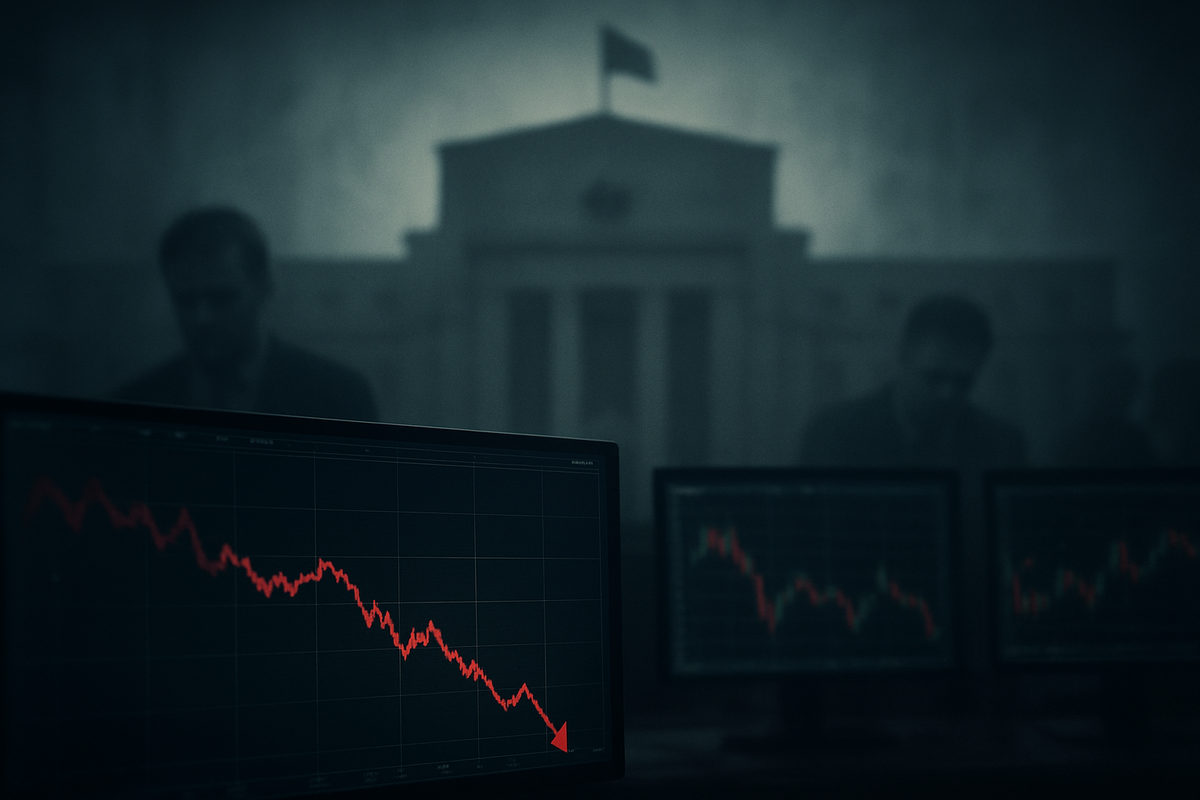
New York, NY – December 10, 2025 – U.S. stock markets are exhibiting a palpable sense of apprehension, with major indices trending lower as investors keenly await the Federal Reserve's final interest rate decision of 2025. The prevailing sentiment across Wall Street is one of cautious anticipation, as market participants attempt to decipher the central bank's next move and its potential ramifications for the broader economy and corporate earnings. While a 25-basis-point rate cut is largely priced in by futures markets, the true focus remains squarely on the accompanying forward guidance, particularly the Fed's "dot plot" projections for 2026.
This environment of "wait-and-see" has translated into increased volatility and a subdued trading landscape. The Street's real-time updates reflect this hesitancy, highlighting how the impending announcement is casting a heavy shadow over equities. Investors are not just reacting to the immediate possibility of a rate adjustment but are more critically assessing the Fed's long-term strategy amidst a complex economic backdrop of inflation concerns, mixed job data, and global uncertainties. The nuanced language from Federal Reserve Chair Jerome Powell and the updated economic projections are expected to be the primary catalysts for market direction in the immediate aftermath of the decision.
The Federal Reserve's December Conundrum: A Deep Dive
The current market trepidation stems from the Federal Reserve's pivotal role in steering the U.S. economy, particularly through its monetary policy decisions on interest rates. As of December 10, 2025, the market is primarily fixated on the outcome of the Federal Open Market Committee (FOMC) meeting, with a widespread expectation, supported by tools like the CME Group's FedWatch, of a 25-basis-point interest rate cut. This would mark the third such reduction in 2025, following previous cuts in September and October, signaling a shift from the aggressive tightening cycle of previous years.
The timeline leading up to this moment has been characterized by a series of economic data releases and central bank communications that have created a complex picture. Throughout 2025, the Fed has navigated persistent, albeit moderating, inflationary pressures, coupled with a robust yet sometimes cooling labor market. Earlier in the year, strong job data occasionally tempered expectations for aggressive easing, while more recent indicators, including some showing a slight softening in the labor market, have reinforced the case for rate reductions. The lingering effects of a government shutdown earlier in the year also delayed some crucial economic statistics, adding layers of uncertainty to the Fed's assessment.
Key players involved in this high-stakes decision include Federal Reserve Chair Jerome Powell, the twelve members of the Federal Open Market Committee (FOMC), and various regional Federal Reserve Bank presidents. These policymakers are reportedly divided, with some advocating for lower rates to bolster employment and economic growth, and others maintaining a more hawkish stance, wary of reigniting inflationary pressures. This internal divergence contributes significantly to the market's uncertainty regarding the Fed's future policy path. Initial market reactions have been predictably volatile; for instance, major tech stocks like (NASDAQ: NVDA) Nvidia and (NASDAQ: INTC) Intel have experienced slight dips in the days leading up to the announcement, while some financial institutions like (NYSE: JPM) JPMorgan Chase have also experienced declines, reflecting broader market anxiety and sector-specific news. The bond market has also been active, with Treasury yields showing mixed movements, indicating the tug-of-war between expectations of rate cuts and concerns about the overall economic outlook.
The market's primary concern isn't just the rate cut itself, which is largely priced in, but rather the "hawkish cut" scenario – where the Fed reduces rates but simultaneously signals caution about further aggressive easing in 2026. This approach would aim to preserve policy flexibility, but it could disappoint investors hoping for a more dovish stance, potentially leading to further selling pressure on equities and bonds. Conversely, a truly dovish cut, signaling a more aggressive easing path, could provide a significant boost to risk assets.
Corporate Fortunes Hang in the Balance: Potential Winners and Losers
The Federal Reserve's interest rate decision, and particularly its forward guidance, will inevitably create a ripple effect across various sectors and individual companies, delineating clear potential winners and losers in the current market environment. Companies with high levels of debt, for instance, stand to benefit significantly from lower interest rates. Sectors such as real estate, utilities, and certain industrial companies often carry substantial debt loads, and reduced borrowing costs can improve their profitability and cash flow. Homebuilders like (NYSE: DHI) D.R. Horton and real estate investment trusts (REITs) such as (NYSE: PLD) Prologis could see increased demand and improved margins if mortgage rates and property development financing become cheaper.
Conversely, a "hawkish cut" or any signal of fewer rate cuts in 2026 could negatively impact growth stocks, particularly those in the technology sector that rely heavily on future earnings potential. Higher interest rates tend to discount future cash flows more heavily, making these stocks less attractive. While major tech players like (NASDAQ: AAPL) Apple and (NASDAQ: GOOGL) Alphabet often have strong balance sheets, their valuations can be sensitive to interest rate expectations. Smaller, high-growth tech companies that are not yet profitable could face greater pressure as their cost of capital remains elevated, potentially hindering expansion plans and innovation.
Financial institutions also face a mixed bag of outcomes. While a rate cut might narrow net interest margins for banks like (NYSE: BAC) Bank of America and (NYSE: WFC) Wells Fargo, potentially impacting their profitability from lending, a clearer, more predictable rate environment could stimulate loan demand. Furthermore, if a rate cut helps stabilize the broader economy, it could lead to fewer loan defaults and a healthier lending landscape in the long run. Brokerage firms and asset managers, on the other hand, might see increased trading volumes and asset inflows if the market rallies post-Fed decision.
Companies in consumer discretionary sectors, such as retailers like (NYSE: AMZN) Amazon and (NYSE: HD) Home Depot, could also experience a boost if lower interest rates translate into increased consumer spending power and confidence. Cheaper credit for consumers, whether for mortgages, auto loans, or credit cards, can free up disposable income, driving demand for goods and services. Conversely, a cautious Fed outlook that signals economic headwinds could dampen consumer sentiment and spending, hurting these companies. Ultimately, the market's reaction will hinge not just on the rate cut itself, but on the Fed's overall assessment of economic health and its projected path for monetary policy, which will dictate investor appetite for risk and influence corporate strategic planning.
Broader Implications: Navigating the Economic Undercurrents
The Federal Reserve's looming decision extends far beyond the immediate fluctuations of stock prices, weaving into the broader fabric of industry trends, regulatory frameworks, and historical economic cycles. This event fits squarely into the ongoing narrative of central banks globally attempting to achieve a "soft landing" – bringing inflation under control without triggering a severe recession. The Fed's actions will be closely watched by other major central banks, including the European Central Bank and the Bank of England, potentially influencing their own monetary policy decisions and contributing to a synchronized global economic adjustment.
The potential ripple effects are extensive. For competitors and partners, a change in U.S. interest rates can alter competitive landscapes. For instance, if the U.S. dollar weakens due to a more dovish Fed, American exporters might find their goods more competitive internationally, benefiting companies like (NYSE: BA) Boeing or (NYSE: CAT) Caterpillar. Conversely, companies heavily reliant on imports could face higher costs if the dollar strengthens. Partners in global supply chains will also feel the impact, as financing costs for international trade and investment shift. Furthermore, the decision will influence capital flows, potentially drawing investment into or out of U.S. markets depending on the perceived attractiveness of returns relative to other global opportunities.
Regulatory and policy implications are also significant. A shift in monetary policy can influence government borrowing costs, impacting national debt servicing and the feasibility of future fiscal spending programs. Policymakers will be keenly observing how the Fed's decision affects inflation and employment, which could, in turn, influence calls for further legislative action or regulatory adjustments in sectors like housing, banking, or energy. For example, if the Fed's actions lead to a significant slowdown, there might be renewed pressure for government stimulus measures.
Historically, periods of significant Federal Reserve policy shifts have often been accompanied by increased market volatility and re-evaluations of asset classes. Comparisons can be drawn to previous cycles of tightening and easing, though each period has its unique economic backdrop. For instance, the transition from aggressive tightening to easing in the early 2000s or the mid-2000s saw distinct market reactions, often leading to sector rotations. The current situation, however, is unique due to the confluence of post-pandemic economic recovery, persistent supply chain issues, and geopolitical tensions, making direct historical comparisons challenging but still valuable for understanding potential trajectories. The Fed's current strategy is a delicate balancing act, aiming to cool the economy just enough to tame inflation without stifling growth, a task made more complex by the inherent lags in monetary policy transmission.
What Comes Next: Navigating the Path Forward
The immediate aftermath of the Federal Reserve's decision will likely be characterized by heightened market activity as investors digest the announcement, the "dot plot" projections, and Chair Powell's press conference. In the short term, we can anticipate significant volatility, with potential sharp swings in equity and bond markets as initial reactions give way to more considered analysis. If the Fed delivers a "hawkish cut," signaling fewer rate reductions for 2026, growth stocks and risk assets could face renewed selling pressure. Conversely, a more dovish stance could provide a much-needed boost to market sentiment, potentially leading to a year-end rally.
Looking further ahead into 2026, the Fed's guidance will shape the investment landscape. A clear path of continued, albeit measured, rate cuts could foster a more stable environment for corporate planning and investment. Companies may find it easier to secure financing for expansion, mergers, and acquisitions, potentially spurring economic activity. Sectors like technology, real estate, and renewable energy, which are often sensitive to borrowing costs, could see renewed interest and investment. However, if the Fed signals a pause or even a potential for future hikes (though less likely in this scenario), companies will need to adapt quickly, potentially re-evaluating capital expenditure plans and focusing on debt reduction and operational efficiency.
Potential strategic pivots or adaptations will be crucial for businesses. Companies with strong balance sheets and diversified revenue streams will be better positioned to weather any continued economic uncertainty. Those heavily reliant on consumer credit or discretionary spending may need to adjust their marketing and sales strategies to align with evolving consumer behavior. Market opportunities may emerge in sectors that demonstrate resilience or benefit from structural shifts in the economy, such as healthcare innovation or specialized manufacturing, irrespective of the rate environment. Conversely, challenges could arise for highly leveraged companies or those in industries facing secular decline, as a less accommodative monetary policy environment could exacerbate existing pressures.
Several scenarios and outcomes are possible. A "soft landing" where inflation is tamed without a significant recession remains the most hoped-for outcome, which would likely support a gradual recovery in equity markets. However, the risk of a "hard landing" – a recession triggered by overly restrictive policy or external shocks – cannot be entirely dismissed, which would necessitate a more defensive investment strategy. Investors should closely monitor key economic indicators such as inflation data, employment reports, and consumer spending trends, as these will heavily influence the Fed's future decisions and, consequently, market direction.
Comprehensive Wrap-Up: Navigating the Market Moving Forward
The Federal Reserve's imminent interest rate decision in December 2025 represents a critical juncture for the U.S. financial markets, with widespread implications for investors, businesses, and the broader economy. The key takeaway from the current market sentiment is that while a 25-basis-point rate cut is largely anticipated, the true market mover will be the Fed's forward guidance regarding its monetary policy trajectory for 2026. A "hawkish cut," where the Fed signals caution about future easing, could lead to continued market volatility and pressure on risk assets, whereas a more dovish tone could ignite a year-end rally.
Moving forward, the market will assess how this decision impacts inflation, employment, and economic growth. Businesses will need to remain agile, adapting their financial strategies and operational plans to align with the evolving interest rate environment. Companies with robust balance sheets and those in resilient sectors are better positioned to navigate potential headwinds or capitalize on new opportunities. The decision will also have broader ripple effects on global capital flows, currency valuations, and the competitive landscape for international trade.
For investors, the coming months will demand a vigilant approach. It is crucial to pay close attention to the nuances of the Fed's communication, particularly the updated "dot plot" and Chair Powell's press conferences, for clues about future policy. Monitoring key economic data points, such as the Consumer Price Index (CPI), Producer Price Index (PPI), and employment figures, will be essential for understanding the underlying economic health and anticipating the Fed's next moves. Diversification across various asset classes and a long-term perspective will remain paramount in navigating what is likely to be a dynamic and potentially challenging market environment. The lasting impact of this decision will be determined by its ability to foster sustainable economic growth while maintaining price stability, setting the tone for market performance well into the next year.
This content is intended for informational purposes only and is not financial advice