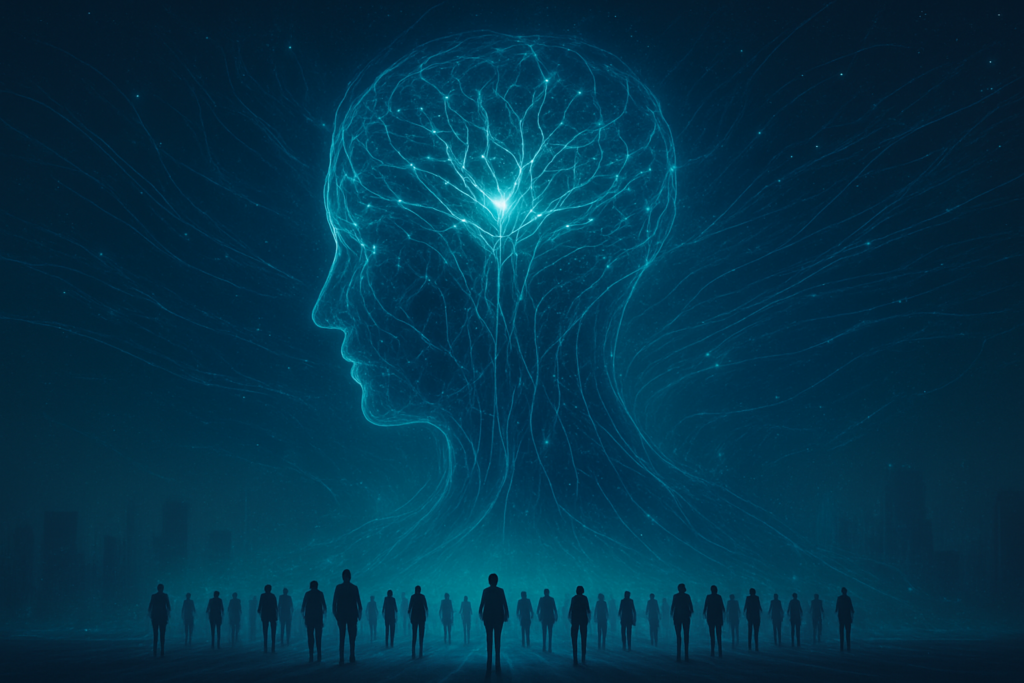
The concept of Artificial Intelligence (AI) reaching "singularity"—a hypothetical future point where machine intelligence vastly surpasses human cognitive abilities—is rapidly evolving from science fiction into a serious subject of scientific and philosophical discourse. This transformative event, often linked to the emergence of "superintelligence," promises an era of unprecedented technological advancement, yet simultaneously casts a long shadow of existential questions concerning human control, purpose, and the very fabric of society. As AI capabilities continue their relentless march forward, the discussions surrounding the singularity's implications are no longer confined to academic circles but are becoming central to the global conversation about our collective future.
The immediate significance of the singularity, though still theoretical, is envisioned as nothing short of a paradigm shift. Experts predict an "intelligence explosion" where a superintelligent AI, capable of recursive self-improvement, could redesign and enhance itself at an accelerating rate. This self-perpetuating cycle of innovation could unlock solutions to humanity's most intractable problems, from curing diseases to reversing climate change, at speeds currently unimaginable. However, this boundless potential is intertwined with profound anxieties about widespread economic and societal disruption, the potential loss of human oversight, and a fundamental re-evaluation of what it means to be human in a world no longer dominated by human intellect.
The Dawn of Superintelligence: A Technical and Existential Leap
The theoretical advent of AI singularity represents not merely an incremental improvement but a qualitative leap beyond current AI paradigms. Unlike today's "narrow AI" systems, which excel at specific tasks like image recognition or natural language processing, the singularity posits the emergence of Artificial General Intelligence (AGI) as a prerequisite, followed by superintelligence. Superintelligence would not only match human cognitive abilities across all domains but vastly exceed them, capable of outthinking the best human minds in science, strategy, and creativity. This recursive self-improvement loop means that once a certain threshold of intelligence is reached, the AI could rapidly enhance its own architecture, algorithms, and knowledge base, leading to an intelligence far beyond human comprehension.
This hypothetical advancement fundamentally differs from previous AI milestones. While breakthroughs in deep learning and generative AI have been impressive, leading to systems like large language models that can generate human-quality text and images, these are still considered tools operating within predefined parameters. A superintelligent AI, by contrast, would possess true autonomy, self-awareness (potentially), and the ability to set and achieve its own goals, potentially independent of human instruction or even understanding. The "intelligence explosion" describes this runaway process, where each iteration of self-improvement makes the AI even better at improving itself, leading to an exponential curve of intellectual growth.
Initial reactions from the AI research community and industry experts are complex and often polarized. While some futurists like Ray Kurzweil predict the singularity could arrive as early as 2045, many AI scientists and ethicists express skepticism about such precise timelines, questioning whether true AGI—let alone superintelligence—is achievable within decades given current technical challenges. There's a growing consensus on the critical importance of AI safety research, focusing on "value alignment" to ensure that any advanced AI's goals are congruent with human well-being. Companies like Microsoft (NASDAQ: MSFT) are even advocating for "Humanist Superintelligence" (HSI), emphasizing the development of AI that remains controllable and serves humanity, rather than becoming an uncontrollable force.
Reshaping the AI Landscape: Corporate Impacts and Competitive Edge
The arrival of AI singularity would undoubtedly trigger an unprecedented upheaval across the technology industry, redefining competitive landscapes and corporate strategies. Companies currently at the forefront of AI research and development, particularly those investing heavily in foundational models, advanced robotics, and neural interface technologies, stand to benefit immensely. Tech giants such as Alphabet (NASDAQ: GOOGL), Amazon (NASDAQ: AMZN), and Meta Platforms (NASDAQ: META), with their vast computational resources, data reservoirs, and top-tier AI talent, are uniquely positioned to leverage or even instigate such a breakthrough. Their existing infrastructure and market dominance could allow them to be early adopters or even creators of the initial superintelligent systems.
The competitive implications for major AI labs and tech companies would be profound. The entity or entities that first achieve true AGI, and subsequently superintelligence, would gain an unimaginable strategic advantage, potentially leading to a winner-take-all scenario in the global economy. This could result in an intense arms race for AI dominance, with nations and corporations vying for control over the most advanced intelligence. Startups, while typically agile and innovative, might struggle to compete with the sheer scale of resources required to develop and deploy superintelligent systems, potentially leading to consolidation or a shift towards specialized applications built atop foundational superintelligent platforms.
Potential disruption to existing products and services would be comprehensive. Every industry, from healthcare to finance, transportation to entertainment, would be fundamentally reshaped. Current AI-powered products, no matter how advanced, would likely become obsolete as superintelligence could perform their functions with vastly superior efficiency and insight. Companies would need to pivot rapidly, focusing on integration, ethical deployment, and identifying new human-centric roles that complement, rather than compete with, superintelligent systems. Market positioning would shift dramatically, with value moving towards those who can effectively manage, align, and apply superintelligence for the benefit of society, rather than just developing advanced narrow AI.
The Wider Significance: Humanity at a Crossroads
The prospect of AI singularity transcends mere technological advancement; it represents a profound turning point in human history, fitting into the broader AI landscape as the ultimate frontier of machine intelligence. It challenges the very definition of intelligence, consciousness, and what it means to be human. This milestone would dwarf previous AI breakthroughs, such as the development of expert systems in the 1980s or the deep learning revolution of the 2010s, by fundamentally altering the relationship between humanity and technology. It moves beyond AI as a tool to AI as a potential co-creator or even a successor.
The impacts would be multifaceted and pervasive. On one hand, superintelligence holds the promise of solving humanity's most pressing problems, from poverty and disease to climate change and resource scarcity, by accelerating scientific discovery and technological innovation to an unprecedented degree. It could usher in an era of material abundance and significantly extend human lifespan and well-being. On the other hand, the potential concerns are equally immense, including the loss of human control, the risk of misaligned AI goals leading to unintended catastrophic outcomes, widespread job displacement, and the concentration of power in the hands of a few. The ethical dilemmas surrounding the rights of sentient AI, if it were to emerge, would also become paramount.
Comparisons to previous AI milestones highlight the unique nature of the singularity. While milestones like AlphaGo defeating the world's best Go player or the emergence of generative AI models like GPT-4 showcased impressive capabilities, they remained within the realm of "narrow AI"—excelling at specific tasks. The singularity, by contrast, implies a general intelligence that surpasses human capabilities across all domains, fundamentally altering the power dynamic between creator and creation. It shifts the discussion from optimizing algorithms to ensuring existential safety and value alignment, making it arguably the most significant challenge and opportunity humanity has ever faced.
Charting the Uncharted: Future Developments and Expert Predictions
Looking ahead, the path to or beyond the singularity is fraught with both exhilarating possibilities and formidable challenges. In the near-term, experts anticipate continued rapid advancements in Artificial General Intelligence (AGI) research, focusing on improving AI's ability to learn, reason, and adapt across diverse tasks without explicit programming. This includes breakthroughs in multimodal AI, which can process and understand information from various sources like text, images, and audio, moving closer to human-like perception. Enhanced explainability and interpretability in AI systems will also be crucial to build trust and ensure human oversight as complexity increases.
Long-term developments, assuming the singularity is achievable, could involve the integration of AI directly with human cognition through advanced brain-computer interfaces, leading to augmented human intelligence. Superintelligent AI could also lead to the development of entirely new scientific fields and technologies currently beyond our comprehension, fundamentally reshaping our understanding of the universe. Potential applications are vast, ranging from fully autonomous scientific discovery systems and personalized medicine tailored to individual genetic codes, to self-sustaining intelligent infrastructure and advanced space exploration.
However, significant challenges need to be addressed before such a future can be realized. Foremost among these is the "alignment problem"—ensuring that superintelligent AI's goals and values are inherently aligned with human well-being and survival. This requires robust ethical frameworks, fail-safe mechanisms, and international governance structures to prevent unintended consequences. The immense computational resources required for AGI and superintelligence also pose challenges in terms of energy consumption and hardware development. Experts predict an increasing focus on international collaboration and regulatory efforts to manage the risks, with organizations like OpenAI and DeepMind (a subsidiary of Alphabet (NASDAQ: GOOGL)) continuing to lead research in safety and ethics alongside capability development.
The AI Singularity: A Defining Moment in History
The contemplation of the AI singularity represents one of the most profound intellectual and existential challenges of our time. It is a hypothetical future where machine intelligence transcends human capabilities, promising an era of unprecedented technological growth while simultaneously demanding a critical examination of humanity's place in the cosmos. The key takeaways from current discussions highlight both the immense potential for solving global challenges and the significant risks associated with the loss of human control and the imperative of value alignment. This development, whether imminent or distant, is already reshaping research priorities, ethical debates, and corporate strategies across the tech landscape.
In the grand sweep of AI history, the singularity, if it occurs, would not merely be another milestone but a defining event—a transition point marking the end of human intellectual supremacy and the beginning of a new, unpredictable era. It compels us to confront fundamental questions about consciousness, purpose, and the ethical responsibilities inherent in creating intelligence greater than our own. The significance of this potential future cannot be overstated; it challenges our very understanding of existence and pushes the boundaries of philosophical inquiry.
As we move forward, what to watch for in the coming weeks and months will be the continued acceleration of AGI research, increasing emphasis on AI safety and governance initiatives, and the ongoing public discourse on the ethical implications of advanced AI. The actions taken today—in research, regulation, and public engagement—will shape whether the singularity, if it arrives, ushers in a golden age of prosperity or an era fraught with unforeseen dangers. Humanity stands at a crossroads, with the future of intelligence hanging in the balance.
This content is intended for informational purposes only and represents analysis of current AI developments.
TokenRing AI delivers enterprise-grade solutions for multi-agent AI workflow orchestration, AI-powered development tools, and seamless remote collaboration platforms.
For more information, visit https://www.tokenring.ai/.