The end of an earnings season can be a great time to discover new stocks and assess how companies are handling the current business environment. Let’s take a look at how Walmart (NASDAQ: WMT) and the rest of the large-format grocery & general merchandise retailer stocks fared in Q2.
Big-box retailers operate large stores that sell groceries and general merchandise at highly competitive prices. Because of their scale and resulting purchasing power, these big-box retailers–with annual sales in the tens to hundreds of billions of dollars–are able to get attractive volume discounts and sell at often the lowest prices. While e-commerce is a threat, these retailers have been able to weather the storm by either providing a unique in-store shopping experience or by reinvesting their hefty profits into omnichannel investments.
The 4 large-format grocery & general merchandise retailer stocks we track reported a strong Q2. As a group, revenues beat analysts’ consensus estimates by 2.1% while next quarter’s revenue guidance was 1.4% below.
While some large-format grocery & general merchandise retailer stocks have fared somewhat better than others, they have collectively declined. On average, share prices are down 1.3% since the latest earnings results.
Weakest Q2: Walmart (NASDAQ: WMT)
Known for its large-format Supercenters, Walmart (NASDAQ: WMT) is a retail pioneer that serves a budget-conscious consumer who is looking for a wide range of products under one roof.
Walmart reported revenues of $187.9 billion, up 5.9% year on year. This print exceeded analysts’ expectations by 0.6%. Despite the top-line beat, it was still a slower quarter for the company with EPS guidance for next quarter missing analysts’ expectations significantly and full-year EPS guidance missing analysts’ expectations.
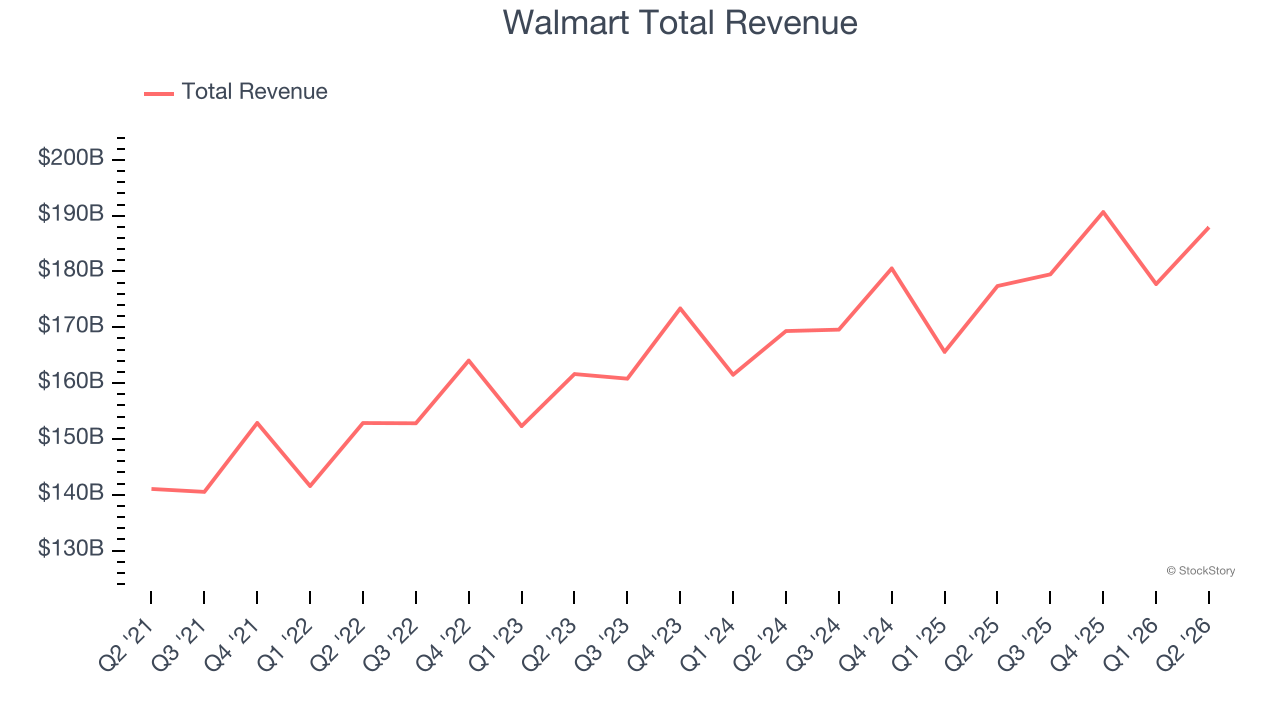
Walmart delivered the weakest performance against analyst estimates in the group. The market seems disappointed with the results as the stock is down 7.3% since reporting and currently trades at $105.98.
Read our full report on Walmart here, it’s free.
Best Q2: Target (NYSE: TGT)
With a higher focus on style and aesthetics compared to other large general merchandise retailers, Target (NYSE: TGT) serves the suburban consumer who is looking for a wide range of products under one roof.
Target reported revenues of $26.54 billion, up 5.3% year on year, outperforming analysts’ expectations by 1.5%. The business had an exceptional quarter with a beat of analysts’ EPS estimates and full-year EPS guidance exceeding analysts’ expectations.
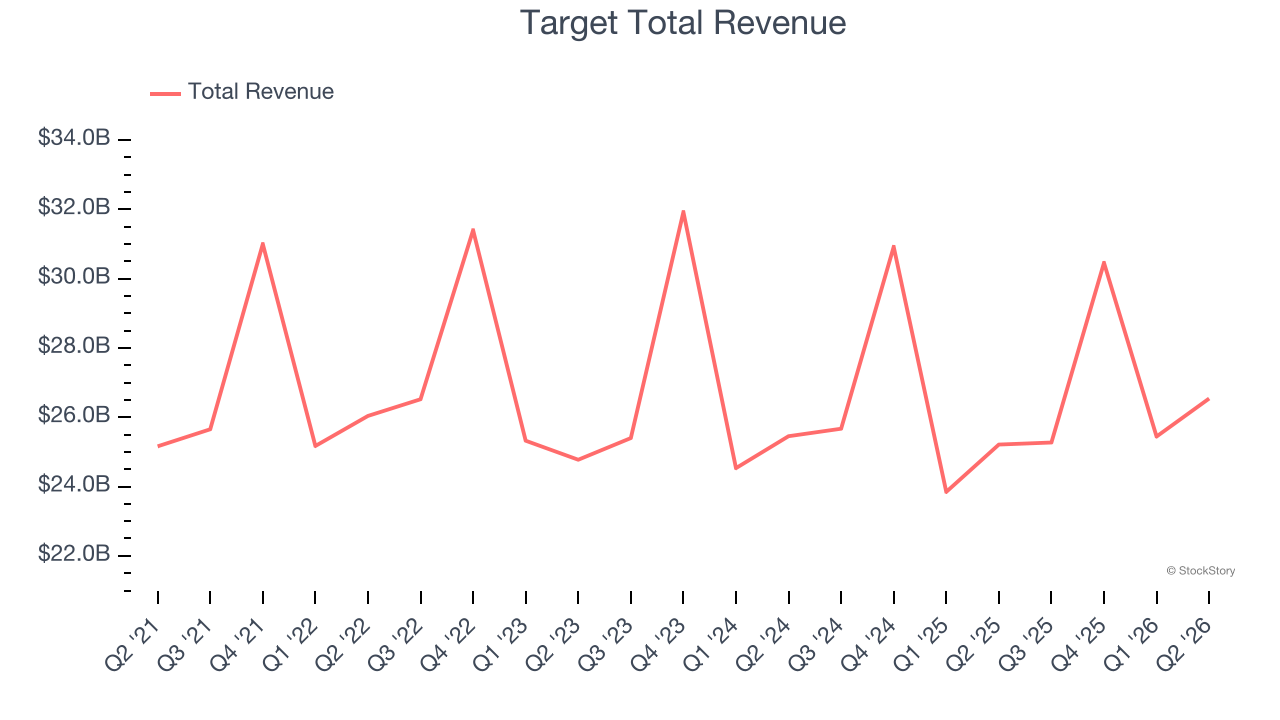
The market seems happy with the results as the stock is up 7.1% since reporting. It currently trades at $163.34.
Is now the time to buy Target? Access our full analysis of the earnings results here, it’s free.
Costco (NASDAQ: COST)
Designed to be a one-stop shop for the suburban consumer, Costco (NASDAQ: COST) is a membership-only retail chain that sells groceries, apparel, toys, and household items, often in bulk quantities.
Costco reported revenues of $70.53 billion, up 11.6% year on year, exceeding analysts’ expectations by 1.5%. It may have had the worst quarter among its peers, but its results were still good as it also locked in a solid beat of analysts’ gross margin estimates.
As expected, the stock is down 6.7% since the results and currently trades at $928.71.
Read our full analysis of Costco’s results here.
BJ's (NYSE: BJ)
Appealing to the budget-conscious individual shopping for a household, BJ’s Wholesale Club (NYSE: BJ) is a membership-only retail chain that sells groceries, appliances, electronics, and household items, often in bulk quantities.
BJ's reported revenues of $6.23 billion, up 15.7% year on year. This result beat analysts’ expectations by 4.7%. Overall, it was an exceptional quarter as it also produced a solid beat of analysts’ EBITDA estimates and full-year EPS guidance beating analysts’ expectations.
BJ's achieved the biggest analyst estimate beat and fastest revenue growth among its peers. The stock is up 1.8% since reporting and currently trades at $92.96.
Read our full, actionable report on BJ's here, it’s free.
Market Update
Over the past year, investors have been forced to repeatedly answer the same question: what is the market’s biggest risk? The answer has changed several times, and each shift has reshaped market leadership.
Late in 2025 and early 2026, artificial intelligence became the market’s primary uncertainty. Investors questioned whether AI would erode software pricing power and weaken competitive moats as AI made it easier to replicate once-differentiated products.
By the spring, technology took a back seat to geopolitics. The U.S. conflict with Iran briefly became the market’s dominant narrative, raising concerns about oil prices, inflation, and global growth. But as energy markets remained orderly and fears of a prolonged supply disruption faded, investors quickly turned their focus back to fundamentals.
Want to invest in winners with rock-solid fundamentals? Check out our Hidden Gem Stocks and add them to your watchlist. These companies are poised for growth regardless of the political or macroeconomic climate.