
Biopharma company Jazz Pharmaceuticals (NASDAQ: JAZZ) reported Q4 CY2025 results exceeding the market’s revenue expectations, with sales up 10.1% year on year to $1.20 billion. On the other hand, the company’s full-year revenue guidance of $4.38 billion at the midpoint came in 2.8% below analysts’ estimates. Its non-GAAP profit of $6.64 per share was 2.1% above analysts’ consensus estimates.
Is now the time to buy Jazz Pharmaceuticals? Find out by accessing our full research report, it’s free.
Jazz Pharmaceuticals (JAZZ) Q4 CY2025 Highlights:
- Revenue: $1.20 billion vs analyst estimates of $1.17 billion (10.1% year-on-year growth, 2.4% beat)
- Adjusted EPS: $6.64 vs analyst estimates of $6.51 (2.1% beat)
- Operating Margin: 21.2%, up from 17.5% in the same quarter last year
- Market Capitalization: $10.53 billion
Company Overview
Originally founded in 2003 and now headquartered in Ireland following a 2012 tax inversion merger, Jazz Pharmaceuticals (NASDAQGS:JAZZ) develops and markets medicines for sleep disorders, epilepsy, and cancer, with a focus on treatments for patients with limited therapeutic options.
Revenue Growth
A company’s long-term sales performance can indicate its overall quality. Even a bad business can shine for one or two quarters, but a top-tier one grows for years. Over the last five years, Jazz Pharmaceuticals grew its sales at a decent 11.4% compounded annual growth rate. Its growth was slightly above the average healthcare company and shows its offerings resonate with customers.
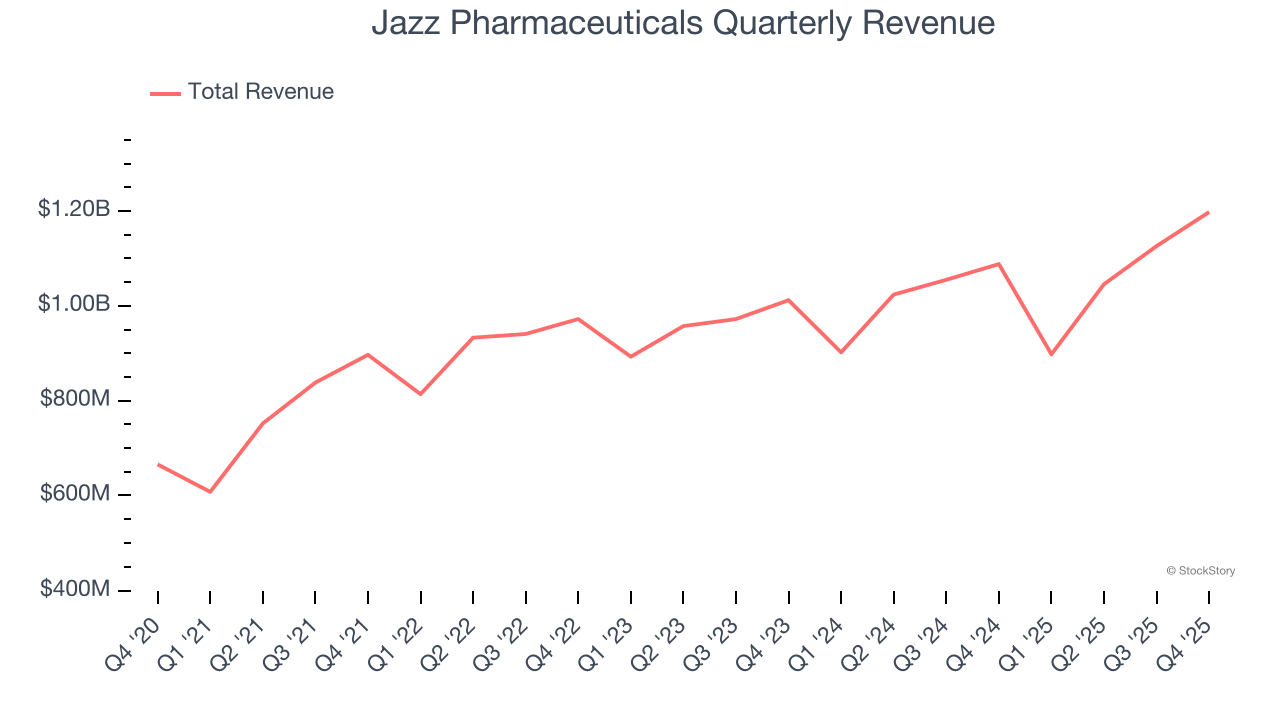
We at StockStory place the most emphasis on long-term growth, but within healthcare, a half-decade historical view may miss recent innovations or disruptive industry trends. Jazz Pharmaceuticals’s recent performance shows its demand has slowed as its annualized revenue growth of 5.5% over the last two years was below its five-year trend. We’re wary when companies in the sector see decelerations in revenue growth, as it could signal changing consumer tastes aided by low switching costs. 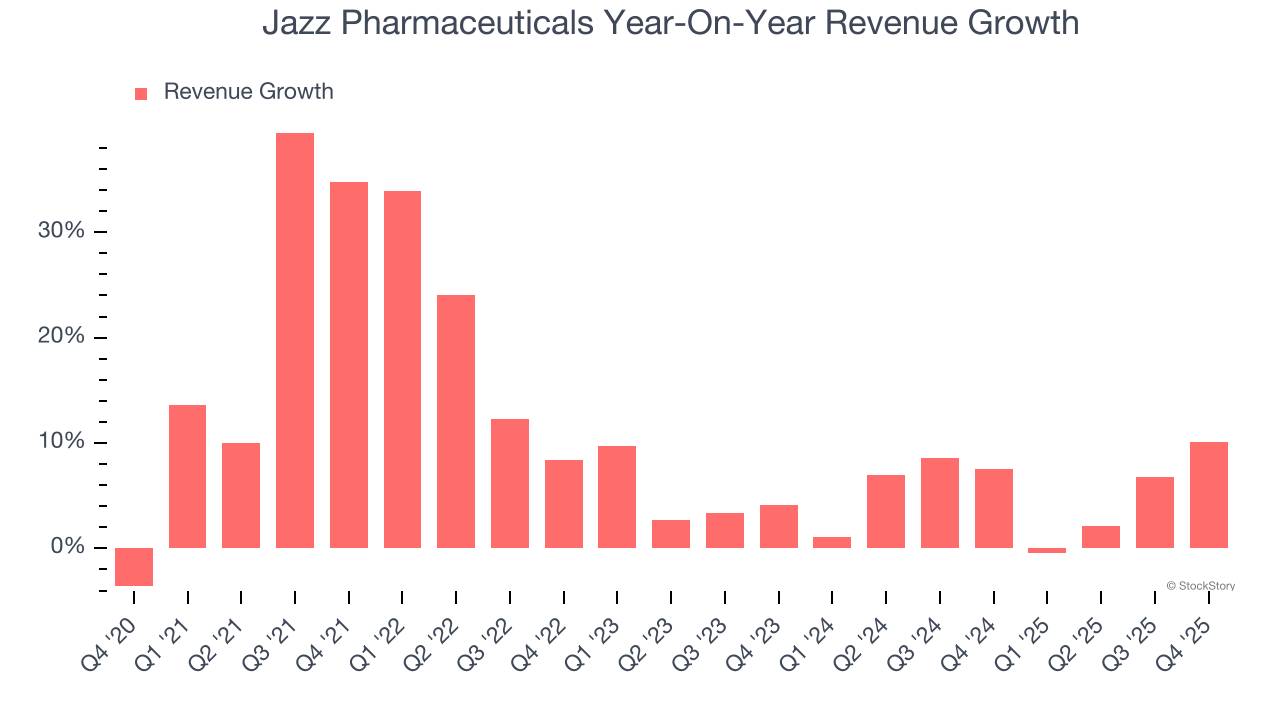
This quarter, Jazz Pharmaceuticals reported year-on-year revenue growth of 10.1%, and its $1.20 billion of revenue exceeded Wall Street’s estimates by 2.4%.
Looking ahead, sell-side analysts expect revenue to grow 4.6% over the next 12 months, similar to its two-year rate. This projection doesn't excite us and indicates its newer products and services will not lead to better top-line performance yet.
Microsoft, Alphabet, Coca-Cola, Monster Beverage—all began as under-the-radar growth stories riding a massive trend. We’ve identified the next one: a profitable AI semiconductor play Wall Street is still overlooking. Go here for access to our full report.
Operating Margin
Jazz Pharmaceuticals was profitable over the last five years but held back by its large cost base. Its average operating margin of 5.1% was weak for a healthcare business.
Analyzing the trend in its profitability, Jazz Pharmaceuticals’s operating margin decreased by 15.6 percentage points over the last five years. This performance was caused by more recent speed bumps as the company’s margin fell by 25.2 percentage points on a two-year basis. We’re disappointed in these results because it shows its expenses were rising and it couldn’t pass those costs onto its customers.
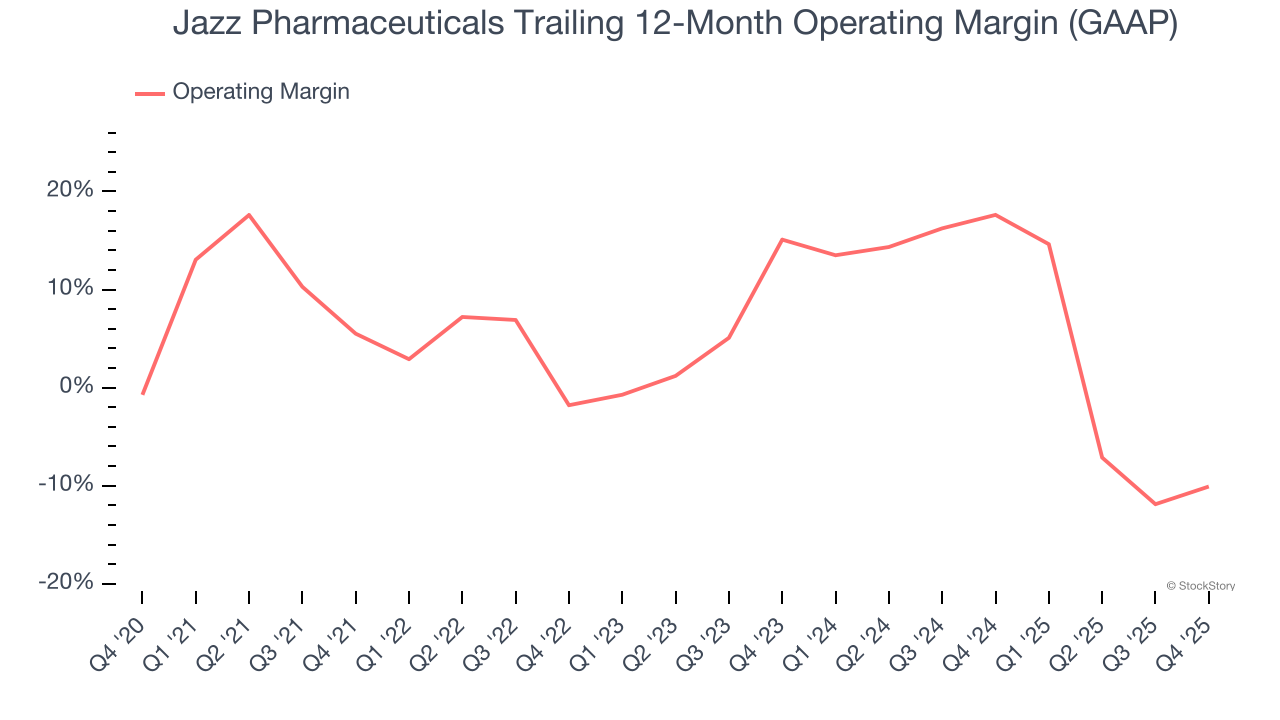
This quarter, Jazz Pharmaceuticals generated an operating margin profit margin of 21.2%, up 3.7 percentage points year on year. This increase was a welcome development and shows it was more efficient.
Earnings Per Share
We track the long-term change in earnings per share (EPS) for the same reason as long-term revenue growth. Compared to revenue, however, EPS highlights whether a company’s growth is profitable.
Sadly for Jazz Pharmaceuticals, its EPS declined by 8% annually over the last five years while its revenue grew by 11.4%. This tells us the company became less profitable on a per-share basis as it expanded.
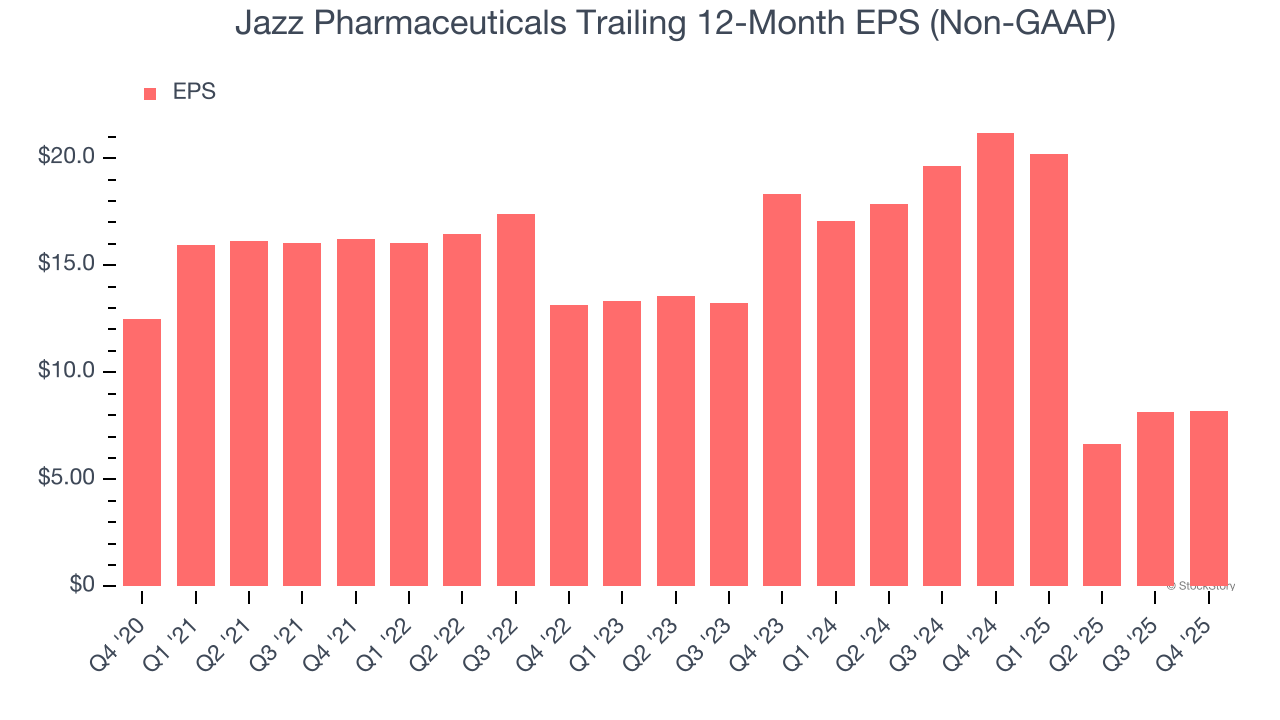
Diving into the nuances of Jazz Pharmaceuticals’s earnings can give us a better understanding of its performance. As we mentioned earlier, Jazz Pharmaceuticals’s operating margin expanded this quarter but declined by 15.6 percentage points over the last five years. Its share count also grew by 10.9%, meaning the company not only became less efficient with its operating expenses but also diluted its shareholders. 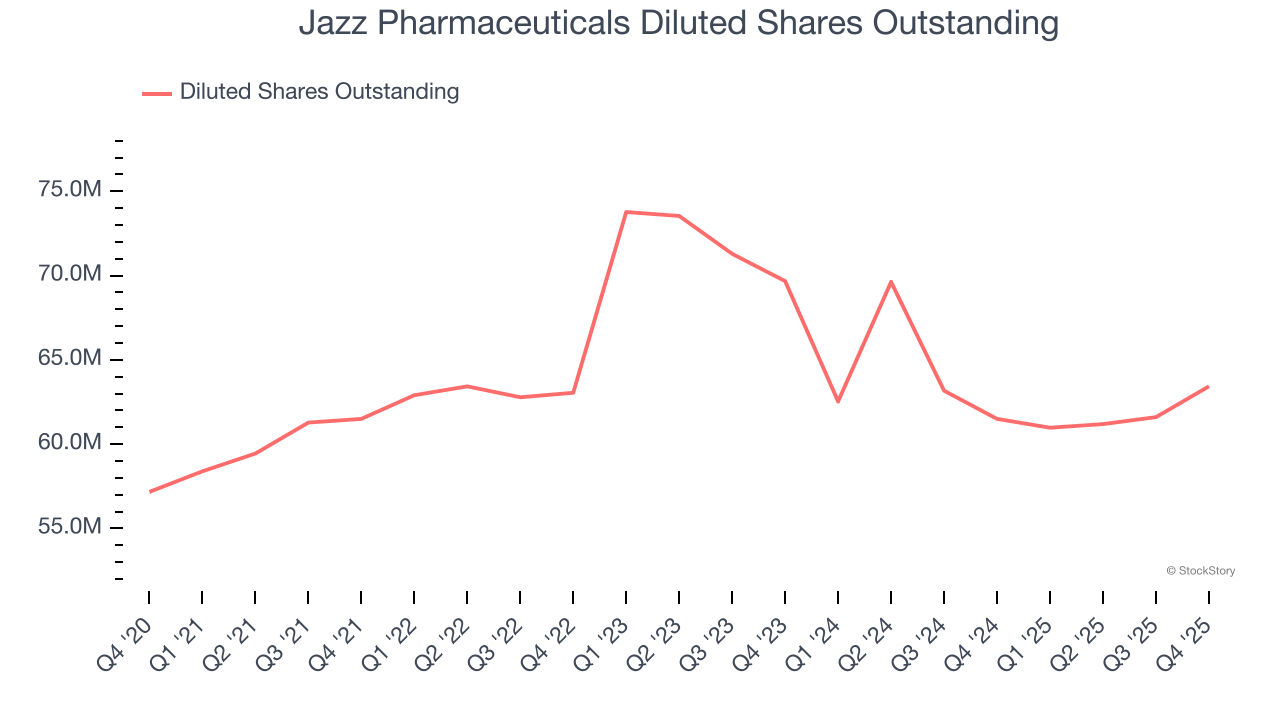
In Q4, Jazz Pharmaceuticals reported adjusted EPS of $6.64, up from $6.60 in the same quarter last year. This print beat analysts’ estimates by 2.1%. Over the next 12 months, Wall Street expects Jazz Pharmaceuticals’s full-year EPS of $8.20 to grow 157%.
Key Takeaways from Jazz Pharmaceuticals’s Q4 Results
It was encouraging to see Jazz Pharmaceuticals beat analysts’ revenue expectations this quarter. On the other hand, its full-year revenue guidance missed. Overall, this was a softer quarter. The stock remained flat at $173.81 immediately after reporting.
Is Jazz Pharmaceuticals an attractive investment opportunity at the current price? The latest quarter does matter, but not nearly as much as longer-term fundamentals and valuation, when deciding if the stock is a buy. We cover that in our actionable full research report which you can read here (it’s free).