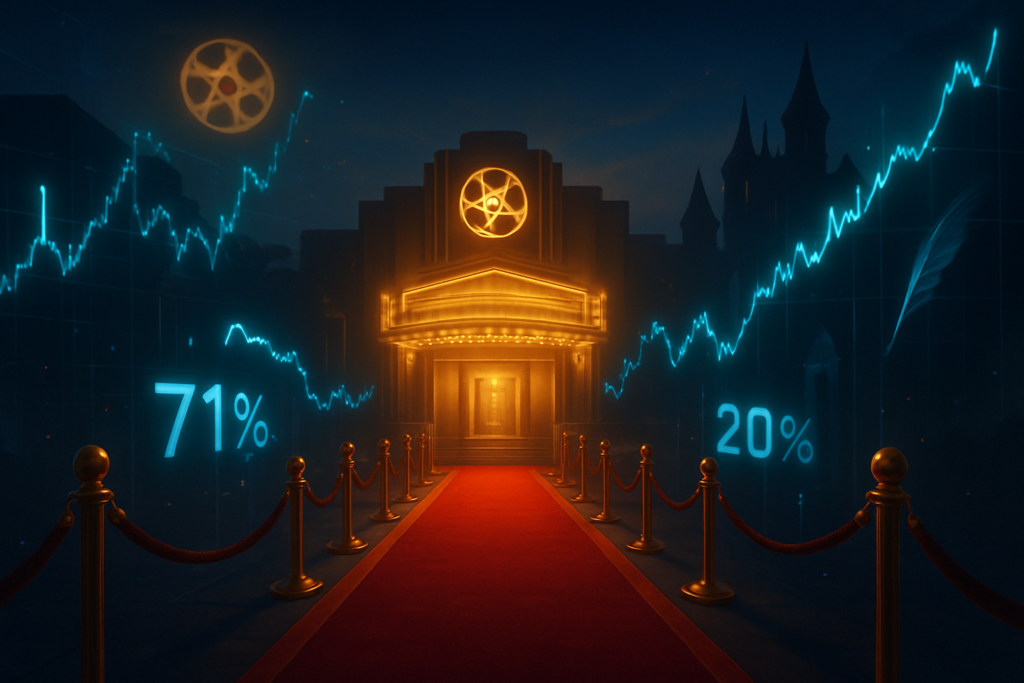
The 98th Academy Awards race has officially entered its most volatile phase following the announcement of the official nominations today, January 24, 2026. In the immediate wake of the Academy's reveal, prediction markets have reacted with lightning speed, cementing a clear hierarchy that suggests a potential landslide victory for one of the year’s most ambitious cinematic projects. Paul Thomas Anderson’s sprawling epic, One Battle After Another, has surged to a commanding 71% win probability, leaving competitors scrambling to close a widening gap in the eyes of bettors.
The market’s intensity is reaching a fever pitch, with traders pouring millions into Best Picture contracts as the "Gold Derby" of the digital age takes center stage. While critical consensus is still forming, the decentralized wisdom of the markets is currently signaling a near-certain coronation for the Warner Bros. Discovery (NASDAQ: WBD) flagship title. However, as any veteran of the 2026 awards cycle knows, the distance between a nomination and a statuette is often paved with market upsets and "whale" maneuvers that can shift the narrative in a single afternoon.
The Market: What's Being Predicted
The primary hub for this speculative frenzy is Polymarket, the decentralized prediction platform that has become the gold standard for high-volume event forecasting. As of this morning, the "Best Picture 2026" market has surpassed $9 million in total trading volume, a record for an entertainment-focused category this early in the calendar year. Traders are currently pricing One Battle After Another at 71 cents (representing a 71% implied probability), a sharp rise from the 55% it held just forty-eight hours ago.
Trailing in a distant second place is Ryan Coogler’s Sinners, also distributed by Warner Bros. Discovery (NASDAQ: WBD), which is currently trading at roughly 20%. The internal competition between two high-budget WBD titles has created a unique dynamic for traders, many of whom are hedging their bets across both films to capture the studio’s dominant momentum. Meanwhile, "long-shot" contenders like Guillermo del Toro’s Frankenstein, distributed by Netflix (NASDAQ: NFLX), and Chloé Zhao’s Hamnet, released via Focus Features and Comcast (NASDAQ: CMCSA), are hovering in the 4% to 7% range, attracting value bettors who believe the Academy may pivot toward more traditional "prestige" dramas in the final vote.
The resolution of these contracts is strictly tied to the official announcement at the 98th Academy Awards ceremony. Unlike traditional betting which often closes weeks in advance, these markets will remain live and liquid right up until the envelope is opened, allowing for frantic last-minute trading as rumors from the Governor's Ball or leaked ballot data begin to circulate.
Why Traders Are Betting
The dominance of One Battle After Another is not merely a reflection of its critical acclaim, but a bet on the "overdue" narrative surrounding director Paul Thomas Anderson. After decades of nominations without a Best Picture win, traders view this 2026 cycle as his definitive moment. The film's massive scale—shot in VistaVision and featuring an ensemble led by Leonardo DiCaprio—signals a return to the "big-screen epic" that the Academy has historically rewarded when technical prowess meets a resonant American story.
Today’s nominations announcement served as the ultimate catalyst for the current odds shift. One Battle After Another led the pack with 14 nominations, including key "litmus test" categories like Film Editing and Best Director, which are statistically correlated with a Best Picture win. Conversely, Sinners performed well but missed out on a crucial Screenplay nomination, a historical red flag that prompted many Polymarket "whales" to liquidate their positions in Coogler's film and consolidate into the favorite.
Strategic betting has also been influenced by the "streaming fatigue" sentiment present in current market commentary. Despite the visual splendor of del Toro’s Frankenstein, traders remain skeptical of Netflix's (NASDAQ: NFLX) ability to secure the top prize against a major theatrical powerhouse like WBD. This skepticism is baked into the 7% price for Frankenstein, which some contrarian traders argue is an undervalued position given del Toro’s previous success with The Shape of Water.
Broader Context and Implications
The $9 million volume on this single Oscar market highlights the growing legitimacy of prediction markets as a sentiment gauge that often outpaces traditional film critics and pundits. While legacy outlets like Variety or The Hollywood Reporter rely on subjective "expert" panels, Polymarket forces participants to put capital behind their convictions, creating a "wisdom of the crowd" effect that has historically proven remarkably accurate in predicting the eventual Best Picture winner.
From a regulatory standpoint, the 2026 Oscar markets are operating in a more established environment than previous years. With platforms like Kalshi and Polymarket gaining mainstream traction, the intersection of pop culture and financial speculation is no longer a niche hobby. These markets provide a real-time data feed for studios like Warner Bros. Discovery (NASDAQ: WBD) and Comcast (NASDAQ: CMCSA), who can monitor the "fair value" of their awards campaigns and adjust their marketing spends accordingly.
Furthermore, this market reveals a public appetite for high-stakes, "Auteur" cinema. The fact that the top four contenders are all directed by visionary filmmakers—Anderson, Coogler, del Toro, and Zhao—suggests that even in a speculative environment, the "brand name" of the director remains the most powerful currency in Hollywood forecasting.
What to Watch Next
The next major volatility event will be the Screen Actors Guild (SAG) and Directors Guild of America (DGA) Awards. Historically, the "Guild Sweep" is the most reliable indicator of Oscar success. If One Battle After Another manages to take the top prize at the DGAs, expect its Polymarket odds to climb into the 85% to 90% range, effectively ending the competitive phase of the market.
Traders should also keep a close eye on the "Anonymous Ballot" season, which typically begins in mid-February. As trade publications begin publishing interviews with unnamed Academy members, small shifts in sentiment can cause massive swings in the 20% "underdog" slot held by Sinners. A late-breaking "passion campaign" for a smaller film like Hamnet (NASDAQ: CMCSA) could also drain liquidity from the top, creating a more fragmented and unpredictable market in the final 72 hours before the ceremony.
Bottom Line
As of January 24, 2026, the prediction markets have spoken: One Battle After Another is the heavy favorite to win Best Picture. With 71% odds and a massive lead in nominations, the film is currently viewed by the market as a juggernaut that is Paul Thomas Anderson's to lose. However, the $9 million in volume suggests that there is still significant disagreement and "hedging" occurring, particularly with Sinners holding onto a respectable 20% of the market share.
The 2026 Oscar cycle demonstrates that prediction markets are no longer just a tool for political or economic forecasting; they are now an integral part of the entertainment industry’s ecosystem. Whether the crowd’s 71% confidence in One Battle After Another is a sign of a true frontrunner or a massive speculative bubble will be decided on the Dolby Theatre stage this March. For now, the smart money is betting on a "Battle" that is increasingly looking like a victory lap.
This article is for informational purposes only and does not constitute financial or betting advice. Prediction market participation may be subject to legal restrictions in your jurisdiction.
PredictStreet focuses on covering the latest developments in prediction markets.
Visit the PredictStreet website at https://www.predictstreet.ai/.