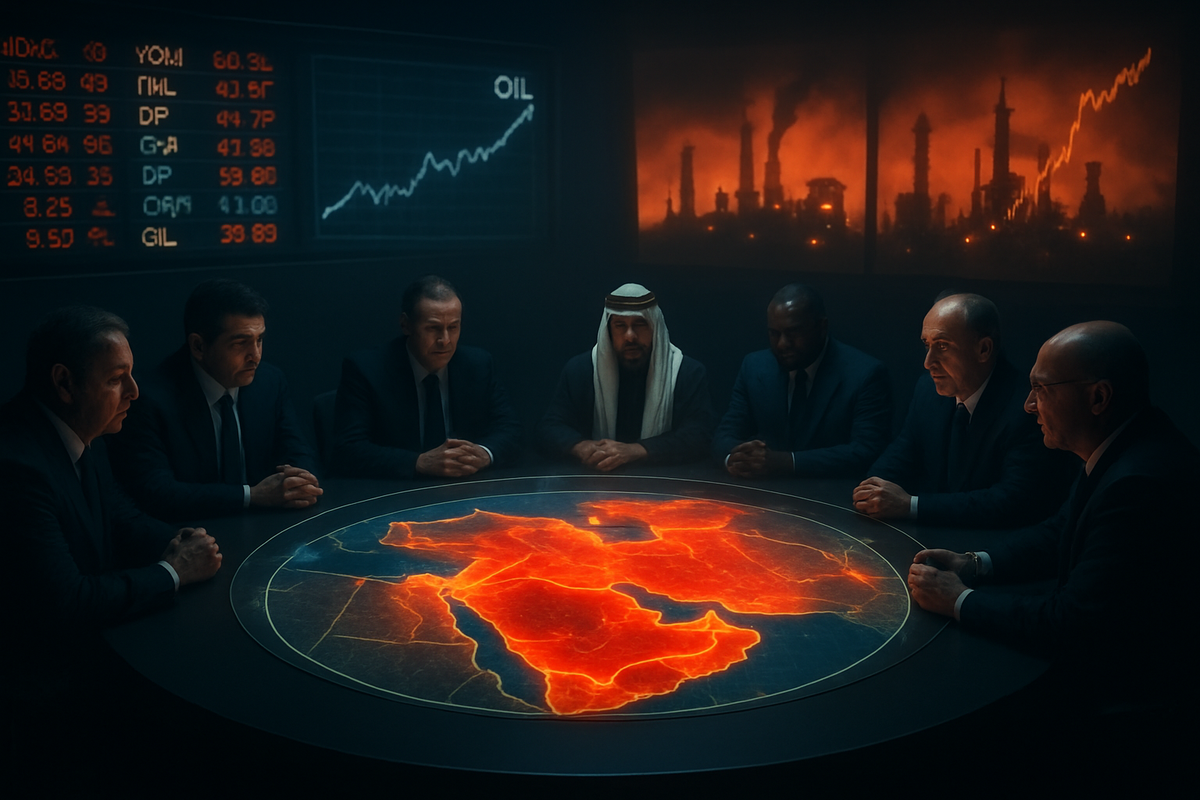
In an extraordinary emergency session held on April 5, 2026, the OPEC+ alliance issued a chilling warning to global markets: the world’s energy architecture is suffering from more than just temporary shipping delays. As the regional conflict, widely dubbed "Operation Epic Fury," continues to intensify, the cartel’s Joint Ministerial Monitoring Committee (JMMC) highlighted that recent strikes on critical infrastructure have caused "structural" damage that will haunt global supply chains for years. The meeting, which took place against the backdrop of a crippled Strait of Hormuz, underscored a growing realization that the current energy crisis is transitioning from a geopolitical bottleneck into a long-term industrial catastrophe.
The immediate implications are stark. Despite the physical inability to move significant volumes through the Persian Gulf, OPEC+ leaders moved to increase production quotas in a bid to stabilize a market characterized by extreme volatility and triple-digit oil prices. While the increase is largely seen as symbolic while shipping lanes remain contested, it represents a desperate attempt to signal future readiness to a world starved for energy security. Meanwhile, a complex diplomatic maneuver by Iran to exempt Iraqi exports from transit restrictions has added a layer of geopolitical intrigue, though market participants remain skeptical of its practical feasibility.
The Infrastructure Crisis and the Symbolic Surge
The primary takeaway from the April 5th summit was the JMMC’s focus on the permanence of recent destruction. Unlike previous disruptions that relied on blocking transit, the latest waves of hostilities have targeted the "heart" of energy processing. OPEC+ officials specifically cited the severe damage to the Ras Laffan gas complex in Qatar and major power facilities in Kuwait. The committee noted that restoring these assets to full operational capacity would be a multi-year endeavor, costing billions and requiring technical expertise that is currently in short supply due to regional instability. This assessment has fundamentally shifted the market’s "war premium" from a temporary tax on transit to a permanent repricing of global scarcity.
In response to the growing supply gap, the "OPEC+ Eight"—a coalition led by Saudi Arabia and Russia—agreed to a production quota increase of 206,000 barrels per day (bpd), effective May 2026. However, analysts were quick to point out the disconnect between policy and reality. With the Strait of Hormuz effectively closed to most traffic, Saudi Arabia has been forced to throttle actual production as its domestic storage tanks reach maximum capacity. The quota increase is viewed by many as a "placeholder" policy, designed to ensure the cartel is legally and strategically positioned to flood the market the moment hostilities cease and the narrows are cleared.
The meeting also addressed a surprising signal from Tehran. On April 4, just a day before the OPEC+ summit, Iranian military officials indicated that Iraq would be granted an "exemption" from restrictions in the Strait of Hormuz. This move was intended to support the economy of a key regional ally, as oil revenues represent nearly 90% of Iraq’s national budget. However, the market reaction was muted. Shipping giants and insurers remain unwilling to risk multi-billion dollar tankers in the narrows, regardless of Iranian "guarantees," especially as insurance premiums have surged to levels not seen since the "Tanker War" of the 1980s.
Initial market reactions saw West Texas Intermediate (WTI) crude fluctuating between $105 and $112 per barrel, while Brent Crude maintained a steady floor near $110. The volatility has led to a massive rotation into energy equities, as investors seek shelter from the broader inflationary pressures weighing down the S&P 500.
Winners and Losers in a Fragmented Market
The current crisis has created a sharp divide between energy companies based on their geographical footprint and infrastructure exposure. Equinor (NYSE: EQNR) has emerged as one of the primary "winners" of this geopolitical shift. With zero exposure to the Persian Gulf and a dominant position in the North Sea, Equinor has capitalized on record-high European gas prices and the desperate need for non-Middle Eastern supply. Bank of America recently identified the company as a top pick, citing its ability to provide stable, secure energy to a continent that has seen its LNG imports from Qatar decimated.
In the United States, major players like ExxonMobil (NYSE: XOM) and Chevron (NYSE: CVX) are navigating a dual reality. On one hand, both companies are reaping massive windfall profits from their operations in the Permian Basin and Guyana, where production remains unhindered. ExxonMobil, however, faces significant headwinds from its co-owned LNG assets in Qatar, which have been sidelined by infrastructure damage. Despite this, Citi recently raised its price target for XOM to $175, driven by the sheer scale of its domestic upstream portfolio. Chevron is also seen as a "compelling investment" by analysts, with projected earnings boosts of $0.85 per share for the first quarter of 2026.
Conversely, European majors like TotalEnergies (NYSE: TTE) are feeling the full weight of the crisis. TotalEnergies reported a staggering 15% loss of its global production capacity due to the shutdowns in Qatar, Iraq, and the UAE. In a strategic pivot that mirrors the broader industry trend, the company recently announced it would redirect $1 billion originally earmarked for offshore wind projects back into fossil fuel extraction and infrastructure repair to shore up its core business.
Downstream players, particularly U.S.-based refiners like Valero Energy (NYSE: VLO) and Marathon Petroleum (NYSE: MPC), have seen their stock prices surge by nearly 40% year-to-date. These companies are benefiting from historic "crack spreads"—the difference between the price of crude oil and the petroleum products extracted from it. As Middle Eastern refined products are locked out of the global market, American refiners have stepped in to fill the void, turning the supply crisis into a refining gold rush.
A Shift from Transition to Security
The April 5th OPEC+ meeting marks a definitive end to the era of "leisurely" energy transition. For the past decade, the industry narrative was dominated by the shift to renewables and the phasing out of fossil fuels. However, the destruction of permanent infrastructure in the Middle East has forced a "Great Re-evaluation." Energy security has now superseded carbon neutrality as the primary driver of both corporate strategy and national policy. This is evident in the actions of Shell (NYSE: SHEL) and BP (NYSE: BP), which have been forced to participate in emergency Strategic Petroleum Reserve (SPR) "loan" schemes to prevent fuel rationing in Europe.
This event bears a striking resemblance to the 1973 oil embargo, but with a modern, more destructive twist. While the 1970s crisis was primarily a matter of political will and transit, the 2026 crisis involves the physical degradation of the world’s most efficient energy-producing machines. The ripple effects are being felt far beyond the oil patch; the massive release of 400 million barrels from strategic reserves by the U.S. and IEA is a historic intervention, yet it has only served to provide a temporary ceiling for prices rather than a long-term solution.
Furthermore, the regulatory landscape is shifting. Policymakers in Washington and Brussels, who were once focused on tightening emissions standards, are now fast-tracking permits for offshore drilling and LNG export terminals. The precedent being set is one where "emergency energy needs" override long-standing environmental protocols, a trend that may take years to reverse even after the current conflict subsides.
The Road Ahead: Scenarios for 2027 and Beyond
In the short term, the market will remain hyper-fixated on the status of the Strait of Hormuz and the technical feasibility of the Iranian "exemption" for Iraqi crude. If Iraq successfully manages to navigate the narrows with Iranian backing, it could provide a crucial, albeit minor, relief valve for global markets. However, the more likely scenario involves a continued stalemate, with prices remaining "higher for longer" as the world adjusts to the loss of Qatari and Kuwaiti capacity.
Long-term, the energy industry is facing a massive "re-shoring" of infrastructure. We can expect a surge in capital expenditure toward "safe" jurisdictions, such as the U.S. Gulf Coast, Canada, and Brazil. For companies like ExxonMobil and Chevron, this will mean a doubling down on shale and deepwater assets that are far removed from geopolitical flashpoints. The strategic pivot required will be immense; companies will need to balance the need for rapid production increases with the reality that the infrastructure they build today must survive an increasingly volatile 21st-century landscape.
Market opportunities will emerge for firms specializing in energy infrastructure repair and maritime security. As the "Operation Epic Fury" conflict eventually cools, the task of rebuilding the Persian Gulf’s energy heart will be one of the largest industrial undertakings in history. Investors should watch for a transition from "pure-play" energy producers to "integrated security and infrastructure" firms that can facilitate this rebuilding.
Conclusion: Navigating the New Energy Reality
The April 5th OPEC+ emergency meeting has codified what many feared: the global energy system is no longer just bent; it is broken. The warning of lasting structural damage to infrastructure suggests that even if a peace treaty were signed tomorrow, the "supply gap" would persist for years. The symbolic quota increase and the Iranian diplomatic maneuvers are mere ripples in a much larger storm of global scarcity and industrial realignment.
For investors, the coming months will require a focus on "deliverability" and "security." Companies with diverse, non-Middle Eastern assets and robust refining capabilities are best positioned to weather the storm. The key takeaways from this event are clear: energy security is the new global currency, and the "war premium" is now a permanent fixture of the market landscape. As we move forward, the focus will shift from the price of a barrel to the physical integrity of the pipes and ports that move it. Watching the progress of infrastructure repairs and the actual (rather than theoretical) movement of Iraqi crude will be the critical metrics for the remainder of 2026.
This content is intended for informational purposes only and is not financial advice.