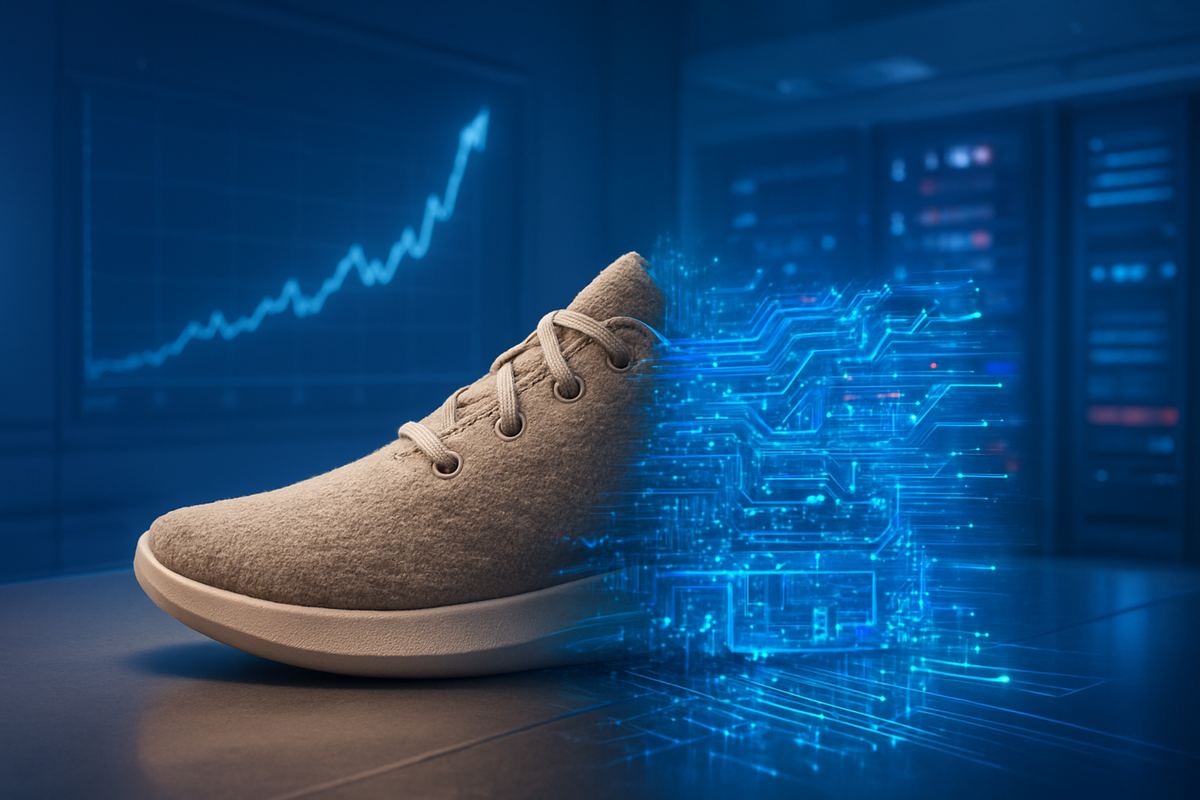
In a move that has stunned Wall Street and signaled a new, more desperate phase of the artificial intelligence gold rush, the sustainable footwear pioneer Allbirds (NASDAQ: BIRD) announced this morning that it has officially completed a total corporate pivot. Effective immediately, the company has rebranded as "NewBird AI," abandoning the wool runners and eucalyptus fiber flats that once defined Silicon Valley fashion in favor of high-performance GPU compute infrastructure.
The market’s reaction was nothing short of explosive. Shares of the newly christened NewBird AI skyrocketed in pre-market trading and maintained their momentum throughout the day, ultimately quintupling in value. The stock, which had been languishing in the "penny stock" doldrums at approximately $2.50 for much of late 2025, surged past $15.00 a share as retail and institutional investors alike scrambled to pile into what is being called the most dramatic "pivot-to-tech" since the dot-com era.
The Transformation: Trading Wool for Wafers
The timeline for this radical shift began in late March 2026, when Allbirds quietly signed a definitive agreement to sell its brand name, intellectual property, and all remaining footwear assets to the American Exchange Group for a reported $39 million. This sale allowed the "Allbirds" footwear brand to survive as a product line under new ownership while leaving the public corporate shell—and its remaining cash—to pursue a vastly different future. On April 15, 2026, CEO Joe Vernachio unveiled the second act: NewBird AI.
Central to this pivot is a $50 million convertible financing agreement with an unnamed institutional investor, specifically earmarked for the procurement of high-end graphics processing units (GPUs). NewBird AI plans to operate as a "GPU-as-a-Service" (GPUaaS) provider, leasing out compute power to AI startups and research firms that have been locked out of the primary cloud markets due to the ongoing global "GPU bottleneck." The company has already begun converting its few remaining logistical hubs into boutique data centers designed to house NVIDIA (NASDAQ: NVDA) and Advanced Micro Devices (NASDAQ: AMD) hardware.
Initial reactions from the industry have been a mix of exhilaration and deep skepticism. While speculators are cheering the audacity of the move, seasoned analysts have noted the irony of a company once dedicated to "carbon-neutral" footwear moving into the notoriously energy-intensive field of AI data centers. "It is the ultimate Silicon Valley ghost story," remarked one retail analyst. "The shoes are gone, but the spirit of the hype cycle remains."
Winners and Losers in the NewBird Pivot
The immediate winners of this pivot are undoubtedly the long-suffering shareholders of Allbirds (NASDAQ: BIRD). After witnessing a 99% decline from its 2021 IPO peak, the stock’s 500% surge today provided a rare, if volatile, exit ramp or a potential new beginning for those who held on through the company’s footwear-related struggles. Furthermore, the American Exchange Group emerges as a winner, picking up a globally recognized lifestyle brand for a fraction of its former valuation, with plans to distribute the shoes through more traditional, lower-cost retail channels.
On the other side of the ledger, the losers include the hundreds of retail employees and corporate staff who were part of the footwear division. The pivot effectively ends the company's identity as a clothing manufacturer, leading to the closure of nearly all remaining flagship stores. Additionally, short sellers were caught in a violent "short squeeze" as the news broke, with many forced to cover their positions at any price, further fueling the stock’s vertical ascent.
The move also places NewBird AI in direct, albeit niche, competition with cloud titans like Amazon (NASDAQ: AMZN), Microsoft (NASDAQ: MSFT), and Alphabet (NASDAQ: GOOGL). While NewBird AI cannot compete on scale, its focus on "altscaling"—providing dedicated, unmanaged access to GPUs—targets a specific segment of the market currently underserved by the major providers. However, these tech giants may eventually view such "shell-pivots" as a nuisance that complicates the supply chain for the hardware they desperately need for their own operations.
A Broader Trend: The Infrastructure Mimicry of 2026
The NewBird AI pivot is not an isolated event; it fits into a broader 2026 industry trend known as "Infrastructure Mimicry." As the software layer of the AI market enters what Gartner calls the "Trough of Disillusionment," investors have shifted their capital toward the physical layer—the "picks and shovels." This has led several struggling small-cap companies in unrelated fields to rebrand themselves as AI infrastructure plays in hopes of capturing a piece of the $2 trillion in AI-related spending projected for this year.
Historical precedents for this behavior are numerous, most notably the 2017 craze where companies like the Long Island Iced Tea Company rebranded to "Long Blockchain Corp," seeing immediate stock surges despite having no previous experience in ledger technology. However, the 2026 version of this trend is under much tighter scrutiny. The Securities and Exchange Commission (SEC) has recently ramped up its "AI Task Force," specifically looking for "AI-washing" in public filings where companies overstate their technical capabilities to lure in speculative investors.
Regulatory implications loom large for NewBird AI. The Federal Trade Commission (FTC), under its "Operation AI Comply" initiative, has signaled that it will be investigating firms that pivot into AI infrastructure without a clear pathway to operational competency. For NewBird, the challenge will be proving that they can manage low-latency data centers and secure consistent hardware allocations from suppliers like NVIDIA (NASDAQ: NVDA) as effectively as they once managed wool supply chains in New Zealand.
What Comes Next for the 'New' Bird
In the short term, NewBird AI must execute on its hardware procurement strategy. The success of the company now hinges entirely on its ability to actually take delivery of the H200 and Blackwell-series chips it has promised to its future tenants. Any delays in the global supply chain could see the stock’s current gains evaporate as quickly as they appeared. The market will be watching the next two quarterly filings closely for signs of actual "compute revenue" versus mere speculative interest.
Long-term, the company faces a strategic fork in the road. It must either evolve into a legitimate, specialized cloud provider or risk becoming a cautionary tale of the AI bubble. There is also the possibility that NewBird AI is positioning itself as an acquisition target for a larger "altscaler" looking for a public listing via a reverse merger. The $50 million in financing is a start, but in the world of AI infrastructure, where "hyperscalers" spend billions monthly, NewBird will need to find a sustainable niche or additional massive infusions of capital.
Market opportunities may emerge in the form of "edge" AI—smaller, localized data centers where NewBird's remaining physical real estate (its old warehouses) could be repurposed. However, the challenges are equally significant, including high energy costs, the need for specialized cooling tech, and the looming implementation of the EU AI Act later this year, which will impose strict new compliance standards on any firm providing AI-related services.
The Market Minute Wrap-Up
The rebranding of Allbirds to NewBird AI stands as one of the most surreal chapters in the ongoing AI revolution. It captures the essence of 2026's financial landscape: a world where legacy brands can be discarded overnight in favor of a "compute-first" identity, and where a single press release can quintuple a company's market cap. The key takeaway for investors is that while the AI infrastructure trade is currently the most crowded and profitable area of the market, the risks of "rebranding-as-strategy" are immense.
Moving forward, the market will likely see a widening gap between companies that are "AI-native" and those that are "AI-reactive." NewBird AI has successfully captured the market's attention, but it has yet to capture its trust. Investors should keep a close watch on the company’s capital expenditure (CapEx) reports and its ability to secure power-purchase agreements for its new data centers.
As we look toward the second half of 2026, the NewBird AI story will serve as a litmus test for the sustainability of the AI infrastructure boom. If the company can successfully transition from sneakers to servers, it may provide a blueprint for other struggling consumer brands. If it fails, it will be remembered as the definitive "jump-the-shark" moment of the 2020s tech cycle.
This content is intended for informational purposes only and is not financial advice.