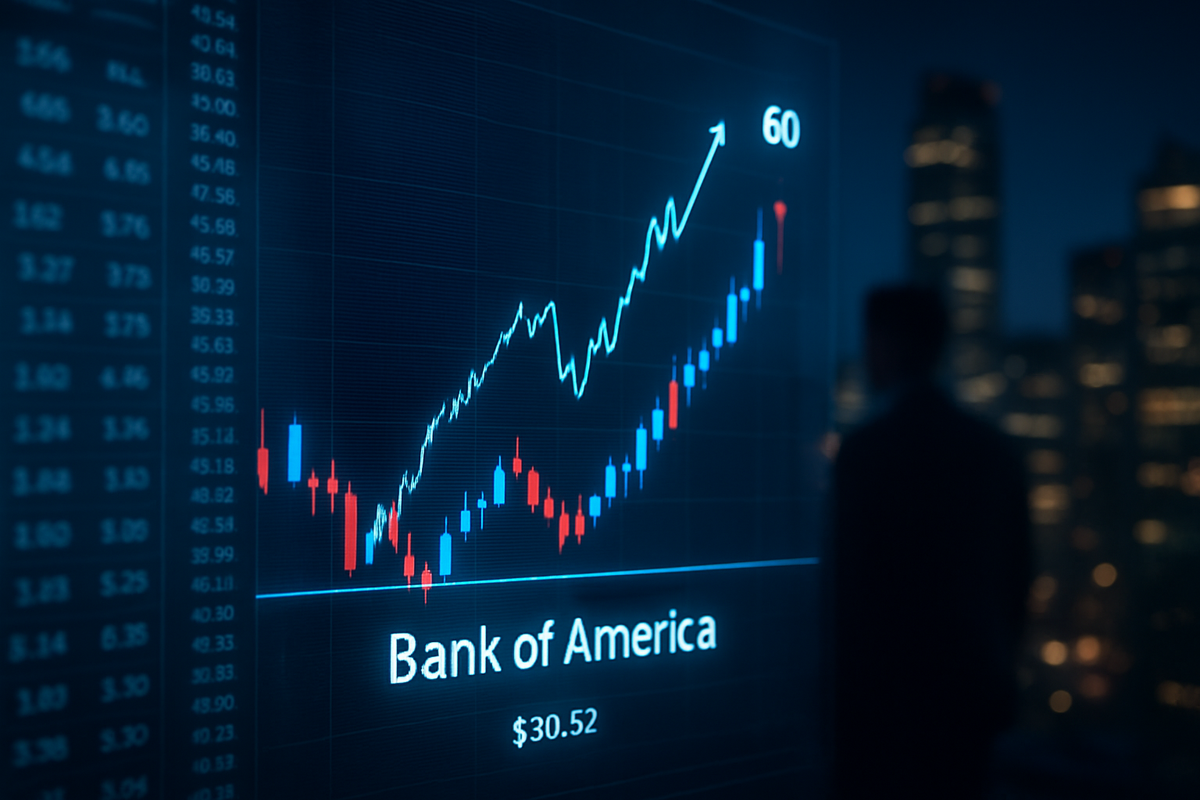
As the opening bell rang on Wall Street this Tuesday, April 14, 2026, all eyes shifted to the technical charts of Bank of America (NYSE: BAC). The banking giant, which has been a cornerstone of the post-2024 market recovery, is currently locked in a high-stakes battle with its 200-day moving average, hovering precariously around the $50.52 mark. For market technicians and institutional investors, this level represents far more than just a mathematical average; it is the primary psychological and structural support floor that has defined the stock’s multi-year uptrend.
The current technical standoff comes at a pivotal moment for the broader financial sector. After a robust rally through late 2025, BAC shares have cooled, leading to this critical retest. If the stock can maintain its footing above $50.52 and stage a clean breakout, analysts believe the momentum could carry the banking titan toward the elusive $60 psychological resistance level—a height not seen since the pre-inflationary shocks of the early 2020s. However, a failure to hold this line could signal a broader cooling of the "big bank" trade that has dominated the last 18 months.
The Technical Battleground: Two Years in the Making
The journey to $50.52 has been a disciplined climb from the volatile lows of 2023 and 2024. Following the Federal Reserve's decisive pivot to a neutral interest rate environment in late 2024, Bank of America (NYSE: BAC) began a steady ascent, bolstered by a "Golden Cross" in early 2024 that signaled the end of its long-term bearish cycle. Throughout 2025, the stock benefited from a stabilization in Net Interest Income (NII) and a resurgence in investment banking fees, which had been dormant during the high-rate shock period.
The current 200-day moving average at $50.52 is the culmination of this two-year growth trajectory. Historically, the 200-day SMA serves as the "frontier" between a bull and bear market for institutional traders. In the weeks leading up to today, BAC has touched this level three times, finding immediate but thinning buy-side support. The timeline of this consolidation began in early March 2026, following a minor correction across the S&P 500 Financials Index, as investors locked in profits from the 2025 surge.
Market participants are particularly focused on the volume accompanying this test. Unlike previous dips, the current interaction with the 200-day average is occurring on average-to-high volume, suggesting a genuine struggle between "dip-buyers" who see value at $50 and "profit-takers" who fear a macroeconomic slowdown. Initial reactions from the trading floor indicate a "wait-and-see" approach, with options activity suggesting a hedge against a potential move toward $48 if the $50.52 support is breached.
Winners, Losers, and the Performance Gap
While Bank of America (NYSE: BAC) fights to maintain its technical integrity, its peers are experiencing a disparate set of fortunes. JPMorgan Chase & Co. (NYSE: JPM), widely considered the sector's "gold standard," has managed to stay well above its own moving averages, trading near all-time highs. JPM’s massive scale and dominant wealth management arm have allowed it to decouple slightly from the more sensitive interest-rate moves that affect BAC. In this scenario, JPM remains a winner, attracting "flight to quality" capital from investors who find BAC’s technical position too risky.
Conversely, the "losers" in this technical skirmish could be the regional banking players, such as the SPDR S&P Regional Banking ETF (NYSE: KRE). When a bellwether like Bank of America (NYSE: BAC) tests major support, it often casts a shadow over smaller institutions that lack its diversified revenue streams. If BAC breaks down, the "contagion of sentiment" often hits regional banks harder, as they are perceived to have less buffer against credit normalization. Citigroup Inc. (NYSE: C), still navigating its multi-year structural turnaround, also finds itself in a precarious spot, as any sector-wide weakness could stall its progress toward a higher valuation multiple.
The potential "winners" are the systematic trend-following funds and retail traders who are eyeing the $60 breakout. If the $50.52 floor holds, the ensuing "short squeeze" of late-cycle bears could provide the fuel needed for the next leg up. Wealth management firms and dividend-focused investors may also see this as a prime entry point, given BAC's recent history of aggressive share buybacks and dividend increases made possible by a more favorable regulatory landscape.
A Regulatory Tailwind and the Wider Significance
The broader significance of Bank of America’s (NYSE: BAC) technical health cannot be decoupled from the recent tectonic shifts in banking regulation. Just last month, in March 2026, U.S. regulators officially finalized the "Mulligan" revision of the Basel III Endgame. In a stunning reversal from the 2023 proposals that would have hiked capital requirements by nearly 20%, the new framework actually offered a net capital relief of approximately 4.8% for the nation's largest G-SIBs.
This regulatory relief has fundamentally changed the math for BAC at the $50 level. With billions in "excess" capital now freed up for distribution, the stock's fundamental floor is arguably stronger than it appears on a chart. This shift mirrors historical precedents where regulatory easing preceded major bull runs in the financial sector, such as the post-2016 period. The 200-day moving average test is, therefore, a test of whether the market has already "priced in" this regulatory gift or if there is more room for expansion.
Furthermore, this event reflects the industry's transition into a "neutral" rate era. With the Federal Funds Rate sitting comfortably between 3.50% and 3.75%, the banking sector is no longer fighting the "high-rate shock" of 2022 or the "zero-bound" struggles of 2020. BAC’s ability to hold $50.52 will be seen as a verdict on the "Neutral Rate Economy"—a test of whether banks can generate sustainable growth without the crutch of extreme Fed intervention or the tailwind of rapidly rising rates.
The Road to $60: Scenarios and Strategic Pivots
Looking ahead, two primary scenarios emerge for Bank of America (NYSE: BAC). In the bullish scenario, a decisive bounce off $50.52, confirmed by a weekly close above $52, would likely trigger a wave of institutional "buy" signals. This would pave the way for a run toward the $60 psychological level. To sustain this, BAC will likely need to demonstrate continued growth in its digital banking segment and a stabilization of credit card delinquencies, which have been a minor point of concern in recent quarterly reports.
In the bearish scenario, a break below $50.52 would necessitate a strategic pivot. Management might be forced to accelerate their share buyback programs to support the stock price, potentially depleting the capital buffers they just regained under the Basel III revisions. Furthermore, a technical breakdown could embolden short-sellers who believe the 2025 rally was overextended. Investors should watch for any sudden shifts in the "Dot Plot" projections from the Federal Reserve; any hint of a return to rate hikes would likely shatter the current support levels.
The short-term hurdle is the upcoming Q1 earnings season. If BAC can provide upbeat guidance regarding its investment banking pipeline, the $50.52 support will likely hold. Long-term, the bank's ability to cross $60 depends on its execution in the wealth management space, where it competes fiercely with the likes of Morgan Stanley (NYSE: MS) and JPMorgan.
Summary: A Defining Moment for Investors
The technical showdown at $50.52 is more than just a chart pattern; it is a barometer for the health of the American financial system in 2026. Bank of America (NYSE: BAC) stands as a proxy for the successful navigation of the post-inflationary era. The key takeaway for investors is that while the $50.52 level is under pressure, the underlying fundamentals—driven by regulatory relief and a stable rate environment—remain robust compared to the uncertainty of two years ago.
As we move forward, the market’s reaction at this "line in the sand" will dictate the narrative for the remainder of the year. A successful defense of this level would confirm that the financial sector's bull market has "legs" to reach new heights. Conversely, a failure would suggest a period of stagnation and consolidation. Investors should keep a close eye on daily closing prices relative to $50.52 and stay tuned to any updates regarding the implementation of the revised Basel III rules.
The coming months will determine if Bank of America (NYSE: BAC) can transform this technical battleground into a launchpad for $60, or if the $50.52 mark will be remembered as the ceiling of a remarkable recovery.
This content is intended for informational purposes only and is not financial advice.