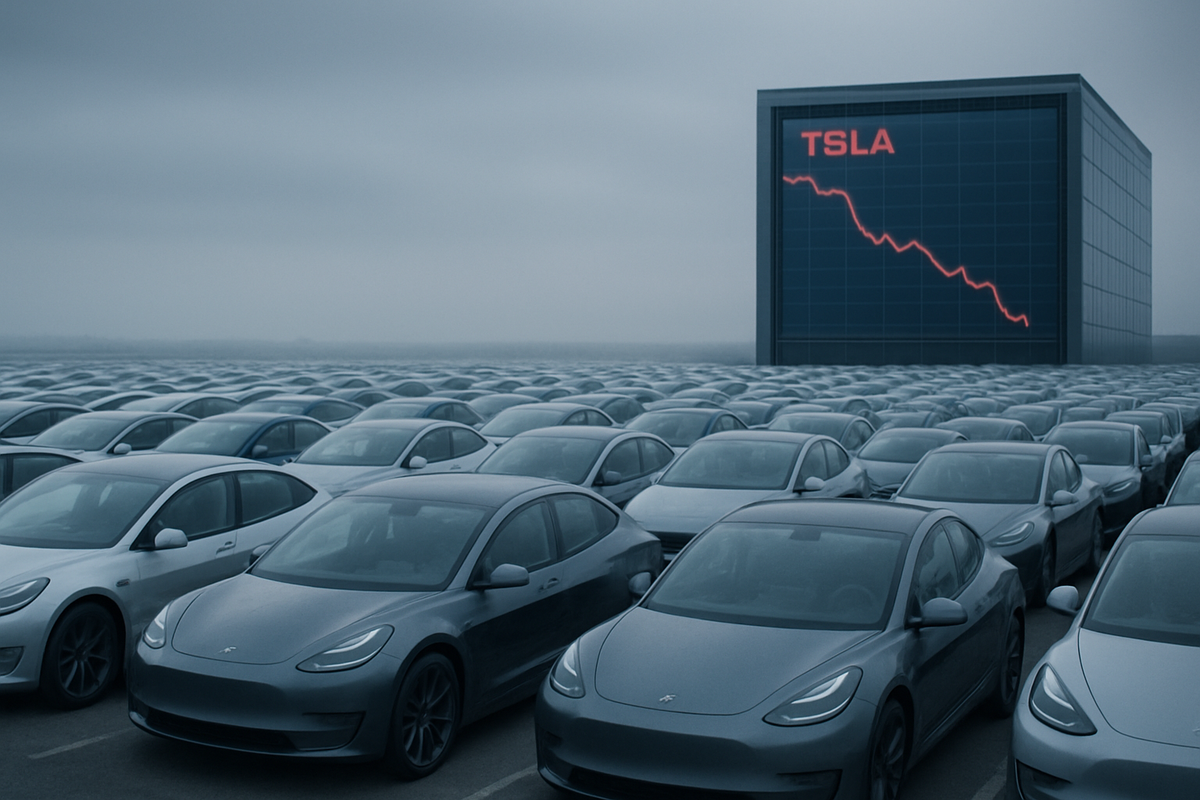
The cooling demand for electric vehicles has reached a critical flashpoint for Tesla, Inc. (NASDAQ: TSLA), as JPMorgan Chase & Co. (NYSE: JPM) issued a scathing analyst note warning of a massive disconnect between the company's surging stock price and its deteriorating fundamental performance. Analyst Ryan Brinkman reiterated his 'Underweight' rating on the EV giant, maintaining a $145 price target that suggests a staggering 60% decline from current trading levels of approximately $355.
The warning comes on the heels of a disappointing first-quarter delivery report that has left investors questioning Tesla’s ability to maintain its premium valuation while its primary automotive business faces unprecedented inventory bloat. With the global EV market entering a mature and hyper-competitive phase, the sheer scale of Tesla’s unsold vehicle stock has become a primary concern for Wall Street, threatening the company’s industry-leading margins and free cash flow.
The Q1 Delivery Miss and the 164,000-Unit Overhang
The catalyst for the renewed bearishness was Tesla's Q1 2026 delivery figures, which totaled 358,023 vehicles—a notable miss compared to the Bloomberg consensus estimate of 372,000 and JPMorgan’s own projection of 385,000. While this represented a modest 6.3% increase over the previous year, the production side of the equation told a far more alarming story. Tesla manufactured 408,386 vehicles during the same period, creating a quarterly surplus of over 50,000 units.
According to Brinkman, this gap has pushed Tesla’s total global unsold inventory to a record high of 164,000 vehicles. This inventory pileup is not just a logistical headache; it represents billions of dollars in tied-up capital at a time when the company is aggressively pivoting its R&D budget toward autonomous "Cybercabs" and the "Optimus" humanoid robot program. The disconnect is particularly sharp because, while the stock has stayed buoyant on AI optimism, the core business of selling cars appears to be hitting a ceiling.
The timeline leading to this moment is marked by the expiration of the $7,500 federal EV tax credit in late 2025, which many analysts believe pulled demand forward and left a vacuum in early 2026. Furthermore, Tesla’s controversial decision on April 1, 2026, to discontinue the veteran Model S and Model X lines to focus on future robotics has alienated a segment of the luxury market, contributing to the delivery shortfall.
Industry Winners and Losers in the Wake of Tesla's Slump
The immediate "loser" in this scenario is undoubtedly Tesla’s current shareholder base, which has seen the stock trade at a significant "AI premium" that Brinkman argues is no longer supported by automotive cash flows. If Tesla is forced to initiate another round of aggressive price cuts to clear the 164,000 units sitting in lots, its gross margins—once the envy of the industry—could compress further, potentially dipping below the 15% threshold.
Conversely, competitors like BYD Company Limited (OTC: BYDDY) stand to gain as they continue to dominate the low-to-mid-price segments globally, often with newer product cycles. Legacy players such as Ford Motor Company (NYSE: F) and General Motors (NYSE: GM) may also see a tactical advantage; as Tesla retreats from traditional luxury segments (S/X) to chase robotaxis, a window opens for these Detroit giants to capture affluent buyers who still want high-end, driver-operated EVs.
Furthermore, the pivot toward AI puts Tesla in more direct competition with companies like NVIDIA Corporation (NASDAQ: NVDA). While Nvidia remains the primary hardware beneficiary of the AI boom, Tesla’s struggle to translate AI potential into automotive sales could lead investors to shift capital away from speculative "AI-adjacent" stocks and toward proven "pure-play" infrastructure providers.
The Wider Significance: A Shift from Autos to AI
This event signifies a broader industry trend where the "first-mover advantage" in EVs is officially over. The market is no longer rewarding companies simply for producing electric cars; it is demanding profitability, efficient inventory management, and a clear path to Level 5 autonomy. Tesla’s inventory crisis highlights the "growing pains" of a company trying to transition from a high-volume hardware manufacturer to a software-and-robotics firm.
The expiration of regulatory subsidies across major markets in 2025 and 2026 has served as a "stress test" for the EV sector. Without the $7,500 incentive, Tesla is discovering the true price elasticity of its customer base. This shift has massive regulatory implications, as it suggests that government-mandated EV adoption may face a "hard landing" unless charging infrastructure and battery costs reach a new equilibrium. Historically, such inventory build-ups in the auto industry (like those seen in 2008 or the 2024 slowdown) have preceded prolonged periods of industrial consolidation.
What Comes Next: The Robotaxi Gamble
In the short term, investors should expect Tesla to prioritize "inventory clearing events." This could manifest as significant discounts, attractive financing rates, or bulk fleet sales, all of which will weigh on the upcoming Q1 earnings report. The market will be hyper-focused on the company's free cash flow, which Brinkman warns could turn negative if the 164,000-unit overhang persists into the second half of the year.
The long-term outlook depends almost entirely on Tesla’s strategic pivot. By discontinuing the Model S and X, CEO Elon Musk is essentially burning the ships behind him, betting the company’s future on the successful deployment of the Cybercab. If the company can demonstrate a functional, scalable robotaxi network by 2027, the current "inventory crisis" may be viewed as a historical footnote. However, if regulatory hurdles or technical limitations delay these AI initiatives, the "fundamental disconnect" noted by JPMorgan could lead to a painful re-rating of the stock.
Final Assessment for Investors
The JPMorgan warning serves as a sobering reminder that even the most innovative companies are subject to the laws of supply and demand. The record 164,000 unsold vehicles represent a physical manifestation of a demand problem that cannot be solved by software updates alone. As the "AI halo" around the stock is tested by the reality of empty showrooms and overflowing holding lots, the volatility of TSLA is likely to increase.
Investors should watch the Q1 earnings call closely for any updates on the "Optimus" production timeline and specific guidance on how the company plans to work through its vehicle surplus. The $145 price target may seem extreme to some, but in a world where the $7,500 tax credit is gone and the core product line is shrinking, it represents a valuation based on what Tesla is today: a car company with more supply than demand.
This content is intended for informational purposes only and is not financial advice.