NEW YORK — As the autonomous vehicle (AV) landscape undergoes a seismic shift from experimental engineering to mass-market commercialization, one player has emerged as the clear frontrunner—not by building the best car, but by building the best network. In a groundbreaking research note released this week, Deutsche Bank reaffirmed its bullish stance on Uber Technologies Inc. (NYSE: UBER), identifying the ride-hailing giant as the "long-term winner" in the global race for self-driving market share.
The report, authored by lead technology analyst Benjamin Black, suggests that Uber’s strategic decision to divest its internal hardware programs years ago in favor of an "asset-light" partnership model has positioned it as the indispensable "Operating System" for the entire autonomous industry. As of March 18, 2026, Deutsche Bank has reiterated a "Buy" rating for the stock with a price target of $108, citing a fundamental transformation in how mobility is consumed and monetized.
The Catalyst: From Ride-Hailing App to Global Mobility Infrastructure
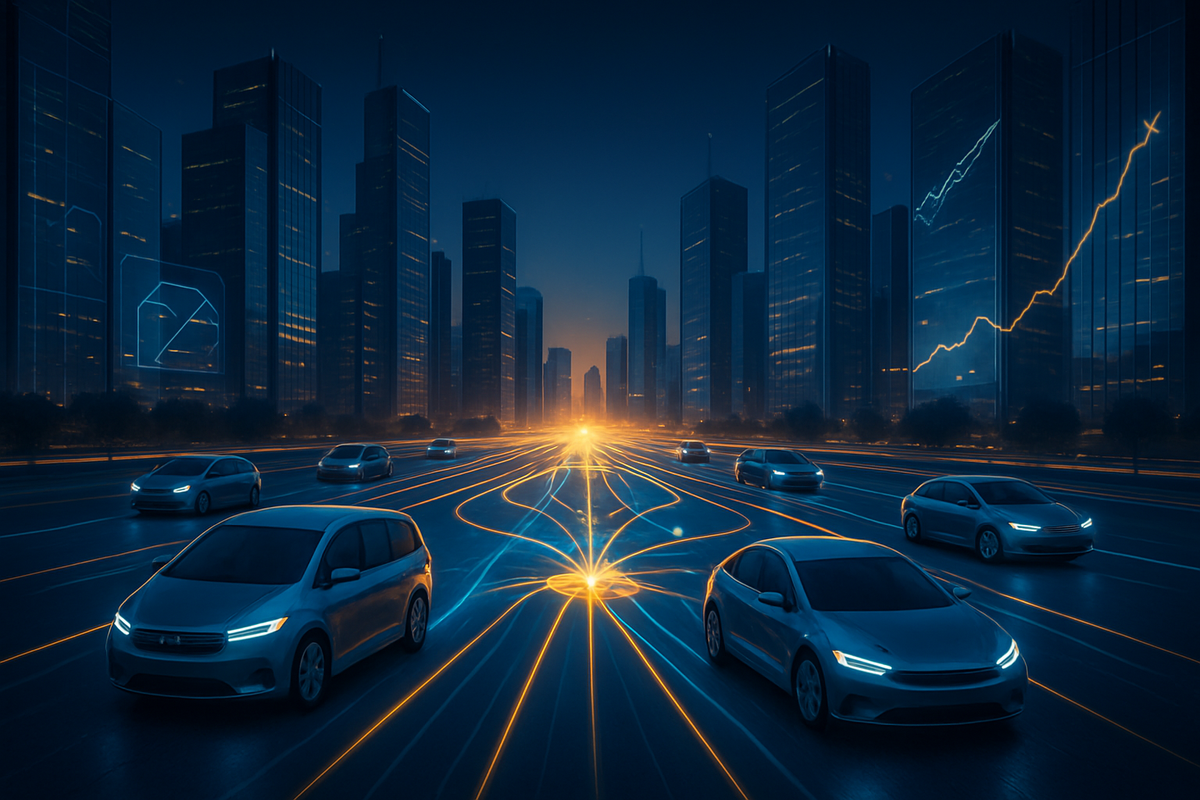
The core of Deutsche Bank’s thesis lies in the concept of the "Uber Operating System" (Uber OS). According to the March 2026 report, Uber has successfully navigated the transition from a logistics company to a multi-layered infrastructure provider. This "OS" leverages Uber’s massive base of over 200 million monthly active platform consumers to provide a guaranteed volume of riders that individual AV manufacturers simply cannot match.
The timeline leading to this dominant position began in earnest back in 2020 when Uber sold its Advanced Technologies Group (ATG) to Aurora Innovation (NASDAQ: AUR). While critics at the time viewed it as a retreat, it is now seen as the masterstroke that allowed Uber to avoid the multibillion-dollar "R&D trap" that has crippled competitors. By early 2026, Uber has solidified partnerships with Alphabet Inc.’s (NASDAQ: GOOGL) Waymo, Amazon.com Inc.’s (NASDAQ: AMZN) Zoox, and even Baidu Inc. (NASDAQ: BIDU), effectively turning its app into a "plug-and-play" marketplace for robotaxi fleets.
The immediate market reaction to Deutsche Bank’s report has been overwhelmingly positive, with Uber’s stock seeing a 4.2% uptick in mid-day trading. Investors are increasingly convinced by the "asset-right" logic: while hardware manufacturers battle high capital expenditures and depreciation, Uber collects a high-margin "take rate" on every autonomous mile driven through its platform.
Winners and Losers: The Great Divergence of 2026
The autonomous revolution of 2026 is creating a sharp divide between those who own the customer and those who own the hardware. Uber stands at the pinnacle of the "winners" circle, joined by Nvidia Corp (NASDAQ: NVDA), whose DRIVE Hyperion platform has become the industry standard for autonomous compute. An expanded 2026 deal between Uber and Nvidia aims to launch autonomous ride-hailing in 28 cities by 2028, further de-risking Uber's long-term growth trajectory.
Alphabet’s Waymo also emerges as a winner, albeit in a symbiotic relationship with Uber. By integrating into the Uber app in key markets like Austin and Atlanta, Waymo has achieved the high utilization rates necessary for profitability, proving that the "Uber demand engine" is the fastest path to scaling.
Conversely, the losers are those who have struggled to bridge the gap between technology and distribution. Tesla Inc. (NASDAQ: TSLA) continues to face headwinds as its dedicated "Cybercab" remains mired in limited pilot production at Giga Texas, with a full commercial launch delayed until late 2026. Tesla’s vision of a proprietary "Tesla Network" currently lacks the geographic density and multi-modal integration (Uber’s mix of cars, bikes, and delivery) that consumers have come to expect. Similarly, General Motors Co. (NYSE: GM) has seen its Cruise division effectively neutralized after a series of safety setbacks in late 2024, forcing the Detroit giant to pivot back toward consumer driver-assist systems rather than a standalone robotaxi fleet.
A Wider Significance: The Commoditization of the Driver
This event signals a broader industry trend toward the commoditization of autonomous hardware. Deutsche Bank notes that as more manufacturers—including BYD Co. (OTC: BYDDF) and Hyundai Motor Co. (OTC: HYMTF)—adopt standardized autonomous platforms, the "vehicle" itself is becoming a secondary consideration to the "network" it operates on.
Regulatory milestones have also cleared the path for this transition. In March 2026, the National Highway Traffic Safety Administration (NHTSA) proposed modernizing Federal Motor Vehicle Safety Standards to explicitly remove requirements for manual controls like steering wheels and pedals in autonomous-only vehicles. This regulatory clarity, combined with the UK's Automated Vehicles Act coming into full effect this spring, has created a "deregulation for innovation" environment that favors incumbents with global reach like Uber.
Historical precedents, such as the rise of the PC industry, offer a stark comparison: while many companies built the hardware, it was the software (Microsoft) and the distribution (Intel) that captured the lion's share of the value. In the world of mobility, Uber is positioning itself as both the software interface and the distribution network.
The Road Ahead: 28 Cities and Beyond
Looking toward the remainder of 2026 and into 2027, Uber is expected to focus on aggressive geographic expansion. The immediate challenge will be integrating diverse AV stacks into a seamless user experience. Short-term, Uber must manage the "hybrid phase" where human drivers still handle peak demand and edge-case routes that AVs cannot yet navigate.
However, the long-term potential for margin expansion is staggering. As Uber gradually replaces the roughly 75% of fare revenue currently paid to human drivers with lower-cost autonomous leases and partnerships, its free cash flow—which hit a record $9.8 billion in 2025—is projected to surge. The strategic pivot required now is not one of engineering, but of logistics: managing the massive physical infrastructure of charging, cleaning, and staging robotaxi fleets in partnership with local operators.
Summary of the Market Shift
The endorsement from Deutsche Bank solidifies a growing consensus: the winner of the autonomous race isn't necessarily the company that builds the smartest car, but the one that makes that car useful to the most people. Uber's evolution into the "Operating System" for mobility provides it with a moat that is increasingly difficult for hardware-centric rivals to cross.
For investors, the coming months will be defined by "utilization metrics" and "partnership density." Watch for Uber’s ability to onboard new AV providers and the pace at which the NHTSA finalizes its "no-steering-wheel" rules. As the "Robotaxi Winter" of the early 2020s gives way to the "Autonomous Spring" of 2026, Uber’s asset-light strategy has turned it into a financial powerhouse that is effectively "future-proofed" against the very disruption that once threatened to destroy it.
This content is intended for informational purposes only and is not financial advice.