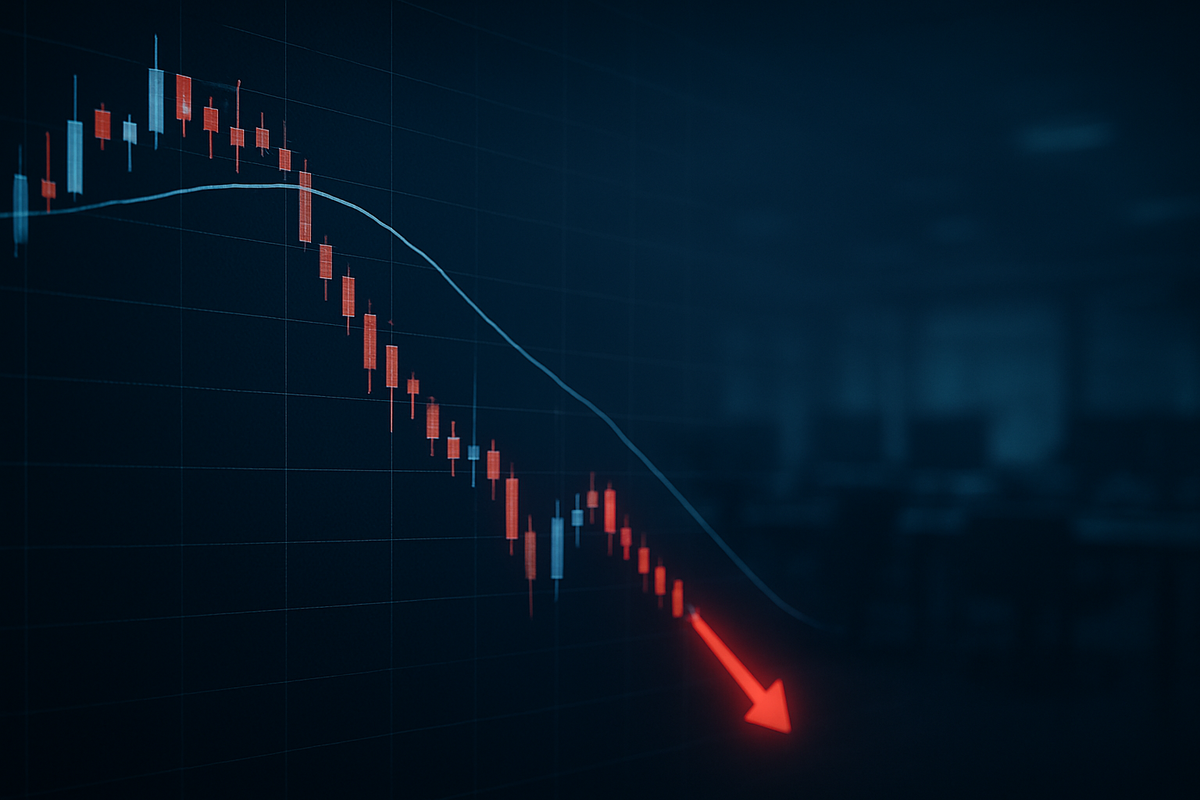
The S&P 500 has officially triggered a "mini death cross," a bearish technical signal where the 20-day moving average crosses below the 50-day moving average, signaling a sharp deterioration in market momentum. This development, occurring in early March 2026, has sent ripples through Wall Street as the index struggles to maintain the historic 7,000 level achieved only weeks ago. For traders and institutional algorithms, this crossover marks a definitive end to the "AI-euphoria" that defined 2025, shifting the market into a defensive posture as former support levels are rapidly converting into formidable overhead resistance.
The immediate implications are significant: systematic and quantitative funds, which rely heavily on trend-following indicators, have begun triggering automated sell programs. As the index slid below its 50-day moving average of 6,838 on March 11, 2026, the technical breakdown accelerated, with the S&P 500 (INDEXSP: .INX) now trading near 6,740. This technical "regime shift" suggests that the "buy the dip" mentality that sustained the market for the past eighteen months is being replaced by "sell the rip," as investors grapple with a cocktail of geopolitical instability and cooling economic data.
A Perfect Storm: From Peak Euphoria to Technical Breakdown
The road to this technical breakdown began in late January 2026, when the S&P 500 hit a psychological milestone by breaching the 7,000 mark. That peak, however, proved to be a "valuation ceiling." By mid-February, a series of macro-economic shocks began to erode the index's foundation. A significant military escalation in the Middle East led to a 36% spike in global oil prices, reviving fears of stagflation. Simultaneously, a disappointing February payrolls report showed unemployment ticking up to 4.3%, forcing the Federal Reserve to pause its anticipated rate-cut cycle.
The timeline reached a critical juncture between March 6 and March 10, 2026, when the 20-day moving average finally dipped below the 50-day average. This "trigger cross" occurred on trading volume 25% above the monthly average, a clear sign of institutional distribution rather than mere retail panic. Key stakeholders, including major hedge funds and Commodity Trading Advisors (CTAs), have pivoted from "net long" to neutral or short positions. The breach of the 6,764 support level on March 11 was the final confirmation many technical analysts needed to declare the short-term bull run over.
Industry reaction has been swift. Analysts at J.P. Morgan (NYSE: JPM) have described the current environment as "valuation saturation," noting that the massive capital expenditures in AI have yet to yield the productivity gains required to justify a 40x Shiller CAPE ratio. The market’s inability to reclaim the 50-day moving average has effectively "trapped" investors who bought the January highs, creating a layer of supply that will likely cap any near-term recovery attempts.
The Great Rotation: Winners and Losers in the Physical Pivot
The technical breakdown has created a stark "K-shaped" divergence in the equity markets. The primary losers are the high-flying "Mega-cap Tech" firms that dominated the 2025 rally. Microsoft (NASDAQ: MSFT) has seen a staggering 17.4% year-to-date decline as cloud revenue growth slowed, while Amazon (NASDAQ: AMZN) fell 13.5% amid concerns over ballooning AI capital expenditures. Even the once-indomitable Nvidia (NASDAQ: NVDA) has slid from its $5 trillion valuation peak, as investors demand tangible proof of ROI from its next-generation Blackwell-2 chips. Software service providers like ServiceNow (NYSE: NOW) and EPAM Systems (NYSE: EPAM) have also been hit hard, as "agentic AI" begins to disrupt traditional seat-based licensing models.
Conversely, a "Physical Pivot" is underway, rewarding companies with tangible assets and defensive cash flows. Energy giants like Exxon Mobil (NYSE: XOM) and ConocoPhillips (NYSE: COP) have emerged as primary beneficiaries of the oil price spike, with Goldman Sachs (NYSE: GS) identifying them as top picks for 2026. The utilities sector has also seen a resurgence; Vistra Energy (NYSE: VST) has outperformed the broader market as it becomes a key power provider for the massive data center clusters powering the AI revolution.
Other winners include industrial and defense stalwarts. Caterpillar (NYSE: CAT) and Lockheed Martin (NYSE: LMT) have bucked the downward trend, buoyed by a $500 billion boost in global defense spending and resilient industrial demand. Defensive staples like Procter & Gamble (NYSE: PG) are once again seeing "safe haven" inflows as investors seek shelter from the volatility of the tech sector. This rotation suggests that while the headline index is suffering, active managers are finding alpha in the "old economy" sectors.
The Canary in the Coal Mine: Broader Significance and Historical Precedents
The 20/50-day "mini death cross" is often viewed as a "canary in the coal mine" for a broader market correction. While it is less severe than the traditional 50/200-day Death Cross, historical precedents from 2015, 2018, and 2022 suggest that such a crossover often precedes an additional 10% to 15% drawdown before a sustainable floor is found. The significance of this event lies in the conversion of support to resistance; the 50-day moving average, which acted as a floor throughout 2025, is now a "ceiling" that must be broken to restore bullish sentiment.
This event fits into a broader industry trend of "momentum exhaustion." After two years of aggressive expansion in AI and technology, the market is undergoing a "necessary recalibration." Strategists at Morgan Stanley (NYSE: MS) suggest this is a "regime shift" where the market is no longer willing to accept "growth at any price." This has regulatory implications as well, as the "Social and Economic Disruption Risk" of AI-driven job displacement begins to enter the political discourse, potentially leading to new taxes or labor protections that could further pressure tech margins.
Furthermore, the ripple effects are being felt in the credit markets. As equity volatility rises, credit spreads have begun to widen, making it more expensive for highly leveraged firms to refinance debt. This creates a feedback loop where technical weakness in the S&P 500 leads to tighter financial conditions, which in turn weighs on corporate earnings expectations.
What Comes Next: Navigating the Tactical Transition
In the short term, the S&P 500 is likely to test the 100-day moving average, currently situated near 6,650. If this level fails to hold, the next major psychological support sits at 6,500. Market participants should watch for a "relief rally" that attempts to retest the 50-day average at 6,838. If the index fails to break above this level on significant volume, it will confirm the transition into a medium-term downtrend.
Long-term, this correction may be viewed as a "healthy wash-out" of speculative excess. BlackRock (NYSE: BLK) analysts note that the underlying economy remains resilient despite the technical breakdown. A strategic pivot toward "Cash-Flow Durability" and "Physical Infrastructure" is expected to be the winning playbook for the remainder of 2026. Potential scenarios include a "sideways grind" where the index consolidates for several months as earnings catch up to valuations, or a "sharper V-shaped recovery" if geopolitical tensions ease and the Fed resumes rate cuts.
Investors should also keep a close eye on the VIX (INDEXCBOE: VIX), which recently hit 30. A sustained move above 35 would signal extreme fear and potentially indicate a capitulation bottom. Conversely, a gradual decline in volatility alongside a stabilization in the "Equal Weight" S&P 500 would suggest that the market is successfully rotating rather than collapsing.
Summary and Outlook for the Coming Months
The appearance of the 20/50-day "mini death cross" in the S&P 500 is a watershed moment for the 2026 market. It marks the transition from a period of unbridled optimism to one of tactical caution. The key takeaway for investors is that the "market of stocks" is becoming more important than the "stock market." While the tech-heavy headline index may struggle under the weight of the "Death Cross," opportunities are emerging in energy, industrials, and defensive staples.
Moving forward, the market’s ability to digest the Iranian conflict and the evolving AI landscape will be paramount. Investors should watch for the "Great Rotation" to continue and for the 6,838 resistance level to serve as the ultimate barometer for market health. If the index can successfully convert this resistance back into support by mid-summer, the bull market may find its second wind. Until then, caution remains the watchword on Wall Street.
This content is intended for informational purposes only and is not financial advice.