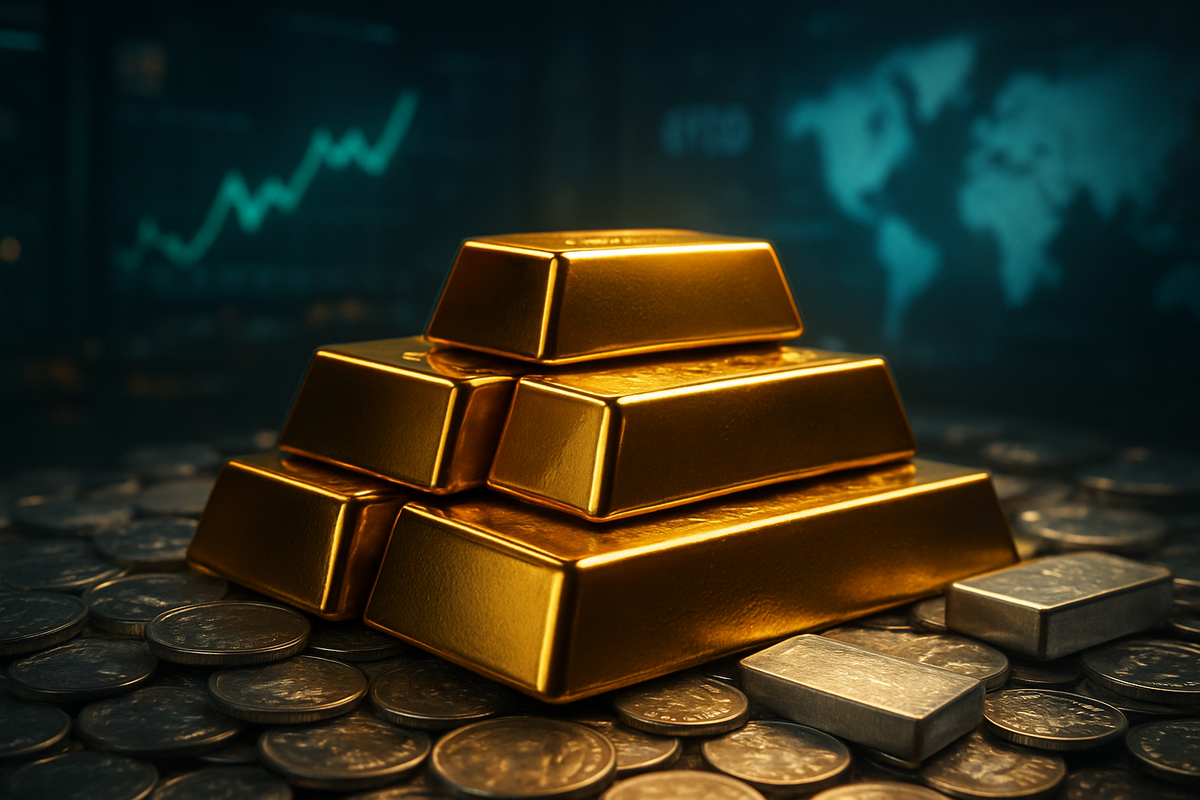
In a move that has rewritten the financial history books, gold prices have surged past the $4,700 per ounce milestone, while silver continues its meteoric ascent toward the elusive $110 mark. This unprecedented rally, peaking in early February 2026, marks a seismic shift in the global financial landscape as investors flee traditional currencies in favor of "hard money." The breach of these psychological barriers has sent shockwaves through Wall Street and global capitals, signaling a profound lack of confidence in the fiat-based monetary system that has dominated the post-war era.
The implications of this surge are immediate and far-reaching. For the first time in history, the total value of gold held by global central banks has surpassed the value of total U.S. Treasury holdings, a symbolic and practical blow to the U.S. Dollar’s status as the world’s primary reserve asset. As the "safe-haven" trade accelerates, the cost of industrial production and jewelry has skyrocketed, creating a dual-track economy where precious metal holders see their wealth soar while consumers face a new wave of commodity-driven inflation.
The path to $4,700 gold and $100 silver was paved by a "perfect storm" of geopolitical and economic triggers throughout 2025 and into the first weeks of 2026. The initial spark was ignited by a renewed wave of tariff threats and trade tensions, primarily between the U.S., China, and the European Union, which disrupted global supply chains and reignited inflationary fears. However, the momentum truly turned parabolic following the nomination of Kevin Warsh as the Federal Reserve Chair in late 2025, which many investors interpreted as a sign of impending political pressure on the central bank to keep interest rates artificially low despite a mounting $38 trillion national debt.
Geopolitical flashpoints have also played a critical role. Tensions surrounding territorial claims in Greenland and the Caribbean, coupled with renewed friction in the Middle East involving Iran, have pushed institutional capital into assets without counterparty risk. By January 2026, the People’s Bank of China (PBOC) was reportedly conducting massive "backdoor" interventions, accumulating over $100 billion in gold in a single month to shield its reserves from potential Western sanctions. This was mirrored by aggressive buying from the National Bank of Poland and the central banks of Brazil and Kazakhstan, who have collectively shifted their reserve portfolios away from sovereign debt toward bullion.
The market reaction has been nothing short of chaotic. Trading platforms for the SPDR Gold Shares (NYSE: GLD) and iShares Silver Trust (NYSE: SLV) saw record-breaking inflows in January, occasionally leading to technical outages as retail "FOMO" (fear of missing out) reached levels not seen since the 2011 rally. In the physical market, premiums for coins and bars reached nearly 30% over the spot price, as bullion dealers struggled to maintain inventory. A brief technical correction in early February saw gold dip from an intraday high of $5,595 back to the current $4,700 level, yet the buying appetite remains voracious on every dip.
The primary beneficiaries of this price explosion are the major mining conglomerates and precious metal streamers. Wheaton Precious Metals (NYSE: WPM) has emerged as a standout winner due to its unique streaming model. By securing fixed-cost purchase agreements for gold and silver years in advance, WPM has seen its margins expand to record levels, with its stock price more than doubling in the last twelve months. Similarly, Newmont (NYSE: NEM), the world’s largest gold producer, has seen its valuation soar as it successfully divested non-core assets to focus on its high-margin "Tier 1" mines.
Barrick Gold (NYSE: GOLD) has also capitalized on the rally, utilizing windfall profits to initiate a massive $1 billion share buyback program. The company’s heavy exposure to copper has provided an additional tailwind, as the industrial metal often rallies alongside silver during periods of infrastructure expansion. Meanwhile, smaller, high-beta silver miners like Pan American Silver (NASDAQ: PAAS) and First Majestic Silver (NYSE: AG) have seen even more dramatic percentage gains, as investors bet on the continued "silver squeeze" toward the $110 level.
On the losing side of this equation are industrial manufacturers and the technology sector. Companies that rely heavily on silver for its conductive properties—such as solar panel manufacturers and electric vehicle producers—are facing a brutal squeeze on their margins. If silver sustains a price above $100, the cost of components for advanced electronics could rise by as much as 15%, potentially forcing price hikes on consumers and slowing the pace of the green energy transition. Traditional banking institutions, heavily invested in long-duration sovereign debt, also face a challenge as the migration toward gold signals a declining appetite for the low-yielding bonds that underpin their balance sheets.
This rally is more than just a price spike; it represents a fundamental realignment of the global financial order. The shift toward gold is a direct response to "de-dollarization," a trend that has accelerated as emerging markets seek to insulate themselves from the weaponization of the U.S. Dollar. The fact that central banks are now prioritizing gold over Treasuries indicates a transition toward a "multipolar" monetary system where hard assets serve as the ultimate arbiter of value.
Historical precedents for this move can be found in the stagflationary 1970s and the post-2008 financial crisis, but the scale of the current movement is unprecedented. Unlike previous rallies, the 2026 surge is backed by a level of sovereign participation that makes it far stickier than a retail-driven bubble. Regulatory bodies are now being forced to reconsider the role of gold in bank capital requirements (Basel III/IV), and there are burgeoning discussions in several nations about returning to a semi-gold-backed currency to restore public trust.
The ripple effects are being felt in the cryptocurrency market as well. While "Digital Gold" (Bitcoin) initially rallied alongside bullion, the physical metal has outperformed in early 2026, suggesting that in times of extreme geopolitical peril, investors still prefer an asset they can physically hold. This has led to a regulatory crackdown on "paper gold" and synthetic derivatives, as authorities attempt to ensure that the spot market remains transparent and backed by actual physical delivery.
Looking ahead, the market enters a phase of "price discovery" where volatility will likely remain the norm. In the short term, if silver successfully breaches and holds the $110 level, it could trigger another wave of technical buying that targets even higher multiples. However, the "mania" phase of the market suggests that a period of consolidation is necessary to build a new base. Strategic pivots will be required for industrial users, who may begin aggressively searching for silver substitutes or investing in recycling technologies to mitigate the impact of triple-digit prices.
For the mining sector, the challenge will be managing the "resource nationalism" that often follows a price boom. As gold and silver become more valuable, host governments in mining-heavy jurisdictions may seek to increase royalties or nationalize assets to bolster their own reserves. Companies with diverse geographic footprints and strong ESG (Environmental, Social, and Governance) scores will be better positioned to navigate these political headwinds.
The surge of gold to $4,700 and silver toward $110 is a definitive marker of the mid-2020s economy. It highlights a "perfect storm" of waning trust in fiat currencies, escalating geopolitical strife, and a strategic pivot by the world’s most powerful central banks. The psychological barriers that have been broken—specifically the triple-digit silver price—signify that the market has entered a new era where traditional valuation models may no longer apply.
Moving forward, the market will be characterized by a "wait-and-see" approach regarding the Federal Reserve’s response to this currency devaluation. Investors should watch for signs of central bank "gold fatigue" or, conversely, a move toward a formal international gold agreement similar to the historical Bretton Woods. For now, the "Golden Renaissance" shows no signs of abating, and the allure of precious metals as the ultimate store of value has never been stronger in the eyes of the global public.
This content is intended for informational purposes only and is not financial advice.