WASHINGTON D.C. — The global financial order was pushed to the brink this morning, January 12, 2026, as the U.S. dollar plummeted following an unprecedented legal assault by the Department of Justice against the Federal Reserve. The greenback, already weakened by a year of fiscal uncertainty, fell sharply in early trading as investors reacted to news that the DOJ has served criminal subpoenas to Fed Chair Jerome Powell, signaling a total breakdown in the traditional wall between the executive branch and the nation’s central bank.
The immediate implications are stark: the U.S. Dollar Index (DXY) has dropped to its lowest level in nearly a decade, while the yield on the 10-year Treasury note has spiked to 4.20%. Markets are now pricing in a "political risk premium" on American assets, fearing that the Fed's ability to manage inflation and interest rates is being compromised by a criminal inquiry that many analysts describe as a pretext for political control.
The Subpoena Shock: A Timeline of the Crisis
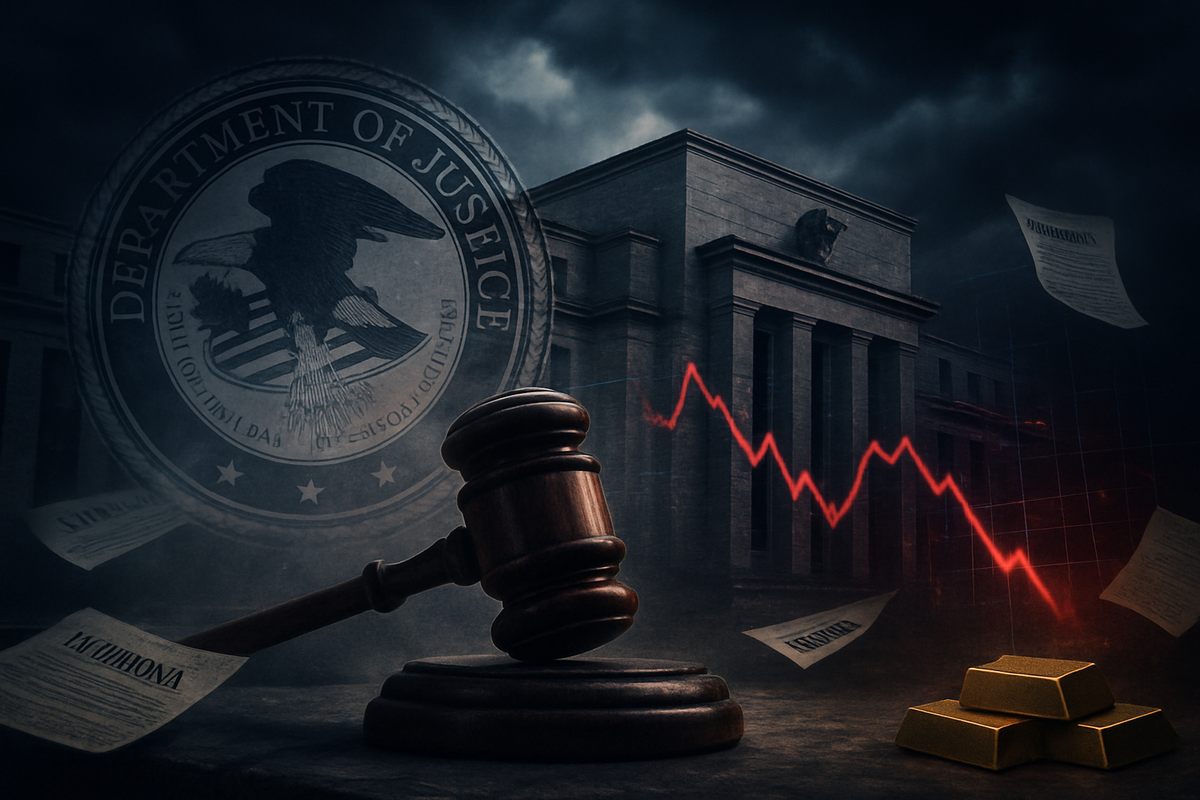
The crisis reached a boiling point on Friday, January 9, 2026, when Attorney General Pam Bondi and U.S. Attorney Jeanine Pirro announced a grand jury investigation into alleged "criminal perjury and mismanagement" at the Federal Reserve. The investigation officially centers on the $2.5 billion renovation of the Marriner S. Eccles Building—the Fed’s headquarters—which saw costs balloon by over $600 million. The DOJ alleges that Chair Powell misled the Senate Banking Committee regarding the inclusion of "extravagant" features, including custom marble finishes and VIP suites.
However, the narrative shifted dramatically on Sunday night, January 11, when Chair Powell released a defiant video statement. In it, he characterized the investigation as a "mere pretext" designed to force the Fed into a massive 200-basis-point interest rate cut. Powell argued the move was a retaliatory strike by the administration of President Donald Trump, intended to bypass the central bank’s independence and fuel a pre-election economic surge. This public defiance by a sitting Fed Chair against the Department of Justice has no modern precedent, effectively creating a constitutional standoff over the control of the nation's money supply.
The market reaction was swift and brutal. By the time Asian markets opened on Monday, January 12, the "Sell America" trade was in full swing. Dow Jones Industrial Average futures fell over 400 points, and international capital began a frantic rotation out of dollar-denominated assets. Key stakeholders, including Senator Thom Tillis (R-NC), have already signaled a legislative impasse, vowing to block all future administration nominees until the DOJ's "interference" in monetary policy is resolved.
Winners and Losers in a Devaluing Dollar Environment
In the wake of the DOJ’s inquiry, a clear divide has emerged between companies positioned to thrive on dollar debasement and those crippled by institutional instability. Newmont Corporation (NYSE: NEM) and Barrick Gold (NYSE: GOLD) have emerged as the primary beneficiaries, as spot gold prices surged toward $4,600 per ounce. Investors are treating gold as the ultimate "safe harbor" from a politically compromised currency. Similarly, royalty firms like Franco-Nevada (NYSE: FNV) are seeing record interest, as they capture the upside of rising bullion prices without the operational risks associated with traditional mining.
Major U.S. exporters are also finding a silver lining in the dollar's decline. Boeing (NYSE: BA) has seen a renewed competitive edge against its European rivals, as a weaker dollar makes its aircraft significantly cheaper for international carriers. Consumer staples giants like Coca-Cola (NYSE: KO) and McDonald’s (NYSE: MCD), which derive more than half of their revenue from overseas, are expected to report a significant "jolt" to their bottom lines as foreign earnings are converted back into a devalued U.S. dollar.
Conversely, the financial sector is reeling. JPMorgan Chase (NYSE: JPM) and Citigroup (NYSE: C) are facing a massive exodus of international capital, as foreign sovereign wealth funds reconsider the safety of U.S. banking institutions. Retailers and importers are also under immense pressure; Walmart (NYSE: WMT) and Gap (NYSE: GPS) are seeing their margins squeezed by the rising cost of foreign goods. Perhaps most surprising is the hit to Tesla (NASDAQ: TSLA), which is suffering from "silver-flation"—as silver prices hit $84 per ounce alongside gold, the cost of raw materials for Tesla’s power management systems has created a multi-billion dollar headwind for the EV maker.
A Dangerous Precedent for Central Bank Autonomy
The current conflict echoes the darkest chapters of Fed history, but with a modern, more litigious twist. Historically, Presidents like Lyndon B. Johnson and Richard Nixon used personal pressure to influence monetary policy. In 1965, LBJ famously shoved Chair William McChesney Martin against a wall at his Texas ranch, demanding more money for the Vietnam War. In the early 1970s, Nixon successfully pressured Arthur Burns to "goose" the economy for the 1972 election, a move that eventually led to the "Great Inflation" of the late 70s.
However, the 2026 scenario is different because it utilizes the legal machinery of the state—the DOJ—to achieve political ends. This shift from "backroom arm-twisting" to "grand jury subpoenas" suggests a fundamental change in the U.S. regulatory landscape. If the Federal Reserve loses its perceived independence, the "inflation anchor" that has stabilized the global economy for decades could vanish. The ripple effects are already being felt by international partners; the Euro and the Indian Rupee have seen sharp gains as capital flees the perceived systemic risk of a "politicized" Federal Reserve.
The Road Ahead: Scenarios and Strategic Pivots
In the short term, the market will likely remain in a state of high volatility as the legal battle between Powell and the DOJ plays out in the courts. If the administration succeeds in forcing Powell out before his term expires in May 2026, we may see a rapid appointment of a more "compliant" Chair. This would likely lead to the 200-basis-point rate cut the administration desires, potentially sparking a short-term rally in equities but at the cost of long-term hyperinflationary risks.
Strategic pivots are already underway. Multi-national corporations are increasingly looking to diversify their cash reserves away from USD and into a basket of currencies or "hard assets." We may also see a rise in "barter-style" international trade agreements that bypass the dollar entirely, a trend that would accelerate the de-dollarization efforts already being pushed by the BRICS nations. For the Federal Reserve, the challenge will be maintaining internal morale and operational integrity while its leadership is under criminal investigation.
Final Takeaways for the Global Market
The events of January 12, 2026, mark a turning point in American financial history. The primary takeaway for investors is that the "institutional stability" of the United States can no longer be taken for granted. The "Sell America" trade is not just a reaction to a weak dollar, but a vote of no confidence in the autonomy of the world’s most important financial regulator.
Moving forward, the market will be hyper-focused on two things: the legal proceedings against Chair Powell and the yields on U.S. Treasuries. If yields continue to climb despite the Fed's efforts to keep them low, it will signal that the bond market has lost faith in the government's ability to manage its debt without inflating it away. Investors should watch for a continued rotation into gold, silver, and high-quality international exporters as a hedge against a potentially prolonged period of domestic political and monetary instability.
This content is intended for informational purposes only and is not financial advice.