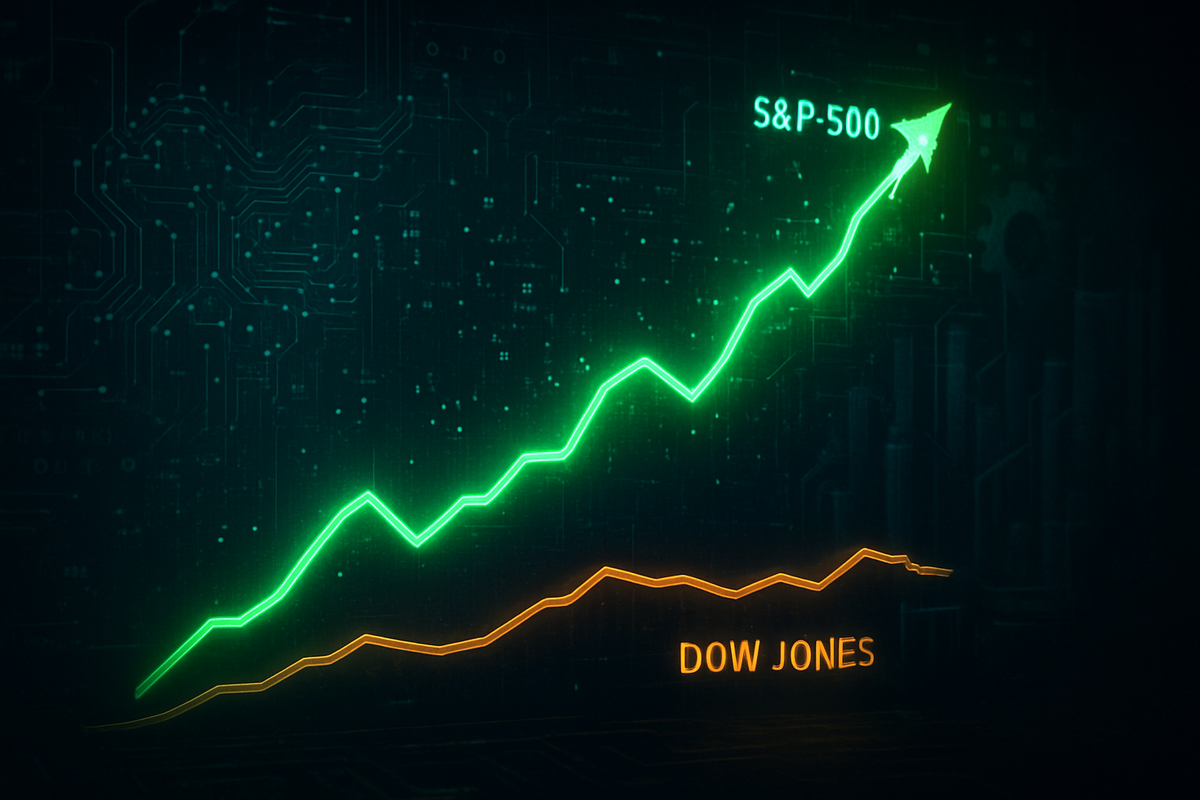
As 2025 draws to a close, the U.S. equity markets are finishing a year defined by record-breaking highs, yet a significant rift has formed between the two most watched barometers of American prosperity. The S&P 500, bolstered by a relentless surge in artificial intelligence and semiconductor demand, has outpaced the Dow Jones Industrial Average by a margin not seen since the height of the post-pandemic recovery. While the S&P 500 surged nearly 19% to flirt with the historic 7,000 level, the Dow struggled to keep pace, posting a more modest 13% gain as it crossed 48,000.
This divergence is more than just a statistical anomaly; it represents a fundamental shift in how the market values growth versus traditional industrial stability. The gap has sparked intense debate among institutional investors regarding market breadth and the risks of a "top-heavy" index. As the S&P 500 benefited from its market-cap-weighted structure, which gives massive influence to trillion-dollar tech titans, the Dow’s price-weighted methodology left it vulnerable to idiosyncratic collapses in high-priced components that failed to catch the AI wave.
A Tale of Two Indices: The 2025 Performance Gap
The year 2025 was a rollercoaster for investors, marked by a dramatic "April Meltdown" that saw the S&P 500 retreat nearly 19% from its peaks following the announcement of "Liberation Day" tariffs—a series of aggressive trade packages that shook global supply chains. However, the recovery that followed was uneven. While technology and growth-oriented sectors rebounded with ferocity, the "old economy" stocks that populate the Dow Jones Industrial Average found the climb much steeper. By mid-summer, the S&P 500 had already reclaimed its losses, driven by a second wave of AI infrastructure spending that expanded beyond chips into storage and cloud networking.
The timeline of this divergence became most apparent during the Q3 earnings season. While the S&P 500's largest components reported record-breaking margins, several Dow stalwarts issued cautious guidance, citing rising labor costs and a cooling consumer. The Federal Reserve's decision to cut interest rates three times throughout the year provided a tailwind for both indices, but the S&P 500—heavily weighted toward growth stocks that benefit more from lower discount rates—captured a disproportionate share of that momentum. By December 31, 2025, the performance gap had widened to roughly 600 basis points, leaving Dow investors questioning the relevance of the 30-stock average in an AI-dominated world.
The Winners and Losers of the AI-Industrial Split
The primary engine behind the S&P 500’s dominance was the continued ascent of the "Magnificent Seven" and a new tier of AI infrastructure providers. Alphabet (NASDAQ: GOOGL) was a standout performer, rising 65% as it successfully integrated generative AI into its core search business and cloud offerings. Nvidia (NASDAQ: NVDA) remained the market's heartbeat, reaching a staggering $5 trillion market capitalization as demand for its Blackwell architecture showed no signs of slowing. Other S&P winners included Oracle (NYSE: ORCL), which surged 42% on massive data center deals, and Western Digital (NASDAQ: WDC), which capitalized on the desperate need for high-capacity AI storage.
Conversely, the Dow was weighed down by a handful of high-priced "anchor" stocks that suffered through a difficult 2025. UnitedHealth Group (NYSE: UNH), which carries significant weight in the price-weighted Dow, saw its shares plummet 33% amid rising medical loss ratios and regulatory headwinds. Nike (NYSE: NKE) also served as a major drag, falling 17% as it struggled to regain its footing against nimble competitors and a deceleration in Chinese consumer spending. Even Salesforce (NYSE: CRM), one of the Dow's tech representatives, underperformed its peers as investors questioned its valuation relative to the hardware-heavy "picks and shovels" winners of the AI era.
Market Breadth and the Wider Significance
The widening gap between the S&P 500 and the Dow offers a stark lesson in market breadth. For much of 2025, the market’s gains were concentrated in a narrow band of technology leaders, leading to concerns that the "average" stock was being left behind. While breadth did begin to improve in the final quarter—with the Russell 2000 and the Dow's financial components showing signs of life—the structural difference in index construction remained the deciding factor. The S&P 500’s market-cap weighting allowed it to ride the momentum of its winners, while the Dow’s price-weighting meant that a single stock's decline, like UnitedHealth's, could offset gains from several other components.
Historically, such a wide divergence has often preceded a period of "mean reversion," where the laggards eventually catch up to the leaders. However, analysts argue that 2025 might be different due to the transformative nature of AI. This event mirrors the late 1990s in its tech-led concentration but differs in that today's leaders are generating massive cash flows. The broader implication for the market is a permanent shift in sector leadership, where traditional manufacturing and healthcare are no longer the primary drivers of index-level returns, potentially forcing a re-evaluation of how "blue chip" stocks are defined.
What Lies Ahead for 2026
Looking into the new year, the primary question for investors is whether the Dow can close the gap. Much will depend on the Federal Reserve’s continued rate trajectory and whether the AI-driven productivity gains begin to manifest in the "old economy" sectors like industrials and consumer staples. If companies in the Dow can successfully integrate AI to lower costs and boost margins, a "catch-up trade" could be the dominant theme of 2026. However, if the concentration in tech continues to intensify, the Dow may require a significant rebalancing of its components to remain a relevant reflection of the modern economy.
Strategic pivots will be necessary for the Dow's laggards. Companies like Nike and UnitedHealth will need to demonstrate clear paths to margin recovery to regain investor confidence. Meanwhile, the S&P 500 faces the challenge of "priced-to-perfection" valuations. Any stumble in the AI narrative could lead to a sharp correction in the very stocks that powered the index to its 7,000 milestone. Investors should watch for a potential rotation into value stocks if the S&P 500’s multiples become unsustainable, which would finally allow the Dow to shine.
Closing Thoughts on a Year of Divergence
The performance of the S&P 500 and the Dow Jones Industrial Average in 2025 has highlighted the growing divide between the digital and physical economies. While the S&P 500’s 19% gain is a testament to the power of technological innovation and the efficiency of market-cap weighting, the Dow’s 13% rise reflects a more sober reality for traditional American industry. The divergence underscores the importance of understanding index construction; in 2025, how an index was weighted mattered almost as much as what was in it.
Moving forward, the health of the market will depend on whether the gains seen in tech can broaden out to the rest of the economy. For investors, the key takeaway from 2025 is that while the "rising tide" of AI lifted many boats, it did not lift them all equally. Monitoring market breadth and the performance of the Dow's industrial and healthcare components will be critical in the coming months to determine if the 2025 divergence was a temporary split or the beginning of a permanent new market regime.
This content is intended for informational purposes only and is not financial advice.