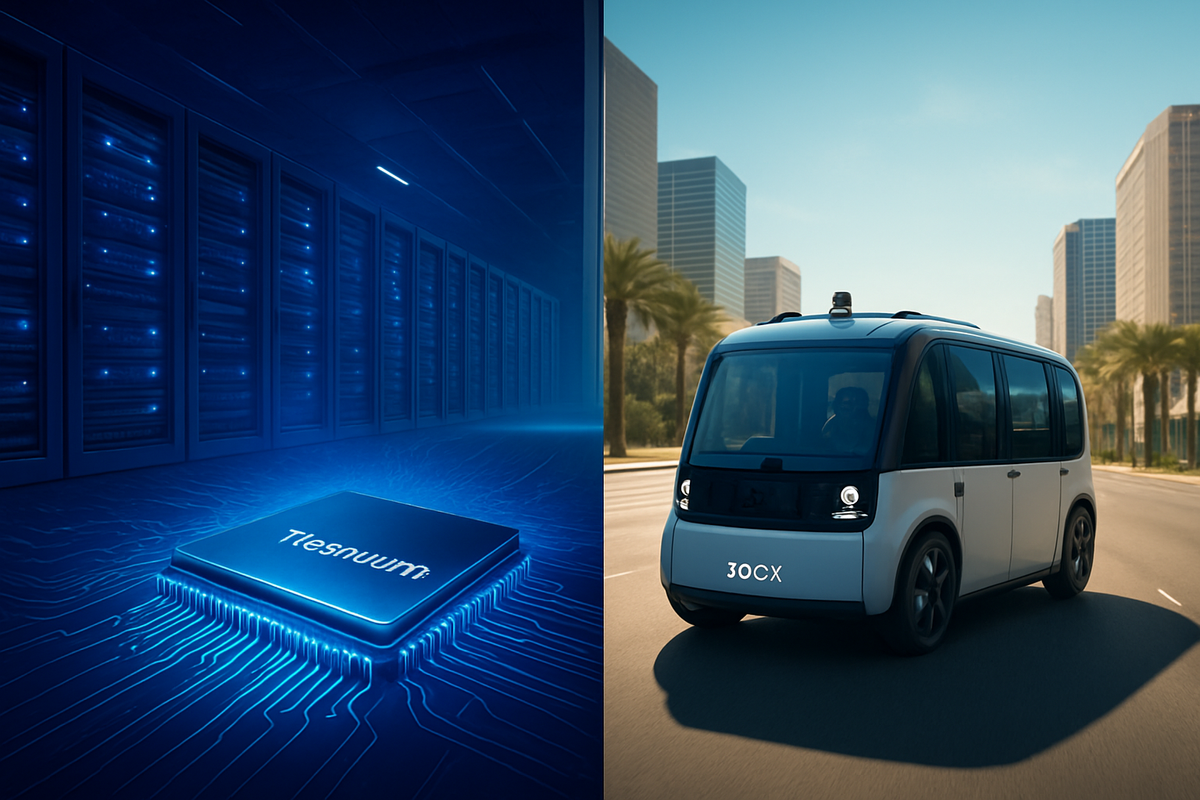
As the final week of 2025 unfolds, Amazon.com, Inc. (NASDAQ: AMZN) finds itself at a pivotal crossroads, transitioning from a year of intensive infrastructure investment to a 2026 narrative defined by commercial scaling. The Seattle-based giant has spent the fourth quarter of 2025 cementing its dominance in the artificial intelligence (AI) arms race via Amazon Web Services (AWS) while simultaneously pushing its autonomous vehicle unit, Zoox, into the public eye. These developments are not merely incremental; they represent a strategic shift where Amazon is no longer just a participant in AI and autonomy but is seeking to become the foundational layer upon which these industries operate.
The immediate implications are profound. By launching next-generation custom silicon and expanding its autonomous "pods" into the streets of major American cities, Amazon is signaling to investors that its high-margin cloud business and its long-shot "Other Bets" are converging. The recent re:Invent 2025 conference and the expansion of Zoox’s pilot programs suggest that the company is preparing for a 2026 where "Agentic AI" and "Mobility as a Service" (MaaS) move from experimental line items to core drivers of shareholder value.
Silicon and Streets: The Late-2025 Blitz
The closing months of 2025 were headlined by the re:Invent conference in early December, where AWS CEO Matt Garman unveiled the Trainium3 UltraServer. Built on a cutting-edge 3nm process, the new silicon offers a staggering 4.4x performance increase over its predecessor, specifically optimized for the massive inference demands of modern generative AI. Perhaps more surprising was the preview of Trainium4, which will feature native NVIDIA NVLink Fusion. This move demonstrates a pragmatic "co-opetition" strategy, allowing AWS customers to blend Amazon’s cost-efficient custom chips with the high-performance GPUs from NVIDIA Corporation (NASDAQ: NVDA). On the software side, the launch of the Amazon Nova 2 model family and "Nova Act"—an agentic AI capable of autonomous browser-based task execution—marks Amazon's entry into the "AI Agent" era, where software doesn't just suggest content but actively completes work.
Simultaneously, Zoox has moved from the laboratory to the pavement. In September 2025, Zoox officially launched its public robotaxi service in Las Vegas, offering free rides to the general public between major resorts on the Strip. This was followed by a November rollout in San Francisco, targeting high-density neighborhoods like SoMa and the Mission District. While these rides remain free for now, the company’s filing for a "555 commercial exemption" with the National Highway Traffic Safety Administration (NHTSA) to deploy up to 2,500 vehicles for paid service indicates that the transition to a revenue-generating model is imminent. This timeline has been years in the making, surviving rigorous internal testing and a mid-2025 safety probe closure that cleared the way for this public debut.
The Competitive Landscape: Winners and Losers
Amazon (NASDAQ: AMZN) stands as the primary beneficiary of this dual-pronged strategy. By reducing its reliance on third-party silicon through Trainium3, AWS is insulating its margins from the high costs of the GPU market. Furthermore, the $38 billion partnership with OpenAI announced in November ensures that the world’s most significant AI workloads remain anchored to AWS infrastructure, a major blow to competitors like Microsoft Corporation (NASDAQ: MSFT) and Alphabet Inc. (NASDAQ: GOOGL). For Microsoft, which has long enjoyed a "first-mover" advantage with OpenAI, Amazon’s late-year surge in custom silicon and agentic services represents a direct challenge to its Azure AI leadership.
Conversely, the rise of Zoox places immense pressure on Tesla, Inc. (NASDAQ: TSLA) and Alphabet’s Waymo. While Tesla continues to refine its "Full Self-Driving" (FSD) software for consumer vehicles, Zoox’s "purpose-built" pod—which lacks a steering wheel or pedals—offers a different vision of urban mobility that bypasses the need for individual car ownership. Waymo remains the incumbent leader in autonomous miles driven, but Amazon’s nearly bottomless pockets and logistical expertise mean Zoox can scale rapidly once regulatory hurdles are cleared. The "losers" in this scenario may be traditional ride-sharing platforms like Uber Technologies, Inc. (NYSE: UBER) and Lyft, Inc. (NASDAQ: LYFT), which face an existential threat if Amazon successfully integrates Zoox into its Prime ecosystem, potentially offering "Prime Moving" as a membership perk.
Broader Industry Trends and Regulatory Ripples
The developments at AWS and Zoox are emblematic of the "Agentic Turn" in the tech industry. We are moving away from chatbots that answer questions and toward agents that execute complex workflows. Amazon's focus on "Nova Act" and "AWS Transform" (a service to modernize legacy code) aligns with a broader trend where AI is being tasked with solving the "technical debt" of the Fortune 500. This shift is likely to trigger new regulatory scrutiny regarding AI autonomy and data privacy, as these agents will require deeper access to personal and corporate systems to function effectively.
In the autonomous vehicle sector, Zoox’s progress reflects a maturing regulatory environment. The NHTSA’s willingness to grant exemptions for vehicles without traditional controls is a historical precedent that will pave the way for other manufacturers. However, the road remains bumpy; Zoox’s voluntary software recall in December 2025, following instances of vehicles stopping in oncoming traffic, serves as a stark reminder that the "edge cases" of autonomous driving remain a significant hurdle. This event mirrors similar challenges faced by Waymo and the now-defunct Cruise, suggesting that while the technology is ready for the public, it is not yet beyond the reach of rigorous, and often disruptive, safety oversight.
The 2026 Horizon: Scaling and Strategy
Looking ahead to 2026, the primary challenge for Amazon will be the transition from "demonstration" to "monetization." For AWS, this means proving that Trainium3 can actually steal significant market share from NVIDIA in the enterprise training space. The success of the "AI Factory" model depends on whether developers find Amazon’s custom ecosystem as easy to use as the industry-standard CUDA platform. If Amazon can successfully lure more frontier model labs onto its own silicon, it will secure a high-margin future that is less sensitive to the cyclical nature of hardware supply chains.
For Zoox, 2026 is the "make or break" year for commercialization. The market is watching for the first paid ride in Las Vegas or San Francisco, which would mark the official start of Amazon’s challenge to the ride-hailing status quo. Strategic pivots may be required if regulatory approval for the 2,500-vehicle fleet is delayed; Amazon might choose to focus more on autonomous middle-mile delivery—integrating Zoox technology into its existing logistics network—as a fallback or parallel revenue stream. The potential for a "Prime-integrated" mobility service remains the ultimate "white whale" for investors, offering a recurring revenue model that could redefine the value of a Prime subscription.
Summary and Investor Outlook
As 2025 draws to a close, Amazon has successfully repositioned itself as a leader in the two most transformative technologies of the decade: Agentic AI and Autonomous Mobility. The late-year blitz of re:Invent and the public rollout of Zoox have provided a clear roadmap for 2026. AWS remains the bedrock of the company, now fortified by custom silicon and a massive partnership with OpenAI, while Zoox represents the high-upside "moonshot" that is finally nearing orbit.
Investors should closely monitor two key metrics in the coming months: the adoption rate of Trainium3 among AWS’s top-tier enterprise clients and the NHTSA’s decision on Zoox’s commercial deployment exemption. While the December software recall for Zoox highlights the ongoing risks of autonomous tech, the broader trajectory suggests that Amazon is successfully building a future where it controls both the digital and physical infrastructure of the modern economy. For the market, the message is clear: Amazon is no longer just a retailer; it is an infrastructure play for the AI age.
This content is intended for informational purposes only and is not financial advice.