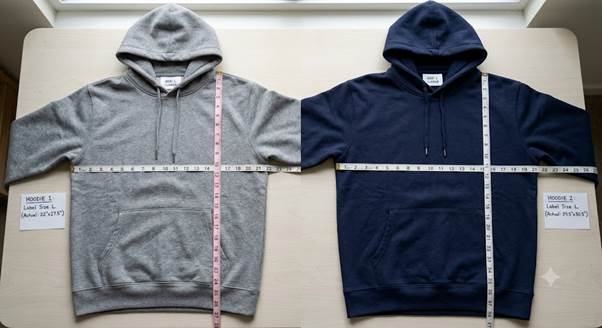
You buy your usual size and it fits perfectly. You buy the same size from another brand and it's a tent, or it's tight across the shoulders, or the sleeves swallow your hands. Nothing about you changed, so it feels like the clothes are gaslighting you. They're not, there are real mechanical reasons a single size number produces wildly different garments. Once you understand them, you stop blaming yourself and start predicting fit before you buy. A cole buxton medium and another brand's medium can be genuinely different garments. Here's what's actually going on.
The Size Number Was Never a Standard
The root of all fit confusion is that clothing sizes have no enforced standard, anywhere. There's no law or industry body defining what "medium" or "size 10" must measure, so every brand decides for itself. That freedom means two garments carrying identical size labels can differ by several centimetres in every dimension. The number is a rough marketing convenience, not a measurement. Brands set their sizing around their own target customer too, so a label aiming at a slim European build cuts smaller than one aiming at a relaxed streetwear fit, even at the same nominal size. Vanity sizing complicates it further, where some brands deliberately label garments smaller than their true measurements because customers feel better buying a lower number. So the same physical garment might be a medium at one brand and a large at another purely for psychological reasons. My honest opinion? The size letter is the least reliable piece of information in the whole transaction, and treating it as meaningful is exactly why people get repeatedly frustrated. The measurement that doesn't lie is the garment's actual dimensions, usually listed as chest width or pit-to-pit. Once you shift your attention from the letter to the centimetres, fit stops being a mystery and becomes something you can check in advance against a piece you already own.
The Pattern Underneath Everything
Every garment is cut from a pattern, and that pattern is where fit is truly decided long before a size label gets attached. The pattern is the template, the set of shapes that get cut from fabric and sewn together, and each brand develops its own. Two brands making a "medium hoodie" start from different templates entirely, so their results differ even when the finished chest measurement happens to match, because the shape of the room is distributed differently. One might put the volume in the body, another in the sleeves. The block is the foundation pattern a brand builds everything from, essentially their house shape, and it reflects assumptions about what a body looks like. A brand whose block assumes broad shoulders and a trim waist produces garments that fit one type of person beautifully and another poorly, regardless of size. That's why you have brands that just seem to fit you and others that never do. Grading is the process of scaling that pattern up and down to create the size run, and different brands grade differently, adding room in different proportions between sizes. So the jump from small to medium at one brand adds width where another adds length. Understanding this explains a lot, since it means "my size" isn't a fixed fact about you, it's a match between your body and a particular brand's assumptions, and finding brands whose block suits you matters more than any size number.
Reading Fit Before You Buy
You can predict how something will fit using a repeatable method. Follow this order:
- Measure a garment you own and love flat, recording chest width, body length, and sleeve length
- Find the product's own measurements on its size chart, in the same flat dimensions
- Compare the numbers directly, ignoring the size letter entirely during this step
- Read the fit description for words like slim, relaxed, or oversized that reveal the intended cut
- Check where the shoulder seam sits on the model, since a dropped seam signals an oversized block
Step three is the whole trick, since matching a garment's chest width to a piece you already know fits removes the guesswork completely. You're no longer trusting a letter, you're matching a measurement to a proven result. Step five catches something numbers miss, because two garments with identical chest widths can still fit differently depending on where the shoulder sits and how the volume is shaped. A dropped shoulder seam sitting on the upper arm tells you the piece is cut oversized on purpose, so your normal size is likely right rather than sizing down. Run these five steps and your online hit rate climbs sharply, because you've replaced hope with comparison.
Why Cut Changes Everything at the Same Size
Beyond brand differences, the intended cut of a garment dramatically changes how a single size fits. A slim-fit and a relaxed-fit piece in the same nominal size are deliberately different garments, since the designer built different amounts of ease into each. Ease is the room added beyond your actual body measurement, and it's a design choice rather than an accident. A slim cut adds minimal ease, sitting close to the body, while an oversized cut adds a lot, hanging away from it. So sizing up on an already-oversized piece overshoots badly, which catches people out constantly. The garment already has the room built in, so adding more turns intentional volume into a costume. Length interacts with this too, since a longer body on the same chest width reads completely differently, and a cropped cut versus a regular cut changes the whole proportion at identical width. Here's the hands-on detail worth knowing: the shoulder seam placement is the single most reliable fit indicator on any top, more than chest or length, because a seam sitting past your natural shoulder point means the whole garment is cut generously and everything else will follow that logic. Check the shoulder first when judging fit from a photo. One honest limitation: even perfect measurements can't fully predict drape, since how fabric falls depends on weight and your own posture and proportions in ways no chart captures, so some trial remains unavoidable with a new brand.
The Details That Quietly Decide Fit
Several less obvious factors shape how a garment sits, and knowing them sharpens your judgement:
● Fabric weight, since heavy fabric hangs away from the body while thin fabric clings and follows every contour
● Fabric stretch, where a little elastane changes how a fitted piece feels far more than the measurements suggest
● Ribbing tightness at cuffs and hem, which gathers the garment and creates the ballooning that reads as intentional
● Shoulder construction, since a set-in sleeve fits differently from a dropped or raglan shoulder at the same size
● Where the hem falls, because the same width reads slim or boxy depending on how long the body runs
Fabric weight does more than people credit, since a heavyweight piece creates its own structure and drapes, while a thin one at identical measurements clings and reveals every lump. So two garments with matching size charts genuinely fit differently based on fabric alone. Ribbing matters too, and firm cuffs and hem let a garment be roomy through the body while staying controlled at the edges, which is what separates a considered relaxed fit from a shapeless one. A dense Hellstar piece behaves differently on the body than a lightweight equivalent even at the same listed dimensions, which is why fabric is part of fit rather than separate from it. My preference is always checking fabric weight alongside measurements, since the two together predict how something sits far better than dimensions alone.
Finding Brands That Fit You
The practical endpoint of all this is discovering which brands suit your particular body and sticking with them. Since fit is a match between your proportions and a brand's block, some brands will consistently work for you and others consistently won't, and that's information worth collecting. So when a brand fits well, note it, because their block matches your shape and future purchases from them are lower-risk. Keep your key measurements saved in your phone, and compare every new brand against them rather than trusting size letters. Track your results over time too, adding a note when something fits well or badly, and within a year you'll have a personal map of which brands run which way. That knowledge compounds and saves both money and returns. Pay attention to your own proportions as well, since if you're long in the torso, body length matters more to you, while broad shoulders make shoulder width your critical measurement. Everyone's key dimension differs slightly, and knowing yours speeds up every decision. Also, don't fight a brand whose block simply doesn't suit you, no matter how much you like the designs, because a fundamentally wrong shape can't be fixed by sizing around it. Find the brands built for a body like yours and dressing gets dramatically easier.
Final Words
The same size fits differently because size was never standardised, every brand cuts from its own pattern, and intended cut builds in wildly different amounts of room. So stop trusting the letter and start comparing measurements against a piece you already know fits. Check the shoulder seam placement, factor in fabric weight and stretch, and read the fit description for the designer's intent. Track which brands suit your body, since fit is a match between your proportions and their assumptions rather than a fixed fact about you. Do that and a confusing, frustrating process becomes a predictable one. The clothes weren't lying. They were just never speaking a standard language.
FAQ BLOCK
Q: Why does my usual size fit differently across brands?
A: Because sizing has no enforced standard. Every brand cuts from its own pattern and grades sizes differently, so two mediums can differ by centimetres. The size letter is a marketing convenience, not a measurement.
Q: What's the most reliable way to predict fit?
A: Measure a garment you own and love flat, then compare its chest width, body length, and sleeve length against the product's size chart. Match the numbers and ignore the size letter entirely.
Q: Why shouldn't I size up on an oversized piece?
A: The room is already built into the cut. Oversized garments add deliberate ease, so sizing up overshoots and turns intentional volume into a costume. Take your normal size on already-relaxed cuts.
Q: What's the best single fit indicator on a top?
A: The shoulder seam placement. A seam sitting past your natural shoulder means the whole garment is cut generously, so everything else follows that logic. It predicts fit better than chest or length alone.
Q: Why do two same-size pieces feel different?
A: Fabric and construction. Heavy fabric hangs away from the body while thin fabric clings, and details like ribbing, sleeve type, and hem length all change how identical measurements actually sit on you.