The advertised weekly rate is only the starting point. Here is what a week aboard a 164-foot yacht in Italian waters actually costs, line by line.
For a certain kind of summer, the headline number is easy to find. A newer 50-meter (164-foot) superyacht cruising the Amalfi Coast or Sardinia typically lists between $150,000 and $300,000 a week, while older yachts of the same length often sell for less. The spread reflects build year, refit history, the crew's reputation and, above all, the calendar.
The advertised rate is not the whole picture, though. Once you add provisioning, taxes, and crew gratuity, the all-in cost of a week in Italian waters typically lands 60% to 70% above the base fee. Knowing this upfront is what separates a well-planned charter from a stressful one, and it is exactly what experienced charterers budget for from day one.
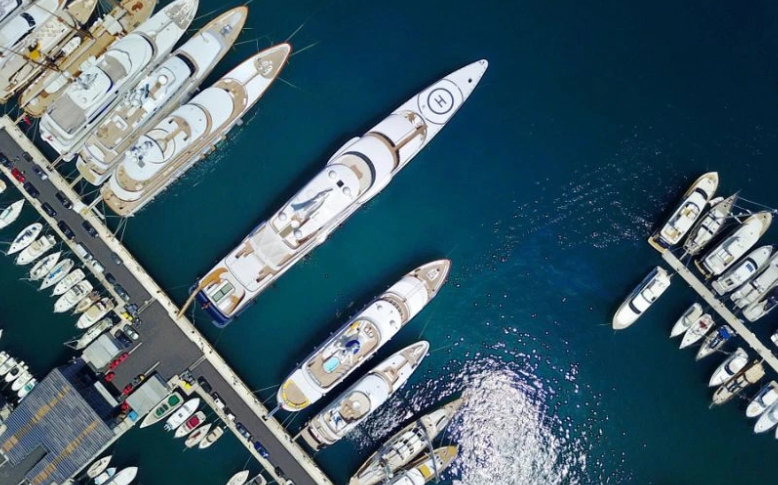
The base charter fee: what the headline rate covers
The base fee pays for the use of the yacht and its full crew for the charter period. On a 50-meter yacht, that usually means about a dozen professionals, from the captain and engineers to the chef, stewards, and deckhands. The fee also covers the crew's wages and the vessel's own insurance.
It does not cover almost everything that keeps the yacht moving and the guests fed. Fuel, food, drinks, marina berths and port fees sit outside the base rate. Rates are set by the owner and, in the Mediterranean, usually contracted in euros under the standard terms of MYBA, the industry's principal charter association.
Season is the single largest lever on the base fee. July and August are the peak months, while June and September offer the same warm water and the same yachts at meaningfully lower rates. For anyone comparing options for a superyacht charter in Italy, the difference between a peak-season and a shoulder-season quote on the same vessel is often tens of thousands of dollars before a single extra is added.
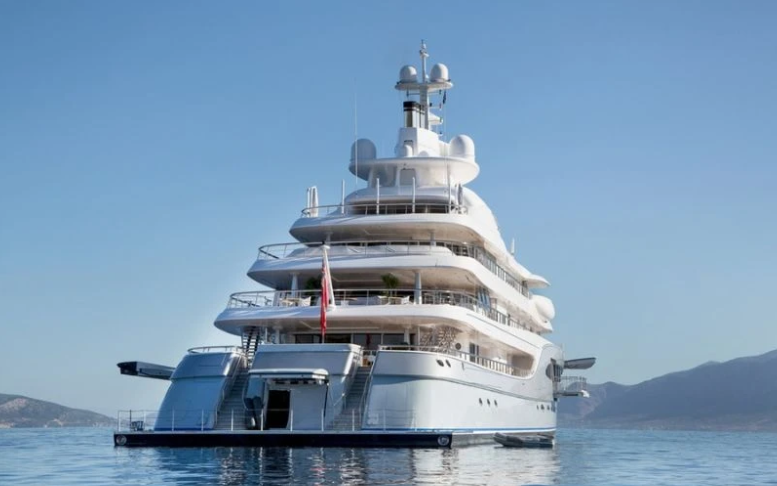
APA: the running-costs budget paid in advance
The Advance Provisioning Allowance, or APA, is best understood as the yacht's running budget for the charter, held on the client's behalf. It is usually set at 35% to 40% of the base fee and paid ahead of embarkation, so that everything the group will enjoy during the week is arranged before they step aboard: fuel, fine food and wines chosen around their tastes, marina berths in the most sought-after harbors, and the practical details that keep the week running smoothly.
What makes APA reassuring rather than a surprise is how it is handled. Every expense is receipted, and the captain presents a full account at the end of the charter. Any unspent balance is returned to the client, and on the rare occasion the week's plans call for more, the budget is simply topped up on board. The pace of the itinerary shapes how much is used: a relaxed week among the Aeolian Islands, with long stops in quiet anchorages, draws on far less fuel than a fast run between Naples and Sardinia.
VAT: how it works in Italy
Value-added tax works differently from US sales tax, and in Italy it is substantial. Since June 2020, Italy has applied its standard 22% VAT rate to charters departing from Italian ports, including any delivery and redelivery fees. This replaced an earlier system of reduced effective rates for yachts cruising partly in international waters.
Time genuinely spent outside EU waters can still reduce the taxable base, with any adjustment calculated after the charter from the yacht's actual route. For a typical Italian itinerary, however, the full rate is the realistic assumption. Other Mediterranean countries differ: France applies 20%, Spain 21% and Croatia 13%, while Greece offers reduced rates for longer charters. The port of departure, not the client's nationality, determines which regime applies.
Crew gratuity: always at the client's discretion
Gratuity is not part of the charter contract, and the amount is always entirely up to the client. It is a personal way of thanking the crew for the week, usually handed to the captain on the final day and shared among the whole team. As a general guide, many charterers choose around 10% to 15% of the base fee, adjusting it based on how they felt about the service. On a 50-meter yacht, where a crew of around a dozen has spent the week anticipating every detail, most guests are happy to include it in their plans from the start.
Delivery and relocation fees
If the chosen yacht is based elsewhere, say on the French Riviera for a charter starting on the Amalfi Coast, the owner may charge a delivery and redelivery fee plus the fuel to reposition the vessel. In Italy, these fees are also subject to VAT. Choosing a yacht already cruising the region, or aligning the embarkation port with its base, removes the line entirely.
A worked example: one week in August versus June
The table below shows an illustrative budget for the same 50-meter yacht in peak and shoulder season. It assumes departure from an Italian port, an itinerary entirely within EU waters, no delivery fee, a fully spent APA at 35%, and gratuities at the low end of the customary range.
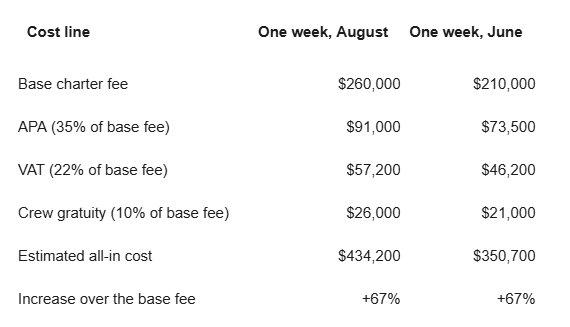
Figures are illustrative and rounded. Actual rates depend on the specific yacht, dates, and itinerary.
The ratio is identical in both scenarios, because every major add-on is calculated as a percentage of the base fee. That's why season matters so much. Moving the same week from August to June saves roughly $83,500 in this example without changing the yacht, the crew, or the destination.
What the money actually buys
Divided among the 12 guests a 50-meter yacht typically accommodates, the August budget above works out to roughly $5,200 per person per night, and about $4,200 in June. High-end travelers will recognize that range from top-tier hotel suites in peak season. The comparison ends there, because what a charter delivers is something no hotel or villa can.
The finest resort on the Amalfi Coast still has other guests, fixed restaurant hours and a view that never changes. Even the most exclusive private villa stays where it is. A superyacht is the only form of travel in which the setting, the schedule and the company are entirely your own. No lobby or reception desk, no one at the next table, and no timetable other than the one the group decides that morning.
That freedom shapes every day on board. Breakfast can be served at anchor off Capri, and lunch in a cove in the Pontine Islands reachable only by sea. If the group falls in love with a bay, the yacht stays; if the wind shifts, the captain finds calmer water. The crew can set up a private beach with loungers, parasols, and a picnic before guests come ashore, rig the inflatable slide from the upper deck for the children, or have the tender waiting to take everyone to a famous waterfront restaurant for dinner and bring them back under the stars. An evening can become a themed party on deck, a birthday dinner cooked around family recipes, or a quiet night of stargazing, all arranged by people whose only job that week is the people on board.
The chef plans menus around each guest's tastes and dietary needs, often sourcing from the local markets of each harbor. Water toys, from jet skis to paddleboards and seabobs, are ready whenever someone wants them. Privacy is total: the only people on board are the group and a professional crew trained to be present when needed and invisible when not.
For families spanning three generations, or friends who rarely manage to be in the same place at the same time, this is what the budget really pays for. It is less a luxury upgrade than a different way of traveling altogether, and for many clients it becomes the one week of the year they plan everything else around.
Currency: a detail worth planning
For US clients, one practical detail is worth keeping in mind. Mediterranean charters are usually contracted in euros, with a deposit at signing and the balance and APA settled a few weeks before embarkation. Since those payments can be spread over several months, the exchange rate between the dollar and the euro may move in the meantime, sometimes in the client's favor, sometimes not.
On a commitment of around €400,000, even a modest 5% shift in the exchange rate can make a difference of roughly €20,000. Many clients simply convert or lock in a rate when they sign, so the budget is settled from the start; others prefer to keep a small margin. A quick conversation with a private banker at booking is usually all it takes to make it one less thing to think about.
How experienced charterers keep the budget under control
Book six to twelve months ahead. The yachts with the most sought-after crews and layouts are often reserved well before the season begins, particularly for July and August. Planning early is less about securing a price than securing the right yacht: one whose cabins suit the group, whose crew matches its style, and whose itinerary fits how it likes to travel.
Book the shoulder season. June and September deliver most of the Italian summer at a lower base fee, which lowers every percentage-based cost with it.
Design the itinerary around pace. Fewer long passages mean less fuel, a smaller APA draw and, often, a more relaxed week.
Choose a yacht already in the region. It avoids delivery fees and the VAT charged on them.
Read the contract before the brochure. Cancellation terms, weather clauses and APA procedures matter as much as the rate.
"Two yachts of the same length and the same price can deliver two completely different weeks," says Giulia Di Leo, founder of YourBoatHoliday, an independent luxury yacht charter brokerage based in Milan. Di Leo, an individual MYBA member and a licensed Italian maritime broker, has spent years inspecting yachts and meeting their crews in person. "What makes the difference is rarely in the specifications. It is how the captain reads the weather and the guests, how the chef adapts to a family with young children, how the layout works when three generations travel together. That knowledge only comes from being on board. At YourBoatHoliday we have a simple way of putting it: the right yacht changes everything, and the right people make it yours."
The bottom line
A realistic budget for a week aboard a 50-meter superyacht in Italy is roughly 1.6 to 1.7 times the advertised base rate, before any currency movement. The good news for disciplined planners is that the largest variables, namely season, itinerary, and where the yacht begins, are all decided at the booking stage. Planned well, the numbers settle early, and what remains is the part no budget captures: private coves, long lunches at anchor and a crew whose only job is the people on board.