Thermo Fisher Scientific Inc. (TMO) is a leading life sciences and technology company that develops and supplies scientific instruments, laboratory equipment, specialty diagnostics, reagents, and biopharmaceutical services used across research, healthcare, and industrial markets worldwide. The company is headquartered in Waltham, Massachusetts, and is growing rapidly through acquisitions and innovation in analytical technologies and laboratory services. Thermo Fisher Scientific’s market cap is around $193.7 billion, making it one of the largest firms in healthcare and diagnostics globally.
Companies worth $10 billion or more are typically referred to as “large-cap stocks.” Thermo Fisher Scientific surpasses this benchmark, highlighting its substantial size, financial stability, and broad influence in the life sciences and medical technology industries. The company has built a dominant presence across research, diagnostics, laboratory equipment, and biopharma services, supported by significant investment in research & development, global operational scale, and strong integrated systems that enhance productivity and quality.
TMO is currently down 19.9% from its 52-week high of $643.99, achieved on Jan. 22. Moreover, shares have plummeted 12% over the past three months, lagging behind the iShares US Medical Devices ETF (IHI), which has declined 7.5% over the same time frame.
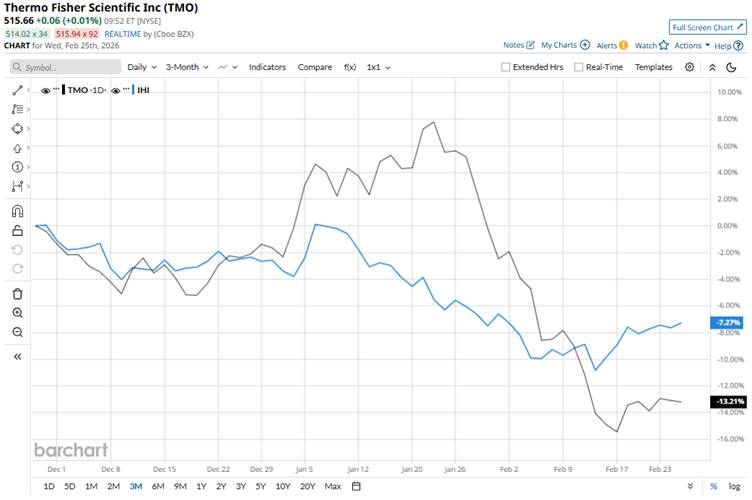
TMO is down 11% on a YTD basis and 3.7% over the past 52 weeks. By contrast, IHI has declined 4.1% in 2026 and 6.8% over the past year.
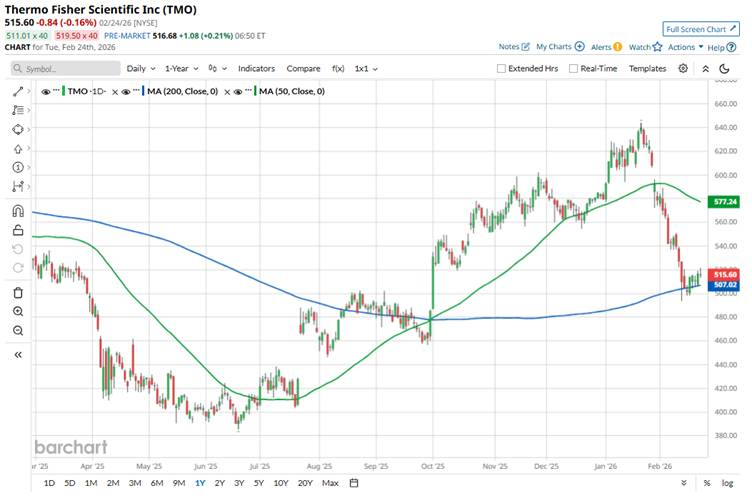
TMO has been trading above its 50-day moving average since early July 2025, but has fallen below the line this month. It has been trading above the 200-day moving average since early October 2025.
Thermo Fisher Scientific’s stock has been under pressure mainly because investors are reacting to cautious guidance despite solid earnings beats. The company beat expectations in its Q4 2025 earnings with revenue of about $12.2 billion (7% year-over-year growth) and adjusted EPS of $6.57 (8% growth), topping Wall Street estimates, and full-year 2025 revenue grew 4% to around $44.6 billion.
However, its 2026 outlook came in somewhat cautious with management guiding growth of 4% to 6% to around $46.3 billion to $47.2 billion in revenue and adjusted EPS around $24.22 to $24.80, which was below expectations and reflects pressure from cuts in academic research funding and slower biotech demand.
In comparison, its competitor IDEXX Laboratories, Inc. (IDXX) shares are down just 4% YTD and a 40% surge over the past 52 weeks.
Despite weak price performance, analysts are highly optimistic about its prospects. The stock has a consensus rating of “Strong Buy” from 23 analysts covering it, and the mean price target of $668.52 indicates a 29.7% upside.
On the date of publication, Subhasree Kar did not have (either directly or indirectly) positions in any of the securities mentioned in this article. All information and data in this article is solely for informational purposes. For more information please view the Barchart Disclosure Policy here.
More news from Barchart
- Cathie Wood Is Buying Up AMD Stock. Should You?
- This Earnings Season, Remember Warren Buffett’s Message That ‘Beating Expectations’ Is ‘Disgusting’ and ‘One of the Shames of Capitalism’
- GE Aerospace Is Linking Up with Palantir. Should You Buy GE Stock Here?
- Okta Stock Is Down 20% in 2026. Can It Survive the Software Apocalypse?