
As the Q1 earnings season comes to a close, it’s time to take stock of this quarter’s best and worst performers in the online marketplace industry, including Instacart (NASDAQ: CART) and its peers.
Marketplaces have existed for centuries. Where once it was a main street in a small town or a mall in the suburbs, sellers benefitted from proximity to one another because they could draw customers by offering convenience and selection. Today, a myriad of online marketplaces fulfill that same role, aggregating large customer bases, which attracts commission-paying sellers, generating flywheel scale effects that feed back into further customer acquisition.
The 12 online marketplace stocks we track reported a satisfactory Q1. As a group, revenues beat analysts’ consensus estimates by 1.7% while next quarter’s revenue guidance was in line.
In light of this news, share prices of the companies have held steady as they are up 1.8% on average since the latest earnings results.
Instacart (NASDAQ: CART)
Powering more than one billion grocery orders since its founding, Instacart (NASDAQ: CART) is an online grocery shopping and delivery platform that partners with retailers to help customers shop from local stores through its app or website.
Instacart reported revenues of $1.02 billion, up 13.6% year on year. This print exceeded analysts’ expectations by 1.2%. Overall, it was a strong quarter for the company with an impressive beat of analysts’ EBITDA and revenue estimates.
"Q1 was a milestone quarter — surpassing $10 billion in GTV and $1 billion in total revenue for the first time. These results prove that our strategy is working. We're the leading grocery technology platform, delivering a best-in-class consumer experience, powering retailers across marketplace and enterprise, and operating a scaled ads ecosystem," said Chris Rogers, CEO.
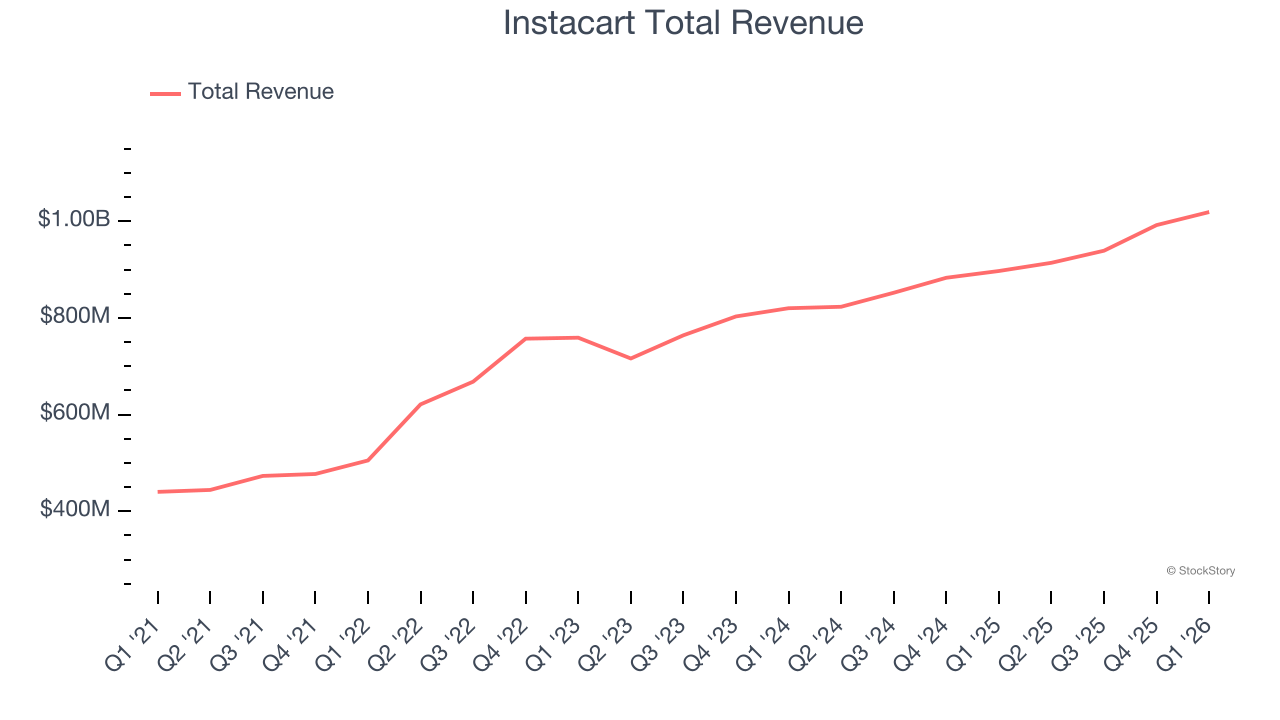
Investor expectations, however, were likely higher than Wall Street’s published projections, leaving some wishing for even better results (analysts’ consensus estimates are those published by big banks and advisory firms, not the investors who make buy and sell decisions). The stock is down 3.5% since reporting and currently trades at $42.20.
We think Instacart is a good business, but is it a buy today? Read our full report here, it’s free.
Best Q1: Sea (NYSE: SE)
Founded in 2009 and a publicly traded company since 2017, Sea (NYSE: SE) started as a gaming platform and has since expanded to offer a variety of services such as e-commerce, digital payments, and financial services across Southeast Asia.
Sea reported revenues of $7.33 billion, up 43.2% year on year, outperforming analysts’ expectations by 9.9%. The business had a stunning quarter with a solid beat of analysts’ EBITDA and revenue estimates.
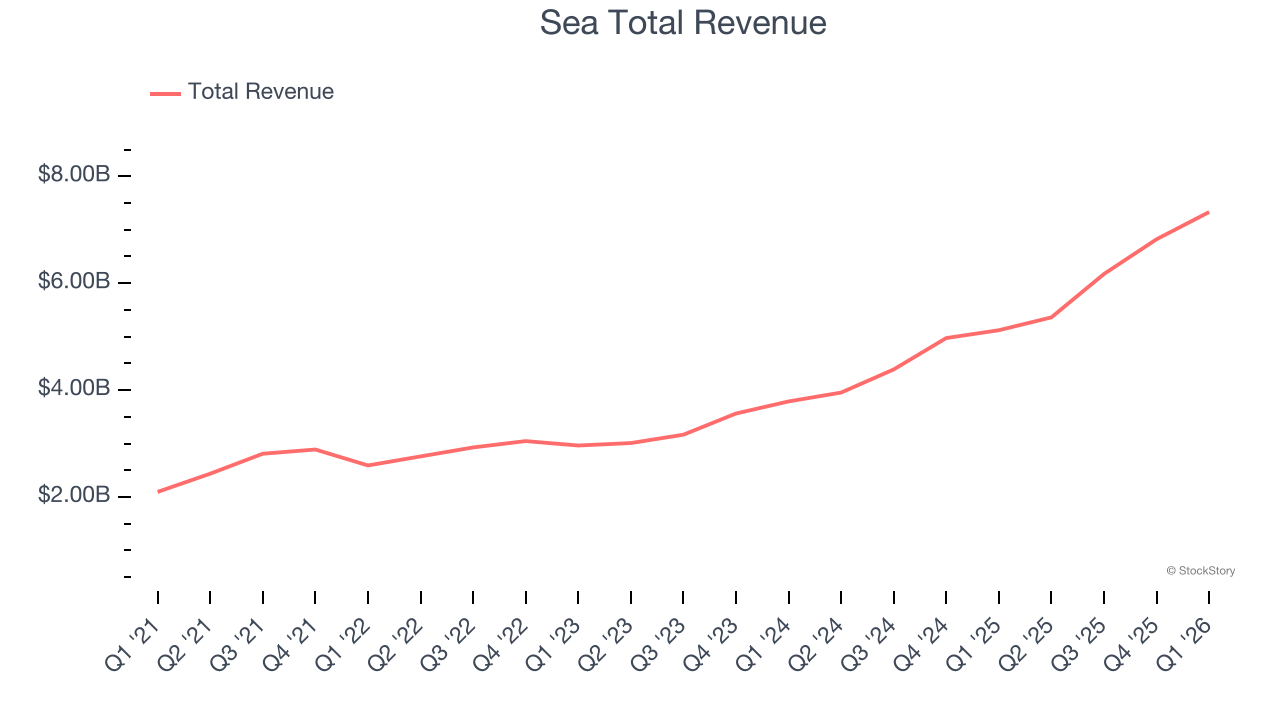
Sea delivered the biggest analyst estimate beat among its peers. The company reported 72.6 million users, up 12.4% year on year. The market seems content with the results as the stock is up 2% since reporting. It currently trades at $86.58.
Is now the time to buy Sea? Access our full analysis of the earnings results here, it’s free.
Weakest Q1: Shutterstock (NYSE: SSTK)
Originally featuring a library that included many of founder Jon Oringer’s photos, Shutterstock (NYSE: SSTK) is now a digital platform where customers can license and use hundreds of millions of pieces of content.
Shutterstock reported revenues of $199.2 million, down 17.9% year on year, falling short of analysts’ expectations by 10.2%. It was a disappointing quarter as it posted a significant miss of analysts’ revenue and EBITDA estimates.
Shutterstock delivered the weakest performance against analyst estimates and slowest revenue growth in the group. As expected, the stock is down 20.7% since the results and currently trades at $13.98.
Read our full analysis of Shutterstock’s results here.
Etsy (NYSE: ETSY)
Founded by a struggling amateur furniture maker Robert Kalin and his two friends, Etsy (NYSE: ETSY) is one of the world’s largest online marketplaces, focusing on handmade or vintage items.
Etsy reported revenues of $631.3 million, up 3.1% year on year. This number surpassed analysts’ expectations by 2.4%. It was a strong quarter as it also recorded a solid beat of analysts’ EBITDA and revenue estimates.
The stock is up 13.3% since reporting and currently trades at $71.62.
Read our full, actionable report on Etsy here, it’s free.
CarGurus (NASDAQ: CARG)
Bringing transparency to a sometimes opaque process, CarGurus (NASDAQ: CARG) is a digital marketplace where auto dealers can connect with potential customers and where car buyers can browse, purchase, and obtain financing.
CarGurus reported revenues of $243.6 million, up 14.8% year on year. This print was in line with analysts’ expectations. Overall, it was a strong quarter as it also put up a solid beat of analysts’ EBITDA estimates and EBITDA guidance for next quarter topping analysts’ expectations.
The company reported 34,596 users, up 6.9% year on year. The stock is down 26.9% since reporting and currently trades at $27.89.
Read our full, actionable report on CarGurus here, it’s free.
Market Update
Late in 2025 into early 2026, there was hand-wringing around artificial intelligence. For software companies, the fear was that AI would erode pricing power and compress margins as new tools made it easier to replicate what once required expensive enterprise platforms. Crypto investors had their own version of the same anxiety: if AI agents could trade, allocate capital, and manage wallets autonomously, what exactly was the long-term value of today’s crypto infrastructure?
These concerns triggered a noticeable rotation away from these sectors and into safer havens. But markets rarely dwell on one narrative for long. Spring 2026 came, and the focus shifted abruptly from technological disruption to geopolitical risk. The US’ conflict with Iran became the dominant driver of market psychology, and when geopolitics takes center stage, the script changes quickly. Investors stop debating growth rates and start worrying about oil supply, inflation, and global stability.
Want to invest in winners with rock-solid fundamentals? Check out our Hidden Gem Stocks and add them to your watchlist. These companies are poised for growth regardless of the political or macroeconomic climate.
StockStory’s analyst team — all seasoned professional investors — uses quantitative analysis and automation to deliver market-beating insights faster and with higher quality.