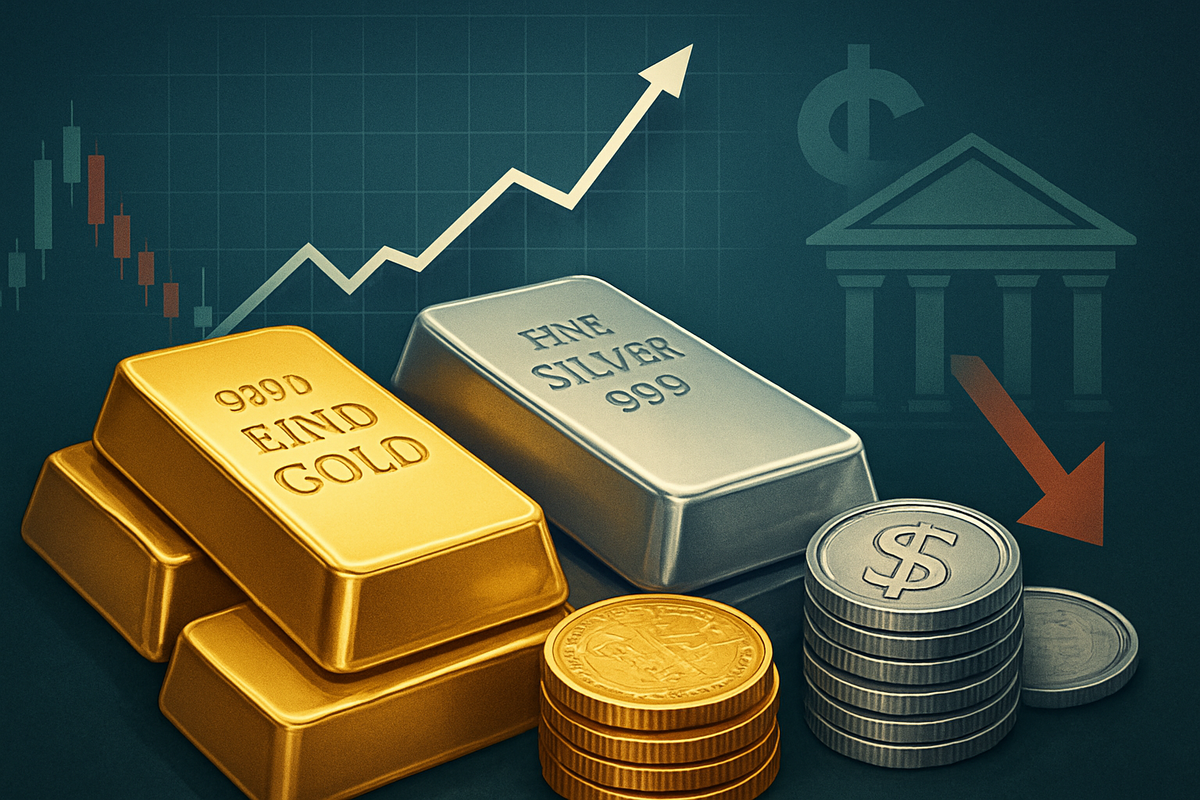
December 1, 2025 – The financial markets witnessed a significant rally today as gold prices climbed to a six-week high, while silver soared to an unprecedented all-time record. This surge in precious metals is largely attributed to mounting expectations of a U.S. interest rate cut by the Federal Reserve and a weakening U.S. dollar, signaling a potential shift in global monetary policy and investor sentiment.
The impressive performance of gold and silver underscores a broader market inclination towards safe-haven assets amidst economic uncertainties and a dovish outlook from central bankers. Investors are increasingly positioning themselves for a period of lower interest rates, which typically diminishes the appeal of holding interest-bearing assets and boosts the attractiveness of non-yielding commodities like gold and silver.
Precious Metals Ascend: A Detailed Look at the Market Rally
On Monday, December 1, 2025, spot gold prices were observed trading between approximately $4,240.55 and $4,255.98 per ounce, marking a significant six-week peak. Concurrently, U.S. gold futures for February delivery saw gains, pushing prices into the range of $4,278.40-$4,290.70. However, the true showstopper was silver, which not only touched an all-time peak of $57.86 per ounce but also settled robustly in the range of $57.39 to $57.77 per ounce, solidifying its record-breaking performance.
The timeline leading up to this moment has been characterized by a series of economic indicators and central bank communications that have collectively fueled expectations of a December rate cut by the Federal Reserve. Recent softer U.S. economic data, coupled with dovish remarks from influential Federal Reserve policymakers such as Governor Christopher Waller and New York Fed President John Williams, have been pivotal. These developments have led markets to price in an 87% to 88% probability of a 25-basis-point rate reduction, significantly impacting currency and commodity markets.
A key player in this scenario is the U.S. dollar, which experienced a notable decline, slipping to a two-week low against a basket of major currencies. A weaker dollar makes dollar-denominated commodities more affordable for international buyers, thereby stimulating demand. Beyond monetary policy, increased market jitters stemming from concerns in the Japanese bond market and broadly weaker global equity markets have also spurred safe-haven demand, channeling capital into precious metals. Speculation surrounding a potential shift in Federal Reserve leadership, with U.S. President Donald Trump indicating a nominee who might favor lower rates, further contributed to the bullish sentiment.
Initial market reactions have been overwhelmingly positive for precious metal investors, reflecting strong confidence in gold and silver as hedges against economic uncertainty and currency fluctuations. Analysts like UBS's Giovanni Staunovo have already projected gold to potentially reach $4,500 per ounce and silver to hit $60 per ounce in 2026, signaling sustained momentum. The weaker dollar and risk-off sentiment also had ripple effects, contributing to higher prices in other commodities like copper, further highlighting the interconnectedness of global markets.
Corporate Fortunes Shine: Miners and Streamers Reap Rewards from Soaring Prices
The dramatic ascent of gold and silver prices has created a clear distinction between winners and those facing headwinds within the public markets. Unsurprisingly, companies directly involved in the extraction and financing of precious metals are poised to be the primary beneficiaries, experiencing substantial boosts to their revenues, profits, and stock valuations. The year 2025 has already seen gold prices advance by 57% to over $4,100 per ounce and silver jump 78% to $51.5 per ounce, setting the stage for exceptional performance across the sector.
Gold and silver mining companies stand as the most direct winners. Higher commodity prices translate immediately into increased revenue per ounce sold, significantly expanding profit margins, especially when production costs remain stable. This operational leverage allows profits to outpace the rise in metal prices, generating robust cash flows that can be channeled into debt reduction, exploration, and shareholder returns through dividends or buybacks. Leading gold miners like Barrick Gold Corporation (NYSE: GOLD; TSX: ABX) have reported "explosive growth" in 2025, with revenues hitting approximately $14.604 billion for the trailing twelve months ending September 30, 2025, an 18.39% increase year-over-year. Net earnings for Q3 2025 soared by 62% to $1.3 billion, and the company increased its base quarterly dividend by 25%. Similarly, Newmont Corporation (NYSE: NEM; ASX: NEM) has seen its profit margins expand to multi-year highs, delivering 1.4 million attributable gold ounces and generating a record $1.6 billion in free cash flow in Q3 2025. Its stock has rallied significantly, with a +73% increase since a previous "Buy" rating. Kinross Gold Corporation (NYSE: KGC; TSX: K) reported a 42% year-over-year revenue increase in Q2 2025 to $1,728.5 million, with margins up 68%, and its stock returning 198.28% year-to-date. Alamos Gold Inc. (NYSE: AGI; TSX: AGI) also demonstrated strong operating leverage, with a 32% revenue increase and 58% adjusted net earnings rise in 2024 despite only a 7% production increase.
Silver miners are experiencing similar tailwinds. Hecla Mining Company (NYSE: HL), a prominent silver producer, saw its profitability surge in 2025 due to higher prices and cost management, achieving a gross profit margin of nearly 50% in the LTM ending Q3 2025. The company reported record quarterly revenue of approximately $409.5 million in Q3 2025, with silver contributing 48% of that. Hecla's share price surged by 175% from November 2024 to November 2025. Pan American Silver Corp. (NYSE: PAAS; TSX: PAAS) generated record free cash flow of $445.1 million in 2024, reflecting strong metal prices and expanding margins, while First Majestic Silver Corp. (NYSE: AG; TSX: AG) saw its stock return 149.26% over the past year.
Royalty and streaming companies, such as Royal Gold, Inc. (NASDAQ: RGLD) and Wheaton Precious Metals Corp. (NYSE: WPM; TSX: WPM), also emerge as significant winners. These companies provide upfront capital to miners in exchange for future metal production at fixed, reduced prices or a percentage of revenue. This model offers direct leverage to commodity prices with lower operational and capital risks. Royal Gold, with 76% of its 2024 revenue linked to gold, reported a record Q3 2025 revenue of $252.1 million, driven by gold surpassing $4,000 per ounce. Wheaton, generating approximately 95% of its revenues from precious metals, announced record revenue, adjusted net earnings, and operating cash flow for Q1 2025, consistently outperforming gold and silver. While direct refiners might see benefits from increased processing volumes due to higher mining activity, their profit models are more volume-dependent than price-dependent. Conversely, potential "losers" include manufacturers that use gold and silver as primary raw materials, such as jewelers and electronics companies, who face increased input costs that may squeeze margins if not passed on to consumers. Companies with high production costs in the mining sector might also see less benefit from the price surge.
Broader Implications: A Shift in Global Financial Tides
The recent surge in gold to a six-week high and silver to an all-time record on December 1, 2025, is more than just a momentary market fluctuation; it signals profound shifts in broader industry trends and carries significant ripple effects across the global financial landscape. At its core, this rally is a testament to the market's strong anticipation of a pivotal shift in monetary policy by the U.S. Federal Reserve, moving away from a "higher for longer" interest rate stance towards a period of easing.
This event strongly reinforces the ongoing trend of a structural bull market for precious metals. Major investment banks, including JPMorgan, Goldman Sachs, Morgan Stanley, and UBS, have expressed increasingly bullish outlooks for gold and silver, with forecasts for gold reaching $4,500-$5,055 per ounce and silver approaching $60 per ounce in 2026. This consensus is driven not only by macroeconomic risks but also by a deeper, more structural trend: the "de-dollarization" movement. Central banks, particularly in emerging markets, have been consistently augmenting their gold reserves, viewing the metal as a less politically vulnerable asset in the wake of events like the freezing of Russia's foreign exchange reserves in 2022. This sustained institutional buying provides a significant demand floor for gold, differentiating the current rally from previous ones. Furthermore, there's a broader flight to hard assets as investors seek protection against volatility in equity and currency markets amidst global uncertainties and concerns over high global debt.
The ripple effects of this precious metals rally extend widely. Other precious and industrial metals, such as platinum, palladium, and copper, have also joined the rally, indicating a broad-based repositioning into the commodities complex. While gold and silver mining companies are clear beneficiaries, the appeal of traditional interest-bearing assets like government bonds may diminish as lower interest rates reduce their real yields, potentially diverting capital towards non-yielding precious metals. Financial institutions with robust commodity trading desks are likely to see increased trading volumes and revenues.
From a regulatory and policy perspective, the immediate focus remains on the Federal Reserve's actions. A December rate cut, followed by signals of further easing in 2026, would validate market expectations and likely sustain the rally. Conversely, an unexpected hawkish turn could trigger a sharp correction. Political developments, such as speculation surrounding President Donald Trump's potential nomination for the next Fed Chair and the impact of a prolonged U.S. government shutdown, also inject uncertainty that can paradoxically fuel safe-haven demand. The recent addition of silver to the U.S. Geological Survey's critical minerals list could also have future policy implications, potentially affecting supply chains and pricing.
Historically, this rally aligns with well-established patterns. There is a clear inverse relationship between gold prices and real interest rates, as well as the strength of the U.S. dollar. When rates fall and the dollar weakens, gold typically becomes more attractive. Historical data from Morgan Stanley shows that gold tends to perform well after the initiation of a Fed interest rate cutting cycle, rising by an average of approximately 6% in the 60 days following such cycles since the 1990s. Gold's year-to-date gain of 65% and silver's over 100% surge in 2025 mark an exceptionally strong performance, drawing comparisons to gold's strongest annual performance since 1979, underscoring the unique confluence of monetary policy shifts, geopolitical tensions, and de-dollarization trends currently at play.
The Road Ahead: Navigating the Bull Market for Precious Metals
The recent surge in gold to a six-week high and silver to an all-time record on December 1, 2025, marks a critical juncture for the precious metals market, driven by strong expectations of Federal Reserve rate cuts and a weaker U.S. dollar. This confluence of factors sets the stage for a dynamic period ahead, characterized by both significant opportunities and inherent challenges.
In the short term, the market is likely to see a continuation of the bullish momentum, albeit with potential for increased volatility and periods of consolidation. Analysts widely believe the rally is not yet exhausted, citing ongoing geopolitical risks and the historical tendency of gold to perform well in the 24 months following Fed interest rate cuts. However, the rapid appreciation could lead to short-term corrections as prices enter technically overbought territory. Upcoming U.S. economic data, such as private payrolls and core PCE inflation figures due in early December 2025, will be crucial in either reinforcing or tempering market expectations for immediate rate cuts. Silver, in particular, is poised to benefit from robust industrial demand in 2026, driven by the green energy sector and AI investments, adding an extra layer of support beyond its safe-haven appeal.
Looking further ahead into 2026 and beyond, the long-term outlook for both gold and silver remains overwhelmingly bullish. Major financial institutions project significant upside for gold, with Goldman Sachs targeting $4,900 per troy ounce, Bank of America forecasting $5,000/oz, and J.P. Morgan envisioning an average of $5,055 in Q4 2026, potentially reaching $6,000 by 2028. Silver is also expected to perform strongly, with UBS predicting $60/oz next year and J.P. Morgan suggesting it could reach $70/oz in an aggressive scenario. These projections are underpinned by persistent low interest rates, a weaker dollar, ongoing geopolitical instability, gold and silver's role as inflation hedges, robust central bank demand, and growing industrial demand for silver in the green transition and AI applications.
For companies in the precious metals sector, strategic adaptation will be paramount. Mining companies are incentivized to expand production, explore merger and acquisition opportunities, and prioritize sustainability and ESG practices. Integrating advanced technologies, optimizing operations, and maintaining unhedged gold production will be key to capitalizing on higher prices. Diversification across multiple jurisdictions and asset classes will help mitigate single-mine risks. Investors, meanwhile, should consider maintaining meaningful allocations to real assets like gold and silver for portfolio diversification and as a hedge against inflation and market turmoil. Dynamic risk assessment, recognizing gold's stability and silver's higher-beta opportunity, will be crucial.
The market opportunities are substantial, including expanded profit margins for miners and streaming companies, increased investment demand from both retail and institutional buyers, and the burgeoning demand for silver in renewable energy and AI. However, challenges persist, such as price volatility, potential competition from strong equity markets, supply constraints in mining, high operating costs, labor shortages, and regulatory hurdles.
Considering the confluence of factors, a "bullish supercycle" scenario appears to have a high probability. If the Federal Reserve continues with anticipated rate cuts, the U.S. dollar remains weak, and geopolitical tensions persist alongside strong central bank demand, gold and silver are likely to experience a prolonged bull market. This could see gold comfortably reaching $4,500-$5,000+ per ounce by mid-to-end 2026, with silver potentially hitting $60-$70 per ounce, leading to significantly expanded profit margins and robust growth for mining companies. A consolidation and resumption scenario, involving short-term corrections before resuming an upward trend, also remains a moderate possibility, offering fresh buying opportunities. A bearish reversal, however, appears less probable given current macroeconomic uncertainties and forecasts.
Market Wrap-Up: A New Era for Precious Metals
The significant gains observed in gold and silver prices on December 1, 2025, mark a pivotal moment, with gold touching a six-week high and silver reaching an unprecedented all-time record. This rally is primarily fueled by strong market expectations of imminent interest rate cuts by the U.S. Federal Reserve and a softening U.S. dollar, alongside persistent risk-off sentiment and tightening physical supply, particularly for silver. Silver's exceptional performance in 2025, doubling its value year-to-date, underscores its unique dual appeal as both a safe-haven asset and an industrially vital commodity.
Moving forward, the market outlook for precious metals remains broadly supportive. Experts anticipate continued strong momentum, with projections for gold to climb to $4,500 per ounce and silver to reach $60 per ounce in 2026. This is driven by expectations of further Fed rate cuts, a weaker U.S. dollar, and the growing industrial demand for silver in the energy transition and AI manufacturing sectors. The existing global supply squeeze in silver is also a critical factor expected to sustain its price surge.
The lasting impact of this surge lies in reinforcing the enduring role of gold and silver as crucial stabilizers within investment portfolios, especially during periods of economic and geopolitical uncertainty. This renewed interest highlights a broader market shift where investors are seeking protection against volatility and inflation. Silver's outperformance could signify a "new normal," where precious metals, particularly silver, maintain elevated valuations due to persistent global economic and political complexities, coupled with genuine supply constraints and growing industrial demand.
Investors should closely monitor the Federal Reserve's December meeting and subsequent policy guidance for 2026, as the pace and depth of anticipated rate cuts will be critical. Key U.S. economic data, the strength of the U.S. dollar, the evolving geopolitical landscape, and trends in industrial demand for silver will also be essential watchpoints. Physical supply dynamics and the gold/silver ratio can offer further insights into market balances and relative strength. As of December 1, 2025, the market is squarely focused on the implications of a dovish Fed and a weaker dollar, creating a highly favorable environment for gold and silver that is expected to persist and potentially strengthen into 2026.
This content is intended for informational purposes only and is not financial advice