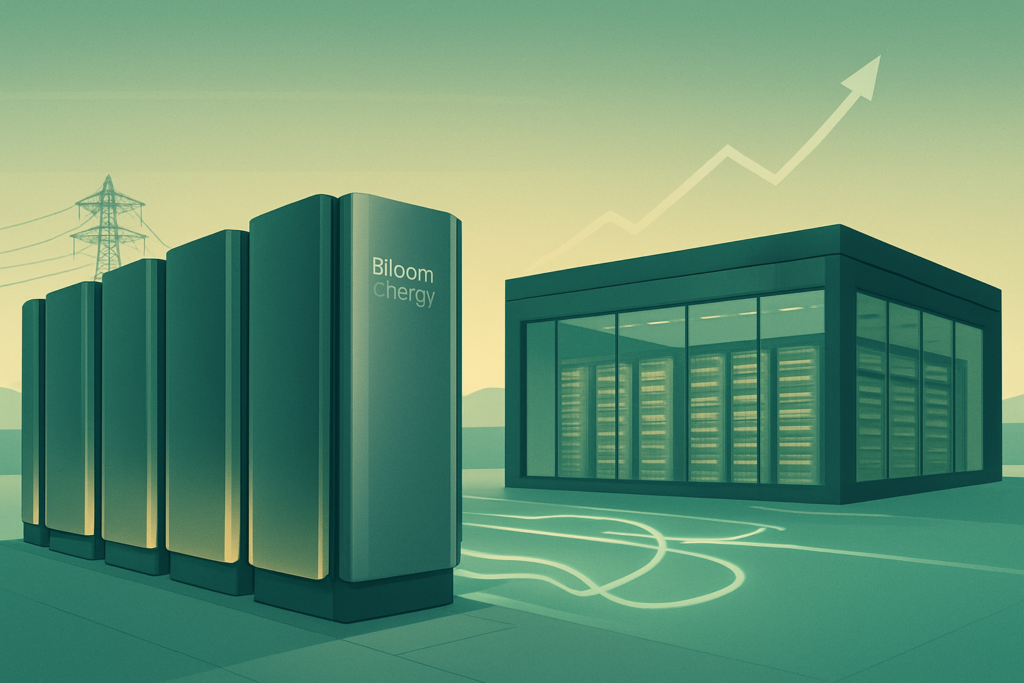
As of March 23, 2026, the energy conversation has shifted from "clean at any cost" to "power at any speed." In this new landscape, Bloom Energy (NYSE: BE) has emerged as one of the most significant beneficiaries of the global infrastructure crisis. Once viewed as a high-cost, niche fuel cell provider with a long road to profitability, Bloom has redefined itself as the mission-critical backbone for the artificial intelligence (AI) revolution.
With the traditional electrical grid failing to meet the voracious power demands of next-generation data centers, Bloom’s "behind-the-meter" solid oxide fuel cells (SOFCs) have become a pragmatic solution for hyperscalers like Amazon (NASDAQ: AMZN) and Microsoft (NASDAQ: MSFT). By delivering firm, 24/7 power in a fraction of the time required for a utility grid connection, Bloom Energy has transformed from a clean-tech speculative play into a $42 billion infrastructure powerhouse.
Historical Background
The story of Bloom Energy begins far from the Silicon Valley data centers it now powers. In the late 1990s, Dr. KR Sridhar, then a professor at the University of Arizona, led a NASA project to develop a solid oxide electrolyzer capable of producing oxygen on Mars. When the mission was canceled, Sridhar pivoted the technology toward Earth-based power generation.
In 2001, Sridhar co-founded the company as Ion America, eventually rebranding to Bloom Energy in 2006. The company spent nearly a decade in "stealth mode," fueled by venture capital from Kleiner Perkins and others. Its public debut on 60 Minutes in 2010 introduced the "Bloom Box" to the world, promising a decentralized energy future.
Bloom Energy went public on the New York Stock Exchange in July 2018 at $15 per share. For several years, the company struggled with high manufacturing costs and its reliance on natural gas, which drew criticism from pure-play "green" advocates. However, the 2024–2025 AI boom acted as a massive catalyst, shifting the market’s focus from Bloom’s fuel source to its reliability and deployment speed.
Business Model
Bloom Energy’s business model has evolved into a multi-layered ecosystem of hardware, long-term service, and "Power-as-a-Service."
- Hardware (Product Sales): The core revenue driver is the Bloom Energy Server. These modular units use electrochemical processes to convert fuels (natural gas, biogas, or hydrogen) into electricity. Crucially, as of 2025, Bloom transitioned its servers to be 800V DC-ready, allowing them to plug directly into AI GPU racks without the energy losses of traditional AC-to-DC conversion.
- Service: Bloom signs 10- to 20-year maintenance and monitoring contracts with nearly every hardware installation. This segment reached a critical milestone in late 2025, achieving sustained profitability and building a massive $14 billion backlog.
- Installation: Bloom provides end-to-end engineering and construction. While traditionally a lower-margin business, it is essential for the "90-day deployment" guarantee that wins major data center contracts.
- Electricity-as-a-Service (EaaS): Through partnerships with financial giants like Brookfield Asset Management (NYSE: BAM), Bloom offers "zero-upfront" power solutions. Customers pay for the electricity consumed, while Bloom and its partners own and operate the assets.
Stock Performance Overview
Over the last decade, Bloom Energy has been a case study in high-beta volatility, followed by a parabolic breakout.
- 1-Year Performance: As of March 2026, the stock has surged +595.9% over the past 12 months. This run-up was fueled by a series of "Gigawatt-scale" announcements in late 2024 and early 2025.
- 5-Year Performance: The stock has returned approximately +442%, overcoming a period of stagnation between 2021 and 2023 when high interest rates pressured clean-tech valuations.
- 10-Year / Since IPO: Since its 2018 IPO, Bloom has returned roughly 900%. Investors who weathered the early volatility have seen their patience rewarded as the company finally scaled its technology to match a massive market need.
Financial Performance
Bloom Energy's Fiscal Year 2025 results, reported in February 2026, marked a turning point for the company's balance sheet.
- Revenue: Total revenue for 2025 hit $2.02 billion, a 37.3% increase year-over-year.
- Profitability: For the first time in its history, Bloom reported a meaningful GAAP operating profit in Q4 2025. Non-GAAP gross margins improved to 30.3%, up from the mid-20s in previous years.
- Backlog: The company’s total product backlog has ballooned to nearly $20 billion (including uncommitted framework agreements), driven largely by the data center sector.
- Liquidity: Bloom ended 2025 with over $2 billion in liquidity, providing the "dry powder" needed to double its manufacturing capacity to 2 GW per year by the end of 2026.
Leadership and Management
The leadership team is led by Founder and CEO Dr. KR Sridhar, whose visionary status is balanced by a board of directors with deep industrial roots.
Key figures include:
- Satish Chitoori (COO): Tasked with the massive operational challenge of scaling manufacturing facilities in Delaware and California to meet the 2 GW target.
- Aman Joshi (CCO): The architect of the company’s recent "data-center-first" commercial strategy.
- The Board: Bloom boasts an unusually high-profile board for a mid-cap company, including former Cisco (NASDAQ: CSCO) CEO John Chambers and former GE (NYSE: GE) CEO Jeff Immelt. Their presence has been instrumental in navigating large-scale utility and enterprise negotiations.
Products, Services, and Innovations
Bloom's technical edge lies in its Solid Oxide platform, which operates at higher temperatures (approx. 800°C) than the Proton Exchange Membrane (PEM) cells used by competitors like Plug Power (NASDAQ: PLUG).
- Efficiency: Bloom’s servers achieve ~60% electrical efficiency, nearly double that of traditional combustion engines.
- Hydrogen Electrolyzers: Bloom’s Solid Oxide Electrolyzer Cell (SOEC) is 15–45% more efficient than PEM alternatives. Because it uses heat as well as electricity, it is particularly well-suited for integration with nuclear power plants or industrial waste heat.
- Carbon Capture: Bloom’s non-combustion process produces a highly concentrated stream of CO2, making it 10x cheaper to capture and sequester than the exhaust from a gas turbine.
Competitive Landscape
Bloom Energy competes across three primary fronts:
- Hydrogen Pure-Plays: Plug Power (NASDAQ: PLUG) and Ballard Power (NASDAQ: BLDP) lead in mobility (forklifts, trucks) but struggle with the high cost of a pure hydrogen fuel chain for stationary power.
- Legacy Fuel Cells: FuelCell Energy (NASDAQ: FCEL) uses Molten Carbonate technology, which is efficient but often less modular and slower to deploy than Bloom’s servers.
- The Grid and Diesel: Bloom’s primary rival is the "status quo." In hubs like Northern Virginia, waiting for a grid connection can take 5+ years. Bloom’s 90-day deployment moat makes it the only viable option for AI companies needing power "now."
Industry and Market Trends
The dominant trend of 2026 is the "Power Latency" crisis. AI chips, such as Nvidia’s (NASDAQ: NVDA) Blackwell and Rubin architectures, require 5x to 10x the power density of previous generations.
The aging U.S. electrical grid cannot upgrade fast enough to support these "AI factories." This has led to the rise of Consumer-Regulated Electric Utilities (CREUs)—large enterprises that effectively become their own power companies. Bloom is the primary technology provider for this "off-grid" movement.
Risks and Challenges
Despite its recent success, Bloom faces significant hurdles:
- Natural Gas Reliance: While Bloom is "hydrogen-ready," most current units run on natural gas. This leaves the company exposed to commodity price volatility and evolving carbon-neutrality mandates.
- Valuation: Trading at approximately 18x Trailing Sales, Bloom is priced for perfection. Any miss in its 2026 revenue guidance ($3.1B–$3.3B) could trigger a significant correction.
- Regulatory Sunset: The generous tax credits that fuel the industry are subject to political shifts, particularly as the One Big Beautiful Bill Act (OBBBA) of 2025 begins its phase-out periods for hydrogen incentives.
Opportunities and Catalysts
The most immediate catalyst is the 1 GW supply agreement with American Electric Power (AEP). As this deal moves from framework to installation in late 2026, it will provide a massive boost to recognized revenue.
Furthermore, the $5 billion strategic partnership with Brookfield provides a roadmap for global expansion. As Brookfield deploys Bloom technology across its real estate and infrastructure portfolio, Bloom gains access to a recurring, high-margin revenue stream that de-risks its capital-intensive manufacturing business.
Investor Sentiment and Analyst Coverage
Wall Street sentiment has turned overwhelmingly bullish following Bloom's first GAAP operating profit. Institutional ownership sits at a robust 84.6%, with major positions held by BlackRock, Vanguard, and the aggressive Situational Awareness LP, which disclosed a $876M stake in late 2025.
Current analyst consensus reflects a "Moderate Buy," with an average price target of $146.42. However, bulls point to the "scarcity value" of 24/7 power as a reason for further valuation expansion toward the $200 level.
Regulatory, Policy, and Geopolitical Factors
The regulatory environment in 2026 is defined by the Section 45X Advanced Manufacturing Credit, which provides tax incentives for every fuel cell component manufactured in the U.S.
Bloom’s decision to reshore its supply chain in 2024 has created a "regulatory moat." By meeting the 65% domestic content requirements, Bloom can offer its systems at a significantly lower net cost than imported competitors. Additionally, the DATA Act of 2026 (currently in Congress) could potentially exempt "Behind-the-Meter" data centers from certain federal oversight, further accelerating Bloom's deployment timelines.
Conclusion
As of March 2026, Bloom Energy has transitioned from a clean-energy "outsider" to an AI-infrastructure "insider." By solving the most pressing bottleneck of the digital age—the power gap—the company has secured a decade-long runway for growth.
While risks regarding fuel sources and valuation remain, Bloom’s massive $20 billion backlog and its first taste of GAAP profitability suggest that the company has finally reached escape velocity. For investors, the key metric to watch throughout 2026 will be the speed of the 2 GW manufacturing scale-up. If Bloom can execute on its delivery promises, it may well become the standard-bearer for the next generation of the decentralized electrical grid.
This content is intended for informational purposes only and is not financial advice.