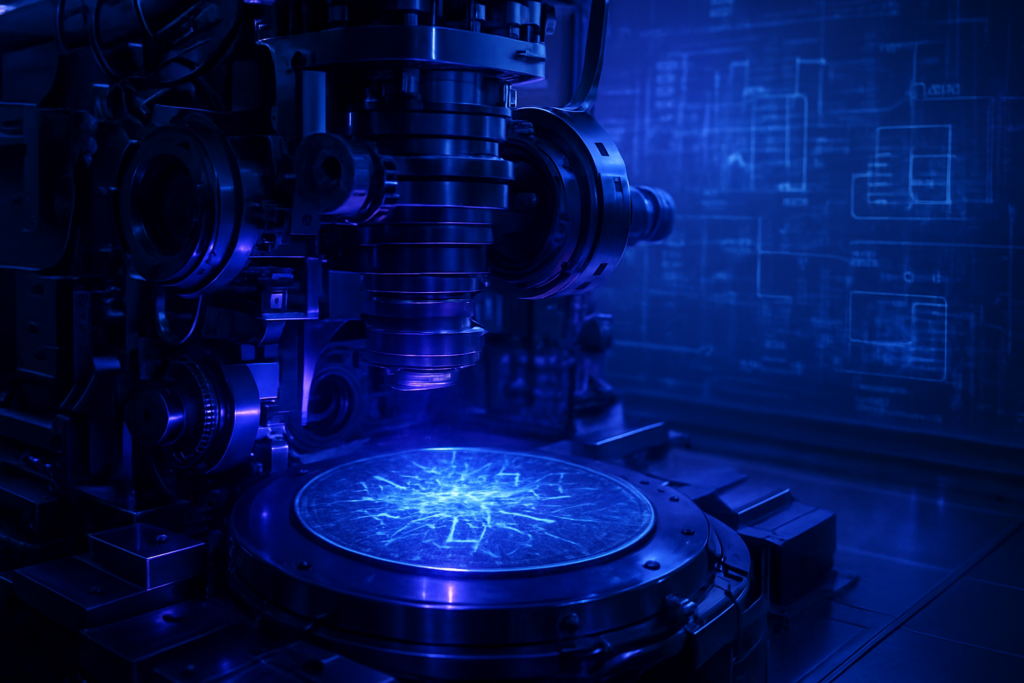
As of early 2026, the global semiconductor industry has officially crossed the threshold into the "Angstrom Era," a transition defined by a radical shift in how the world’s most advanced microchips are manufactured. At the heart of this revolution is High-Numerical Aperture (High-NA) Extreme Ultraviolet (EUV) lithography—a technology so complex and expensive that it has rewritten the competitive strategies of the world’s leading chipmakers. These machines, produced exclusively by ASML (NASDAQ: ASML) and carrying a price tag exceeding $380 million each, are no longer just experimental prototypes; they are now the primary engines driving the development of 2nm and 1nm process nodes.
The immediate significance of High-NA EUV cannot be overstated. As artificial intelligence models swell toward 10-trillion-parameter scales, the demand for more efficient, denser, and more powerful silicon has reached a fever pitch. By enabling the printing of features as small as 8nm with a single exposure, High-NA EUV allows companies like Intel (NASDAQ: INTC) to bypass the "multi-patterning" hurdles that have plagued the industry for years. This leap in resolution is the critical unlock for the next generation of AI accelerators, promising a 15–20% performance-per-watt improvement that will define the hardware landscape for the remainder of the decade.
The Physics of Precision: Inside the High-NA Breakthrough
Technically, High-NA EUV represents the most significant architectural change in lithography since the introduction of EUV itself. The "NA" refers to the numerical aperture, a measure of the system's ability to collect and focus light. While standard EUV systems use a 0.33 NA, the new Twinscan EXE:5200 platform increases this to 0.55. According to Rayleigh’s Criterion, this higher aperture allows for a much finer resolution—moving from the previous 13nm limit down to 8nm. This allows chipmakers to print the ultra-dense transistor gates and interconnects required for the 2nm and 1nm (10-Angstrom) nodes without the need for multiple, error-prone exposures.
To achieve this, ASML and its partner Zeiss had to reinvent the system's optics. Because 0.55 NA mirrors are so large that they would physically block the light path in a conventional setup, the machines utilize "anamorphic" optics. This design provides 8x magnification in one direction and 4x in the other, effectively halving the exposure field size to 26mm x 16.5mm. This "half-field" constraint has introduced a new challenge known as "field stitching," where large chips—such as NVIDIA (NASDAQ: NVDA) Blackwell successors—must be printed in two separate halves and aligned with a sub-nanometer overlay accuracy of approximately 0.7nm.
This approach differs fundamentally from the 0.33 NA systems that powered the 5nm and 3nm eras. In those nodes, manufacturers often had to use "double-patterning," essentially printing a pattern in two stages to achieve the desired density. This added complexity, increased the risk of defects, and lowered yields. High-NA returns the industry to "single-patterning" for critical layers, which simplifies the manufacturing flow and, theoretically, improves the long-term cost-efficiency of the most advanced chips, despite the staggering upfront cost of the hardware.
A New Hierarchy: Winners and Losers in the High-NA Race
The deployment of these machines has created a strategic schism among the "Big Three" foundries. Intel (NASDAQ: INTC) has emerged as the most aggressive early adopter, having secured the entire initial supply of High-NA machines in 2024 and 2025. By early 2026, Intel’s 14A process has become the industry’s first "High-NA native" node. This "first-mover" advantage is central to Intel’s bid to regain process leadership and attract high-end foundry customers like Amazon (NASDAQ: AMZN) and Microsoft (NASDAQ: MSFT) who are hungry for custom AI silicon.
In contrast, TSMC (NYSE: TSM) has maintained a more conservative "wait-and-see" approach. The world’s largest foundry opted to stick with 0.33 NA multi-patterning for its A16 (1.6nm) node, which is slated for mass production in late 2026. TSMC’s leadership argues that the maturity and cost-efficiency of standard EUV still outweigh the benefits of High-NA for most customers. However, industry analysts suggest that TSMC is now under pressure to accelerate its High-NA roadmap for its A14 and A10 nodes to prevent a performance gap from opening up against Intel’s 14A-powered chips.
Meanwhile, Samsung Electronics (KRX:005930) and SK Hynix (KRX:000660) are leveraging High-NA for more than just logic. By January 2026, both Korean giants have integrated High-NA into their roadmaps for advanced memory, specifically HBM4 (High Bandwidth Memory). As AI GPUs require ever-faster data access, the density gains provided by High-NA in the DRAM layer are becoming just as critical as the logic gates themselves. This move positions Samsung to compete fiercely for Tesla’s (NASDAQ: TSLA) custom AI chips and other high-performance computing (HPC) contracts.
Moore’s Law and the Geopolitics of Silicon
The broader significance of High-NA EUV lies in its role as the ultimate life-support system for Moore’s Law. For years, skeptics argued that the physical limits of silicon would bring the era of exponential scaling to a halt. High-NA EUV proves that while scaling is getting exponentially more expensive, it is not yet physically impossible. This technology ensures a roadmap down to the 1nm level, providing the foundation for the next decade of "Super-Intelligence" and the transition from traditional LLMs to autonomous, world-model-based AI.
However, this breakthrough comes with significant concerns regarding market concentration and economic barriers to entry. With a single machine costing nearly $400 million, only a handful of companies on Earth can afford to participate in the leading-edge semiconductor race. This creates a "rich-get-richer" dynamic where the top-tier foundries and their largest customers—primarily the "Magnificent Seven" tech giants—further distance themselves from smaller startups and mid-sized chip designers.
Furthermore, the geopolitical weight of ASML’s technology has never been higher. As the sole provider of High-NA systems, the Netherlands-based company sits at the center of the ongoing tech tug-of-war between the West and China. With strict export controls preventing Chinese firms from acquiring even standard EUV systems, the arrival of High-NA in the US, Taiwan, and Korea widens the "technology moat" to a span that may take decades for competitors to cross, effectively cementing Western dominance in high-end AI hardware for the foreseeable future.
Beyond 1nm: The Hyper-NA Horizon
Looking toward the future, the industry is already eyeing the next milestone: Hyper-NA EUV. While High-NA (0.55 NA) is expected to carry the industry through the 1.4nm and 1nm nodes, ASML has already begun formalizing the roadmap for 0.75 NA systems, dubbed "Hyper-NA." Targeted for experimental use around 2030, Hyper-NA will be essential for the sub-1nm era (7-Angstrom and 5-Angstrom nodes). These future systems will face even more daunting physics challenges, including extreme light polarization that will require even higher-power light sources to maintain productivity.
In the near term, the focus will shift from the machines themselves to the "ecosystem" required to support them. This includes the development of new photoresists that can handle the higher resolution without "stochastics" (random defects) and the perfection of advanced packaging techniques. As chip sizes for AI GPUs continue to grow, the industry will likely see a move toward "system-on-package" designs, where High-NA is used for the most critical logic tiles, while less sensitive components are manufactured on older, more cost-effective nodes and joined via high-speed interconnects.
The Angstrom Era Begins
The arrival of High-NA EUV marks one of the most pivotal moments in the history of the semiconductor industry. It is a testament to human engineering that a machine can align patterns with the precision of a few atoms across a silicon wafer. This development ensures that the hardware underlying the AI revolution will continue to advance, providing the trillions of transistors necessary to power the next generation of digital intelligence.
As we move through 2026, the key metrics to watch will be the yield rates of Intel’s 14A process and the timing of TSMC’s inevitable pivot to High-NA for its 1.4nm nodes. The "stitching" success for massive AI GPUs will also be a major indicator of whether the industry can continue to build the monolithic "giant chips" that current AI architectures favor. For now, the $400 million gamble seems to be paying off, securing the future of silicon scaling and the relentless march of artificial intelligence.
This content is intended for informational purposes only and represents analysis of current AI developments.
TokenRing AI delivers enterprise-grade solutions for multi-agent AI workflow orchestration, AI-powered development tools, and seamless remote collaboration platforms.
For more information, visit https://www.tokenring.ai/.