
Western Alliance Bancorporation trades at $78.52 per share and has stayed right on track with the overall market, gaining 13.6% over the last six months. At the same time, the S&P 500 has returned 16.4%.
Is there a buying opportunity in Western Alliance Bancorporation, or does it present a risk to your portfolio? Check out our in-depth research report to see what our analysts have to say, it’s free.
Why Is Western Alliance Bancorporation Not Exciting?
We’re passing on Western Alliance Bancorporation for now. Here are three reasons why there are better opportunities than WAL, plus one stock we’d rather own.
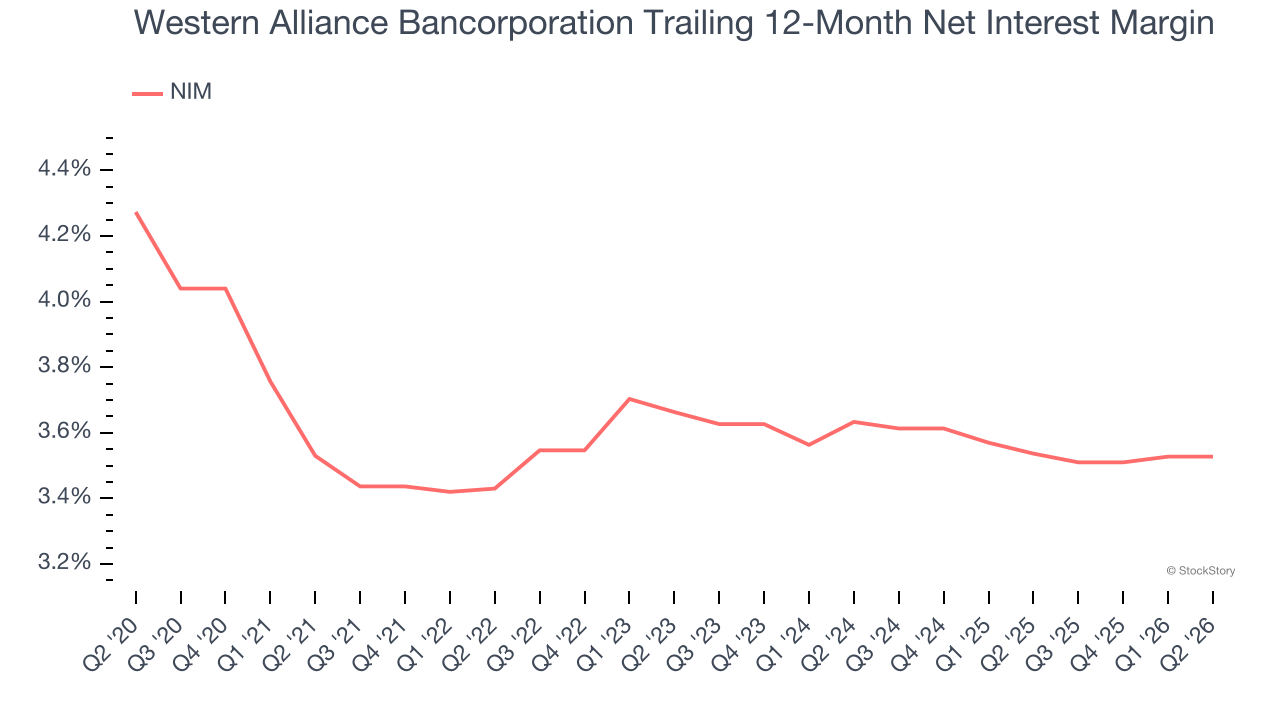
1. Net Interest Margin Dropping
Net interest margin (NIM) represents the unit economics of a bank by measuring the profitability of its interest-bearing assets relative to its interest-bearing liabilities. It’s a fundamental metric that investors use to assess lending premiums and returns.
Over the past two years, Western Alliance Bancorporation’s net interest margin averaged 3.5%. However, its margin contracted by 10.6 basis points (100 basis points = 1 percentage point) over that period.
This decline was a headwind for its net interest income. While prevailing rates are a major determinant of net interest margin changes over time, the decline could mean Western Alliance Bancorporation either faced competition for loans and deposits or experienced a negative mix shift in its balance sheet composition.
2. Efficiency Ratio Expected to Falter
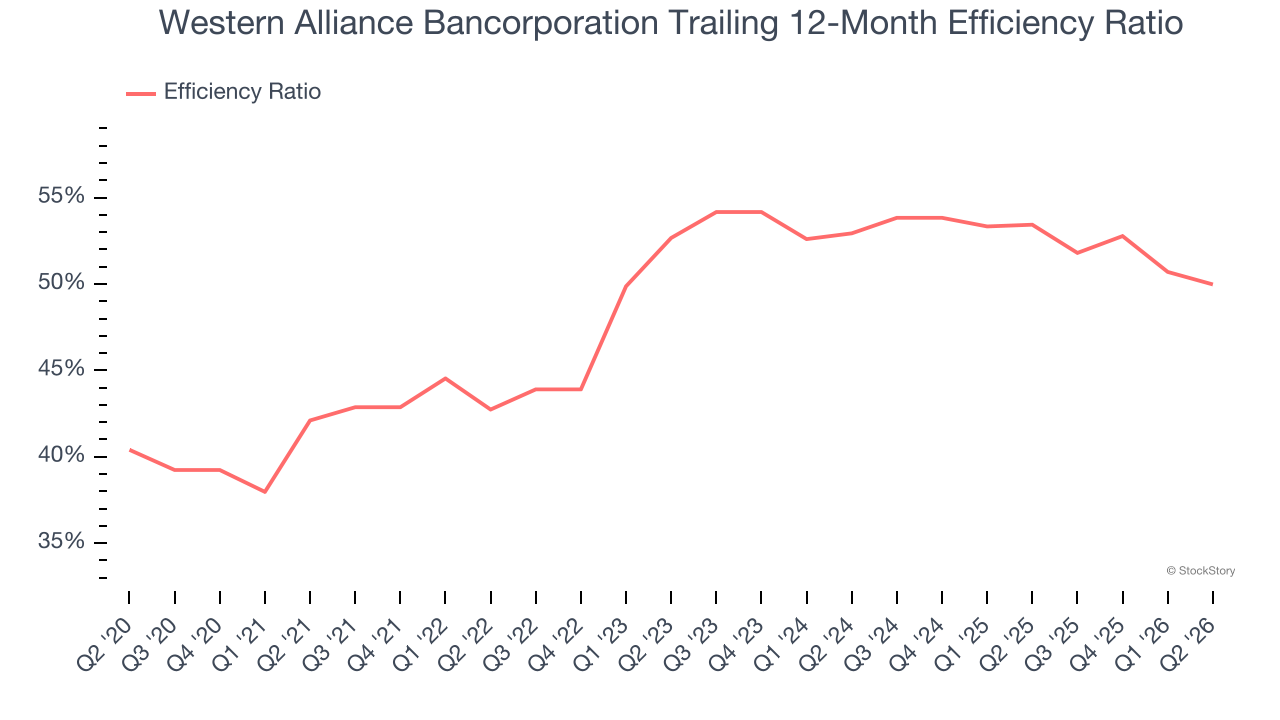
Topline growth carries importance, but the overall profitability behind this expansion determines true value creation. For banks, the efficiency ratio captures this relationship by measuring non-interest expenses, including salaries, facilities, technology, and marketing, against total revenue.
Markets emphasize efficiency ratio trends over static measurements, recognizing that revenue compositions drive different expense bases. Lower efficiency ratios signal superior performance by indicating that banks are controlling costs effectively relative to their income.
For the next 12 months, Wall Street expects Western Alliance Bancorporation to become less profitable as it anticipates an efficiency ratio of 57.9% compared to 50% over the past year.
3. EPS Barely Growing
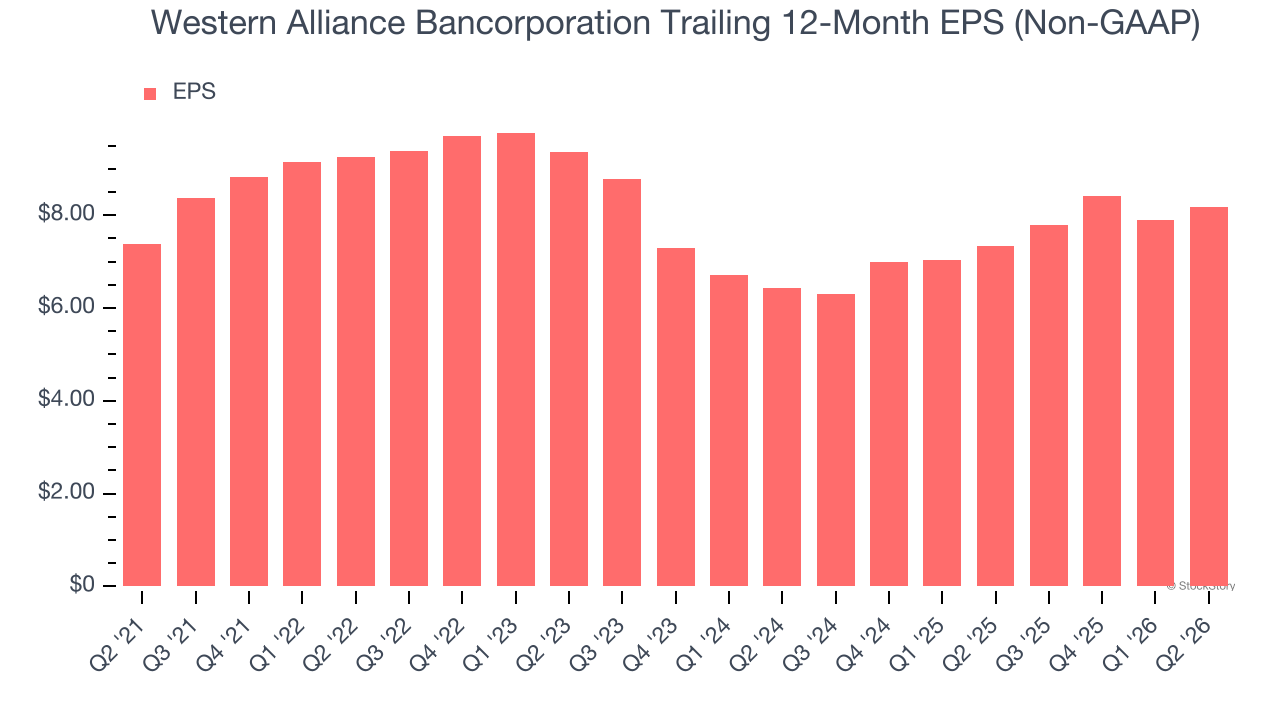
Analyzing the long-term change in earnings per share (EPS) shows whether a company’s incremental sales were profitable — for example, revenue could be inflated through excessive spending on advertising and promotions.
Western Alliance Bancorporation’s EPS grew at a weak 2% compounded annual growth rate over the last five years, lower than its 21.1% annualized revenue growth. This tells us the company became less profitable on a per-share basis as it expanded.
Final Judgment
Western Alliance Bancorporation isn’t a terrible business, but it doesn’t pass our bar. That said, the stock currently trades at 1.1× forward P/B (or $78.52 per share). While this valuation is reasonable, we don’t really see a big opportunity at the moment. We’re fairly confident there are better investments elsewhere. We’d recommend looking at a top digital advertising platform riding the creator economy.
High-Quality Stocks for All Market Conditions
ONE MORE THING: Top 5 Growth Stocks. The biggest stock winners almost always had one thing in common before they ran. Revenue growing like crazy. Meta. CrowdStrike. Broadcom. Our AI flagged all three. They returned 315%, 314%, and 455%, respectively.
Find out which 5 stocks it’s flagging this month — FREE. Get Our Top 5 Growth Stocks for Free HERE.
Stocks that have made our list include now familiar names such as Nvidia (+1,460% between June 2020 and June 2025) as well as under-the-radar businesses like the once-small-cap company Comfort Systems (+1,154% between June 2020 and June 2025). Find your next big winner with StockStory today.