The end of the earnings season is always a good time to take a step back and see who shined (and who didn’t). Let’s take a look at how hardware & infrastructure stocks fared in Q2, starting with Dell (NYSE: DELL).
The Hardware & Infrastructure sector will be buoyed by demand related to AI adoption, cloud computing expansion, and the need for more efficient data storage and processing solutions. Companies with tech offerings such as servers, switches, and storage solutions are well-positioned in our new hybrid working and IT world. On the other hand, headwinds include ongoing supply chain disruptions, rising component costs, and intensifying competition from cloud-native and hyperscale providers reducing reliance on traditional hardware. Additionally, regulatory scrutiny over data sovereignty, cybersecurity standards, and environmental sustainability in hardware manufacturing could increase compliance costs.
The 9 hardware & infrastructure stocks we track reported an exceptional Q2. As a group, revenues beat analysts’ consensus estimates by 5.4% while next quarter’s revenue guidance was 16.7% above.
Luckily, hardware & infrastructure stocks have performed well with share prices up 10.1% on average since the latest earnings results.
Dell (NYSE: DELL)
Founded by Michael Dell in his University of Texas dorm room in 1984 with just $1,000, Dell Technologies (NYSE: DELL) provides hardware, software, and services that help organizations build their IT infrastructure, manage cloud environments, and enable digital transformation.
Dell reported revenues of $46.97 billion, up 57.7% year on year. This print exceeded analysts’ expectations by 4.2%. Overall, it was an incredible quarter for the company with a beat of analysts’ EPS estimates and an impressive beat of analysts’ EPS guidance for next quarter estimates.
“IT environments have shifted from cost centers to value drivers that fuel growth and competitive advantage, and customers are investing accordingly – creating opportunity across our portfolio,” said Jeff Clarke, vice chairman and chief operating officer, Dell Technologies. “That’s clearest in our AI server business where we booked a record $60.9 billion in orders, recognized a record $16.4 billion in revenue and exited the quarter with a record $95 billion backlog. We’re seeing broader revenue growth as well, with traditional servers and networking up 122%, storage up 26% and our client solutions up 20% year over year. Our second quarter results underscore the compounding benefits of our competitive advantages, the breadth of our portfolio and the strength of our operating model.”
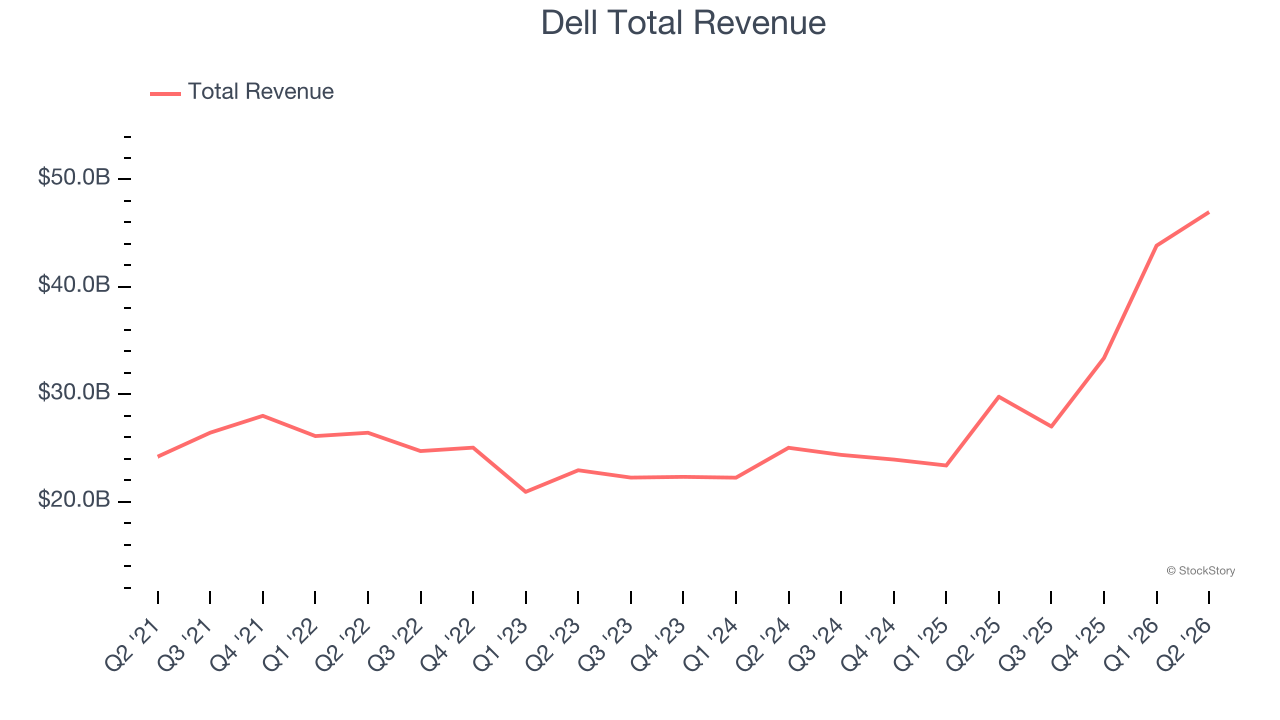
Interestingly, the stock is up 34.4% since reporting and currently trades at $571.05.
Best Q2: Everpure (NYSE: P)
Founded in 2009 as a pioneer in enterprise all-flash storage technology, Everpure (NYSE: P) provides all-flash data storage hardware and software that helps organizations manage their data more efficiently across on-premises and cloud environments.
Everpure reported revenues of $1.19 billion, up 37.7% year on year, outperforming analysts’ expectations by 7.7%. The business had an incredible quarter with a solid beat of analysts’ billings estimates and a beat of analysts’ EPS estimates.
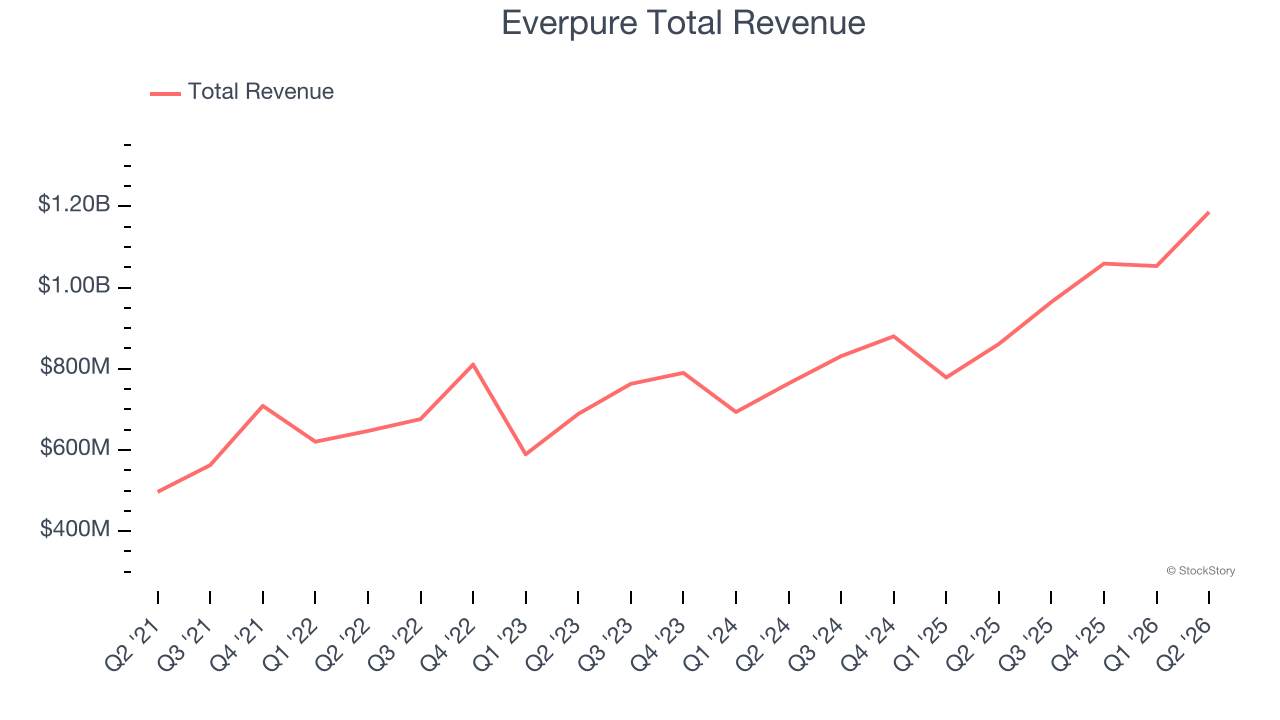
Although it had a fine quarter compared to its peers, the market seems unhappy with the results as the stock is down 4.3% since reporting. It currently trades at $104.17.
Is now the time to buy Everpure? Access our full analysis of the earnings results here, it’s free.
Weakest Q2: Diebold Nixdorf (NYSE: DBD)
With roots dating back to 1859 and a presence in over 100 countries, Diebold Nixdorf (NYSE: DBD) provides automated self-service technology, software, and services that help banks and retailers digitize their customer transactions.
Diebold Nixdorf reported revenues of $927.6 million, up 1.4% year on year, falling short of analysts’ expectations by 0.6%. It was a slower quarter as it posted full-year revenue guidance meeting analysts’ expectations and EPS in line with analysts’ estimates.
Diebold Nixdorf delivered the slowest revenue growth and weakest full-year guidance update of the whole group. As expected, the stock is down 30.4% since the results and currently trades at $63.19.
Read our full analysis of Diebold Nixdorf’s results here.
Xerox (NASDAQ: XRX)
Pioneering the modern office copier and inventing technologies like Ethernet and the laser printer, Xerox (NASDAQ: XRX) provides document management systems, printing technology, and workplace solutions to businesses of all sizes across the globe.
Xerox reported revenues of $1.92 billion, up 22% year on year. This number beat analysts’ expectations by 1.2%. It was a very strong quarter as it also put up a beat of analysts’ EPS estimates.
The stock is up 31.4% since reporting and currently trades at $3.47.
Read our full, actionable report on Xerox here, it’s free.
IonQ (NYSE: IONQ)
Founded by quantum physics pioneers from the University of Maryland and Duke University in 2015, IonQ (NYSE: IONQ) develops quantum computers that process information using trapped ions to solve complex computational problems beyond the capabilities of traditional computers.
IonQ reported revenues of $80.05 million, up 287% year on year. This print surpassed analysts’ expectations by 20.4%. Overall, it was a strong quarter as it also produced full-year revenue guidance exceeding analysts’ expectations.
IonQ scored the biggest analyst estimate beat and fastest revenue growth in the group. The stock is down 2.2% since reporting and currently trades at $39.05.
Read our full, actionable report on IonQ here, it’s free.
Market Update
Over the past year, investors have been forced to repeatedly answer the same question: what is the market’s biggest risk? The answer has changed several times, and each shift has reshaped market leadership.
Late in 2025 and early 2026, artificial intelligence became the market’s primary uncertainty. Investors questioned whether AI would erode software pricing power and weaken competitive moats as AI made it easier to replicate once-differentiated products.
By the spring, technology took a back seat to geopolitics. The U.S. conflict with Iran briefly became the market’s dominant narrative, raising concerns about oil prices, inflation, and global growth. But as energy markets remained orderly and fears of a prolonged supply disruption faded, investors quickly turned their focus back to fundamentals.
Want to invest in winners with rock-solid fundamentals? Check out our Strong Momentum Stocks and add them to your watchlist. These companies are poised for growth regardless of the political or macroeconomic climate.