
Quarterly earnings results are a good time to check in on a company’s progress, especially compared to its peers in the same sector. Today we are looking at Repligen (NASDAQ: RGEN) and the best and worst performers in the drug development inputs & services industry.
Companies specializing in drug development inputs and services play a crucial role in the pharmaceutical and biotechnology value chain. Essential support for drug discovery, preclinical testing, and manufacturing means stable demand, as pharmaceutical companies often outsource non-core functions with medium to long-term contracts. However, the business model faces high capital requirements, customer concentration, and vulnerability to shifts in biopharma R&D budgets or regulatory frameworks. Looking ahead, the industry will likely enjoy tailwinds such as increasing investment in biologics, cell and gene therapies, and advancements in precision medicine, which drive demand for sophisticated tools and services. There is a growing trend of outsourcing in drug development for nimbleness and cost efficiency, which benefits the industry. On the flip side, potential headwinds include pricing pressures as efforts to contain healthcare costs are always top of mind. An evolving regulatory backdrop could also slow innovation or client activity.
The 8 drug development inputs & services stocks we track reported a very strong Q2. As a group, revenues beat analysts’ consensus estimates by 4.1% while next quarter’s revenue guidance was 0.8% above.
Luckily, drug development inputs & services stocks have performed well with share prices up 10.3% on average since the latest earnings results.
Repligen (NASDAQ: RGEN)
With over 13 strategic acquisitions since 2012 to build its comprehensive bioprocessing portfolio, Repligen (NASDAQ: RGEN) develops and manufactures specialized technologies that improve the efficiency and flexibility of biological drug manufacturing processes.
Repligen reported revenues of $204.1 million, up 11.9% year on year. This print exceeded analysts’ expectations by 1.1%. Overall, it was a very strong quarter for the company with a beat of analysts’ EPS and organic revenue estimates.
Olivier Loeillot, President and Chief Executive Officer of Repligen said, “We were very pleased to deliver 13% organic growth in the second quarter, reflecting sequential acceleration and continued market outperformance. This reflects the strength and diversification of our portfolio and our disciplined execution. The order momentum from the first quarter continued into the second quarter. Our strong first half results and improved line of sight to the second half give us the confidence to increase our full year guidance.”
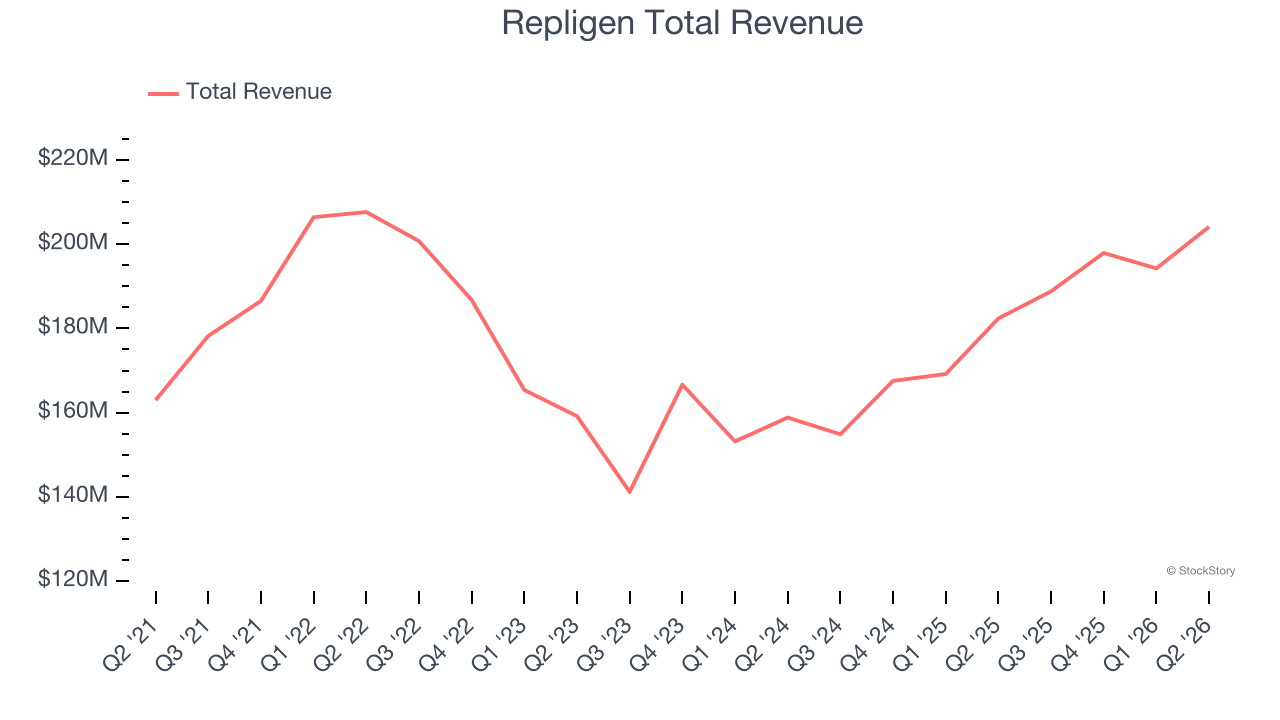
Repligen delivered the weakest performance against analyst estimates and weakest full-year guidance update of the whole group. Interestingly, the stock is up 29.4% since reporting and currently trades at $169.56.
Is now the time to buy Repligen? Access our full analysis of the earnings results here, it’s free.
Best Q2: Azenta (NASDAQ: AZTA)
Serving as the guardian of some of medicine's most valuable materials, Azenta (NASDAQ: AZTA) provides biological sample management, storage, and genomic services that help pharmaceutical and biotechnology companies preserve and analyze critical research materials.
Azenta reported revenues of $161.2 million, up 12% year on year, outperforming analysts’ expectations by 8%. The business had an incredible quarter with a beat of analysts’ EPS estimates.
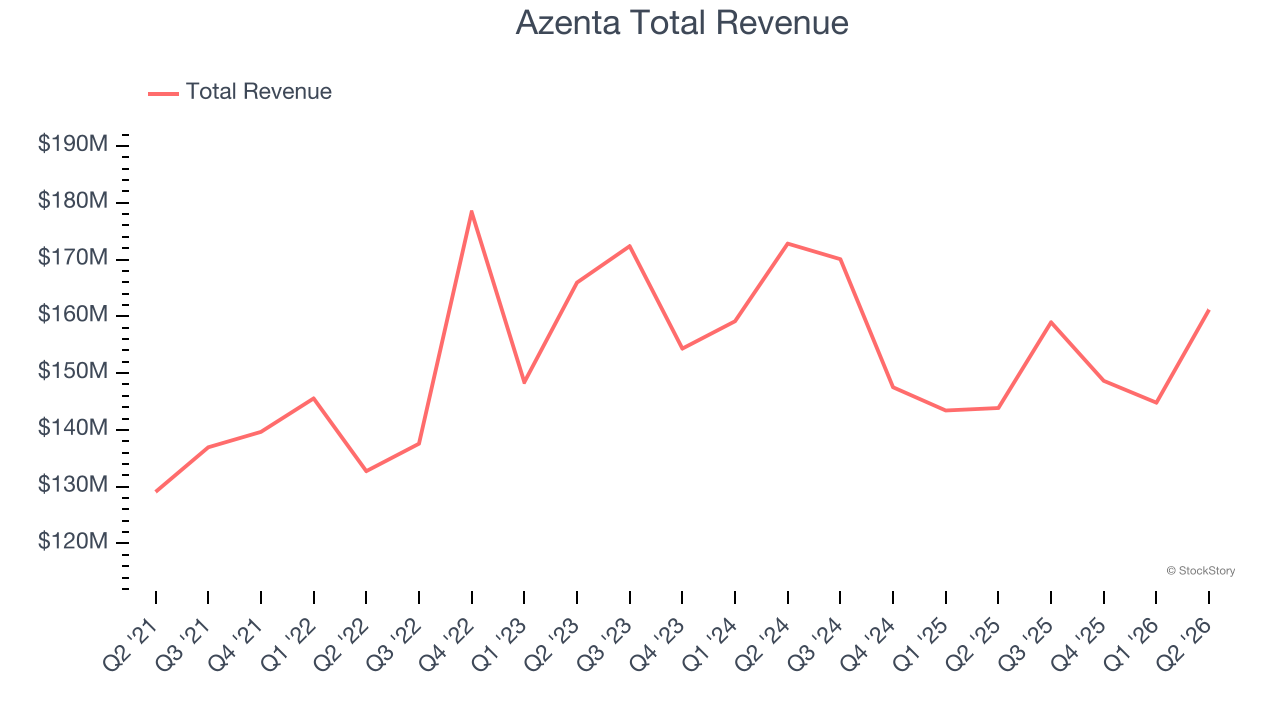
The market seems happy with the results as the stock is up 10.6% since reporting. It currently trades at $33.33.
Is now the time to buy Azenta? Access our full analysis of the earnings results here, it’s free.
Slowest Q2: IQVIA (NYSE: IQV)
Created from the 2016 merger of Quintiles (a clinical research organization) and IMS Health (a healthcare data specialist), IQVIA (NYSE: IQV) provides clinical research services, data analytics, and technology solutions to help pharmaceutical companies develop and market medications more effectively.
IQVIA reported revenues of $4.37 billion, up 8.7% year on year, exceeding analysts’ expectations by 1.5%. It was a satisfactory quarter as it also posted full-year revenue guidance slightly topping analysts’ expectations.
Interestingly, the stock is up 11% since the results and currently trades at $236.60.
Read our full analysis of IQVIA’s results here.
Charles River Laboratories (NYSE: CRL)
Named after the Massachusetts river where it was founded in 1947, Charles River Laboratories (NYSE: CRL) provides non-clinical drug development services, research models, and manufacturing support to pharmaceutical and biotechnology companies.
Charles River Laboratories reported revenues of $1.00 billion, down 2.7% year on year. This print surpassed analysts’ expectations by 2.5%. Overall, it was a very strong quarter as it also logged a solid beat of analysts’ organic revenue estimates and a beat of analysts’ EPS estimates.
The stock is up 19.6% since reporting and currently trades at $280.01.
Read our full, actionable report on Charles River Laboratories here, it’s free.
West Pharmaceutical Services (NYSE: WST)
Founded in 1923 and serving as a critical link in the pharmaceutical supply chain, West Pharmaceutical Services (NYSE: WST) manufactures specialized packaging, containment systems, and delivery devices for injectable drugs and healthcare products.
West Pharmaceutical Services reported revenues of $872.3 million, up 13.8% year on year. This number topped analysts’ expectations by 3.5%. It was a very strong quarter as it also produced an impressive beat of analysts’ full-year EPS guidance estimates and a beat of analysts’ EPS estimates.
The stock is down 2.5% since reporting and currently trades at $349.60.
Read our full, actionable report on West Pharmaceutical Services here, it’s free.
Market Update
Over the past year, investors have been forced to repeatedly answer the same question: what is the market’s biggest risk? The answer has changed several times, and each shift has reshaped market leadership.
Late in 2025 and early 2026, artificial intelligence became the market’s primary uncertainty. Investors questioned whether AI would erode software pricing power and weaken competitive moats as AI made it easier to replicate once-differentiated products.
By the spring, technology took a back seat to geopolitics. The U.S. conflict with Iran briefly became the market’s dominant narrative, raising concerns about oil prices, inflation, and global growth. But as energy markets remained orderly and fears of a prolonged supply disruption faded, investors quickly turned their focus back to fundamentals.
Want to invest in winners with rock-solid fundamentals? Check out our Top 6 Stocks and add them to your watchlist. These companies are poised for growth regardless of the political or macroeconomic climate.