Fast-food company Yum! Brands (NYSE: YUM) met Wall Street’s revenue expectations in Q2 CY2026, with sales up 12.2% year on year to $2.17 billion. Its non-GAAP profit of $1.62 per share was 3.7% above analysts’ consensus estimates.
Is now the time to buy Yum! Brands? Find out by accessing our full research report, it’s free.
Yum! Brands (YUM) Q2 CY2026 Highlights:
- Revenue: $2.17 billion vs analyst estimates of $2.18 billion (12.2% year-on-year growth, in line)
- Adjusted EPS: $1.62 vs analyst estimates of $1.56 (3.7% beat)
- Operating Margin: 30.2%, down from 32.2% in the same quarter last year
- Free Cash Flow Margin: 18.8%, similar to the same quarter last year
- Locations: 63,778 at quarter end, up from 61,272 in the same quarter last year
- Same-Store Sales rose 3% year on year (2% in the same quarter last year)
- Market Capitalization: $41.87 billion
Company Overview
Spun off as an independent company from PepsiCo, Yum! Brands (NYSE: YUM) is a multinational corporation that owns KFC, Pizza Hut, Taco Bell, and The Habit Burger Grill.
Revenue Growth
Reviewing a company’s long-term sales performance reveals insights into its quality. Any business can put up a good quarter or two, but the best consistently grow over the long haul.
With $8.72 billion in revenue over the past 12 months, Yum! Brands is one of the most widely recognized restaurant chains and benefits from customer loyalty, a luxury many don’t have. Its scale also gives it negotiating leverage with suppliers, enabling it to source its ingredients at a lower cost. However, its scale is a double-edged sword because there are only a finite of number places to build restaurants, making it harder to find incremental growth. To accelerate system-wide sales, Yum! Brands likely needs to optimize its pricing or lean into new chains and international expansion.
As you can see below, Yum! Brands’s 6.8% annualized revenue growth over the last seven years was mediocre as it barely increased sales at existing, established dining locations.
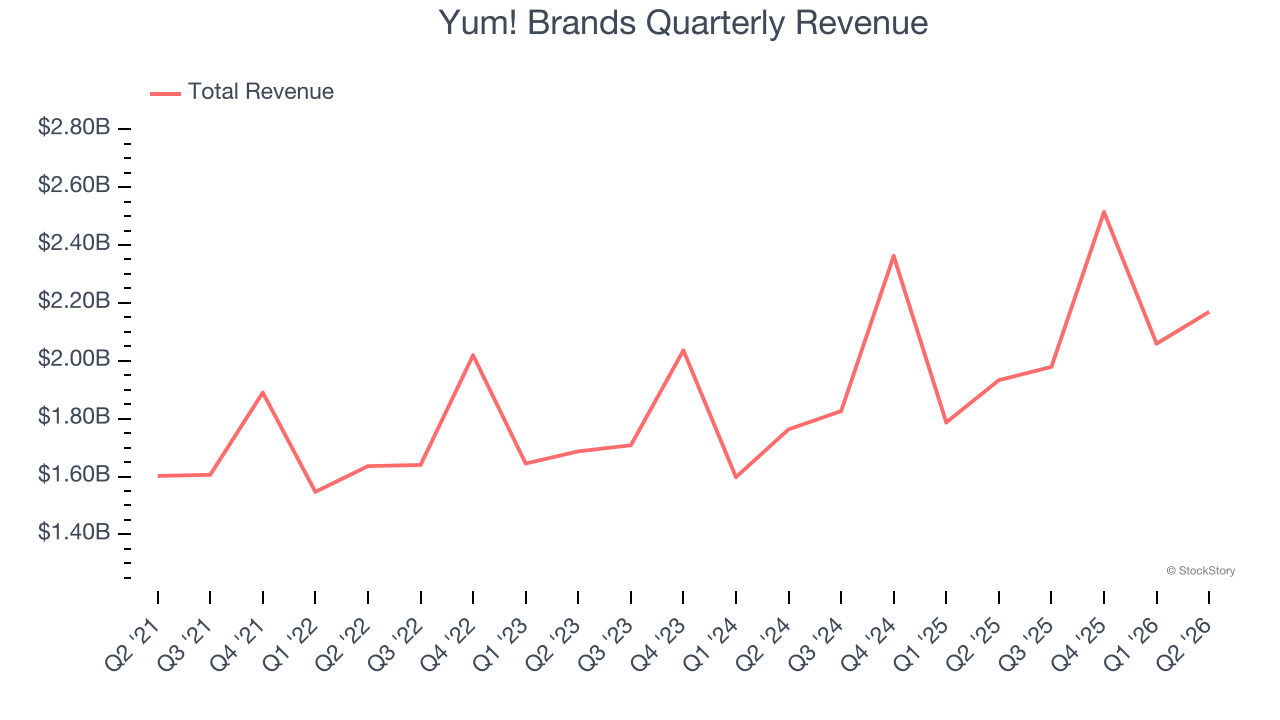
This quarter, Yum! Brands’s year-on-year revenue growth was 12.2%, and its $2.17 billion of revenue was in line with Wall Street’s estimates.
Looking ahead, sell-side analysts expect revenue to grow 6% over the next 12 months, similar to its seven-year rate. This projection doesn’t excite us and suggests its newer menu offerings will not lead to better top-line performance yet. At least the company is tracking well in other measures of financial health.
WHILE YOU’RE HERE: The Next Palantir? One satellite company captures images of every point on Earth. Every single day. The Pentagon wants it. Hedge funds are using it to beat earnings. You’ve probably never heard of it.
This is what the early days of Palantir looked like before it became a giant. Same playbook. Different technology. If you missed Palantir, you need to see this. Claim The Stock Ticker for Free HERE.
Restaurant Performance
Number of Restaurants
A restaurant chain’s total number of dining locations influences how much it can sell and how quickly revenue can grow.
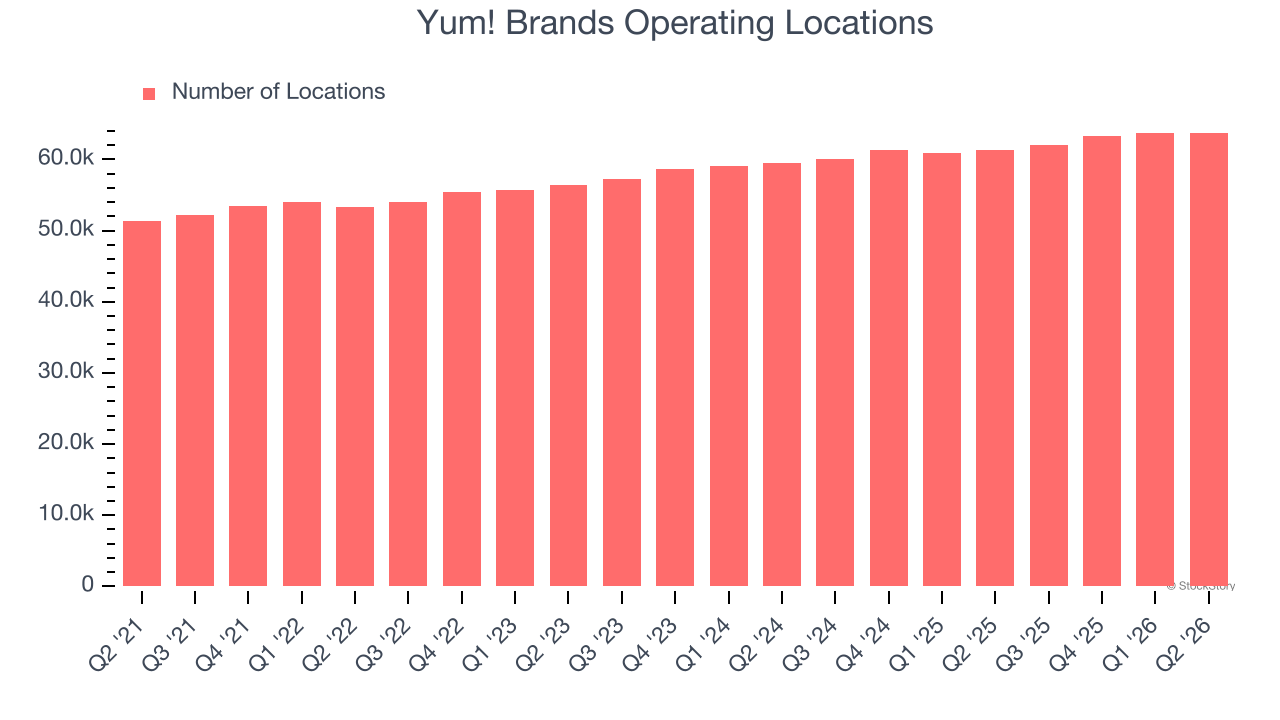
Yum! Brands sported 63,778 locations in the latest quarter. Over the last two years, it has opened new restaurants at a rapid clip by averaging 3.8% annual growth, among the fastest in the restaurant sector. Furthermore, one dynamic making expansion more seamless is the company’s franchise model, where franchisees are primarily responsible for opening new restaurants while Yum! Brands provides support.
When a chain opens new restaurants, it usually means it’s investing for growth because there’s healthy demand for its meals and there are markets where its concepts have few or no locations.
Same-Store Sales
A company’s restaurant base only paints one part of the picture. When demand is high, it makes sense to open more. But when demand is low, it’s prudent to close some locations and use the money in other ways. Same-store sales gives us insight into this topic because it measures organic growth at restaurants open for at least a year.
Yum! Brands’s demand within its existing dining locations has been relatively stable over the last two years but was below most restaurant chains. On average, the company’s same-store sales have grown by 2% per year. This performance suggests it should consider improving its foot traffic and efficiency before expanding its restaurant base.
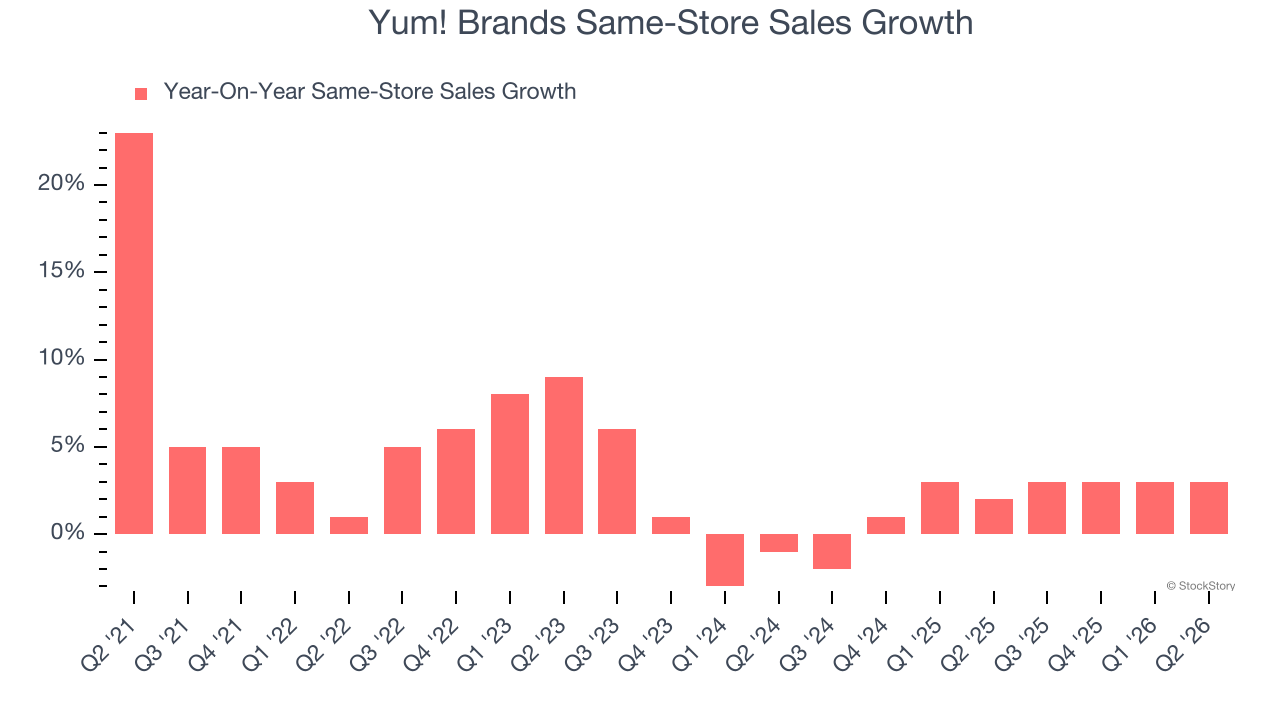
In the latest quarter, Yum! Brands’s same-store sales rose 3% year on year. This performance was more or less in line with its historical levels.
Key Takeaways from Yum! Brands’s Q2 Results
It was good to see Yum! Brands beat analysts’ EPS expectations this quarter. On the other hand, its same-store sales growth and revenue were just in line. Zooming out, we think this was a fine quarter. The market seemed to be hoping for more, and the stock traded down 1.6% to $149.50 immediately following the results.
Is Yum! Brands an attractive investment opportunity right now? What happened in the latest quarter matters, but not as much as longer-term business quality and valuation, when deciding whether to invest in this stock. We cover that in our actionable full research report which you can read here (it’s free).