Financial services company Robinhood (NASDAQ: HOOD) reported revenue ahead of Wall Street’s expectations in Q2 CY2026, with sales up 32.3% year on year to $1.31 billion. Its GAAP profit of $0.62 per share was 43.7% above analysts’ consensus estimates.
Is now the time to buy Robinhood? Find out by accessing our full research report, it’s free.
Robinhood (HOOD) Q2 CY2026 Highlights:
- Revenue: $1.31 billion vs analyst estimates of $1.29 billion (32.3% year-on-year growth, 1.8% beat)
- EPS (GAAP): $0.62 vs analyst estimates of $0.43 (43.7% beat)
- Adjusted EBITDA: $741 million vs analyst estimates of $629.8 million (56.7% margin, 17.7% beat)
- Operating Margin: 54.2%, up from 44.4% in the same quarter last year
- Free Cash Flow Margin: 53.2%, down from 189% in the previous quarter
- Funded Customers: 28.4 million, up 1.9 million year on year
- Market Capitalization: $83.53 billion
"Whether it's the Robinhood Chain, Robinhood Ventures, or Trump Accounts, our product velocity is focused on one goal: making everyone an owner," said Vlad Tenev, Chairman and CEO of Robinhood.
Company Overview
With a mission to democratize finance, Robinhood (NASDAQ: HOOD) is an online consumer finance platform known for its commission-free stock and crypto trading.
Revenue Growth
Reviewing a company’s long-term sales performance reveals insights into its quality. Any business can experience short-term success, but top-performing ones enjoy sustained growth for years. Thankfully, Robinhood’s 43.5% annualized revenue growth over the last three years was incredible. Its growth surpassed the average consumer internet company and shows its offerings resonate with customers, a great starting point for our analysis.
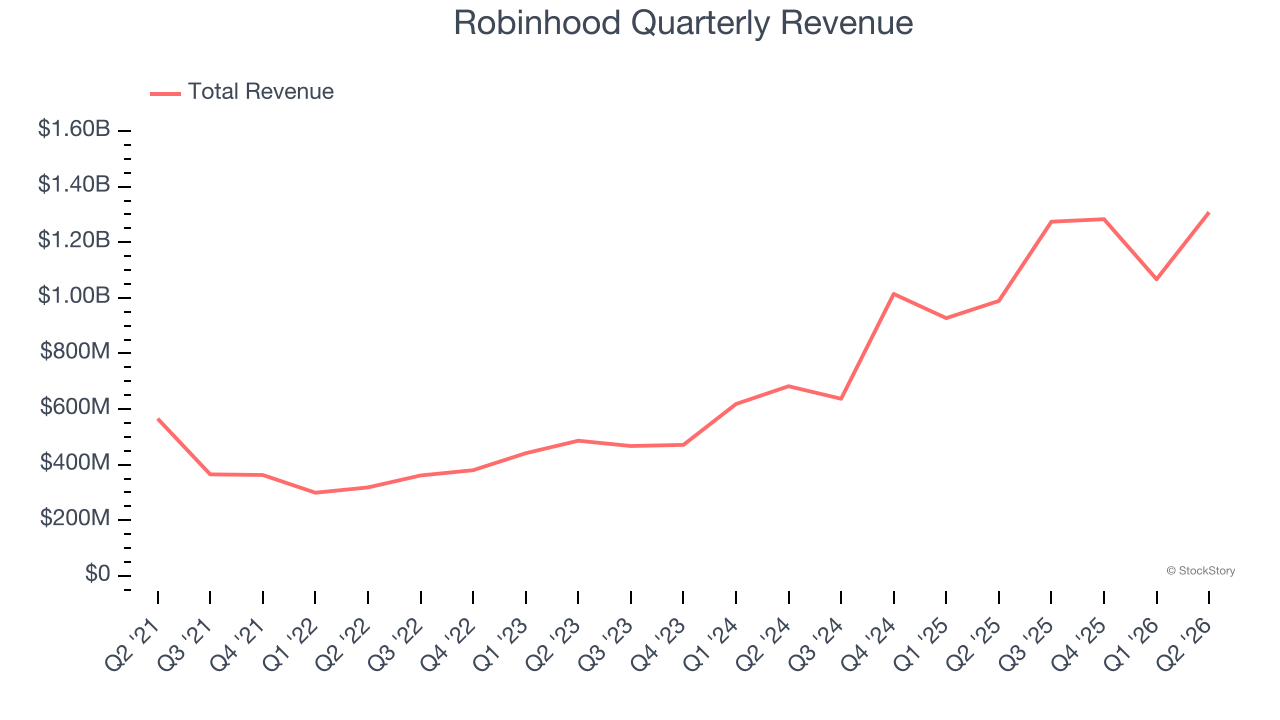
This quarter, Robinhood reported wonderful year-on-year revenue growth of 32.3%, and its $1.31 billion of revenue exceeded Wall Street’s estimates by 1.8%.
Looking ahead, sell-side analysts expect revenue to grow 16.9% over the next 12 months, a deceleration versus the last three years. Still, this projection is admirable and implies the market sees success for its products and services.
ONE MORE THING: 3 Hidden Platforms Growing 3X Faster than Amazon, Google, and PayPal. Amazon, Google, and Meta all followed the same playbook: Dominate an ignored market. Build an unbeatable moat. Scale until you’re unstoppable.
These three platforms are running that exact playbook right now. The early investors in Amazon made fortunes. The early investors in these could do the same. Get All 3 Stocks Here for FREE.
Funded Customers
User Growth
As a fintech company, Robinhood generates revenue growth by increasing both the number of users on its platform and the number of transactions they execute.
Over the last two years, Robinhood’s funded customers, a key performance metric for the company, increased by 7.6% annually to 28.4 million in the latest quarter. This growth rate is decent for a consumer internet business and indicates people enjoy using its offerings. 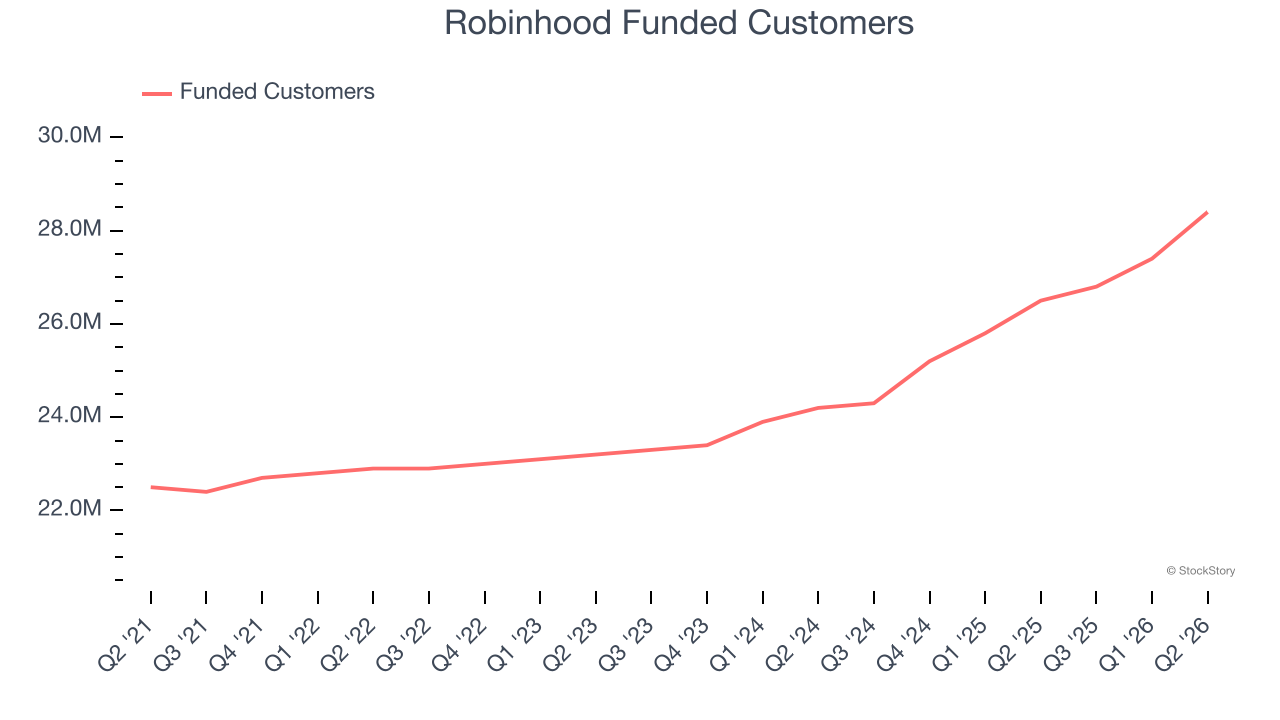
In Q2, Robinhood added 1.9 million funded customers, leading to 7.2% year-on-year growth. The quarterly print isn’t too different from its two-year result, suggesting its new initiatives aren’t accelerating user growth just yet.
Revenue Per User
Average revenue per user (ARPU) is a critical metric to track because it measures how much the company earns in fees from each user. ARPU also gives us unique insights into the average transaction size on Robinhood’s platform and the company’s take rate, or “cut”, on each transaction.
Robinhood’s ARPU growth has been exceptional over the last two years, averaging 91.2%. Its ability to increase monetization while growing its funded customers demonstrates its platform’s value, as its users are spending significantly more than last year. 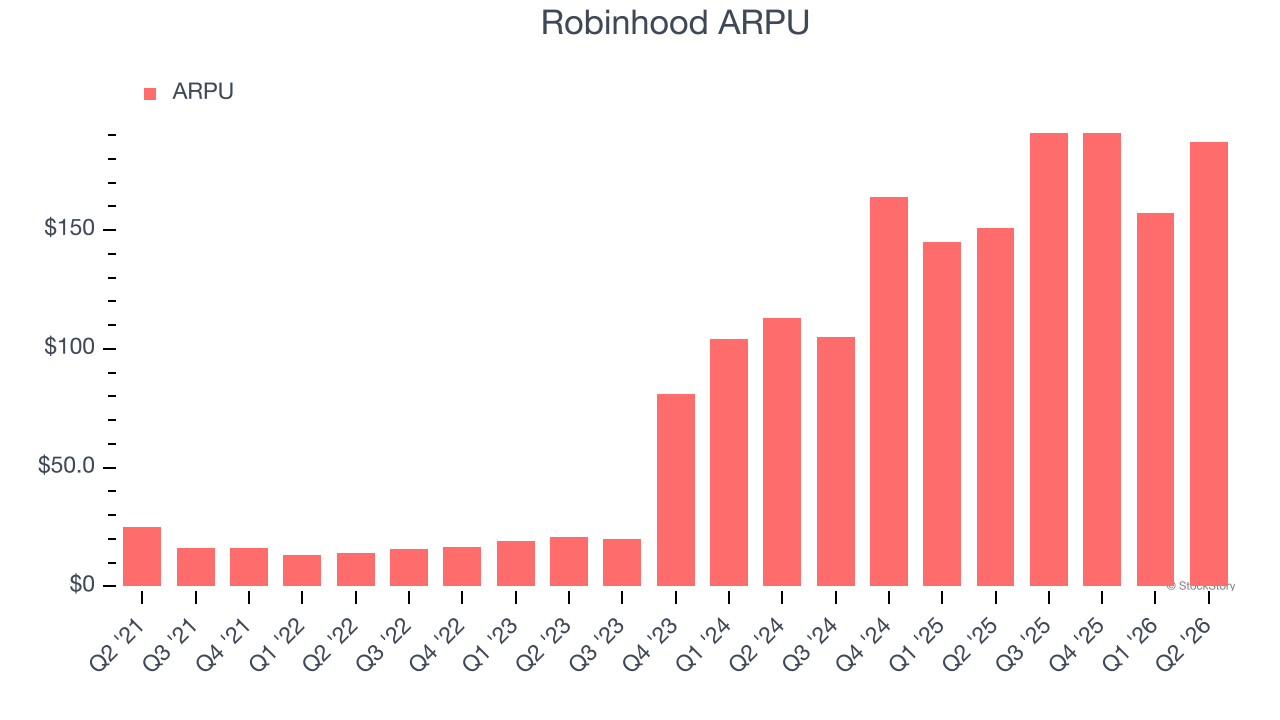
This quarter, Robinhood’s ARPU clocked in at $187. It grew by 23.8% year on year, faster than its funded customers.
Key Takeaways from Robinhood’s Q2 Results
We were impressed by how significantly Robinhood blew past analysts’ EBITDA expectations this quarter. We were also happy its revenue outperformed Wall Street’s estimates. Zooming out, we think this quarter featured some important positives. Investors were likely hoping for more, and shares traded down 3.2% to $86.50 immediately following the results.
Is Robinhood an attractive investment opportunity right now? We think that the latest quarter is only one piece of the longer-term business quality puzzle. Quality, when combined with valuation, can help determine if the stock is a buy. We cover that in our actionable full research report which you can read here (it’s free).