What Happened?
A number of stocks fell in the afternoon session as investors rotated from the high-multiple growth names that led the recent rally.
Software companies are priced on earnings projected years into the future, and the discount rate applied to those future cash flows is sensitive to both inflation expectations and the Federal Reserve's rate path. The May import price data introduced the sharpest inflation surprise of the session: prices rose 1.9% against a 1.1% forecast, with an annual gain of 6.7%, the largest since August 2022. The data complicated the view that the Iran peace deal had cleanly resolved the inflation problem. Investors appeared to be rotating into cyclicals on falling oil and positioning cautiously ahead of new Chairman, Kevin Warsh's first Federal Reserve meeting later in the week.
The Bank of America fund manager survey added structural pressure. Portfolio managers cut allocations to tech stocks broadly, naming an AI bubble as the second-largest tail risk, cited by 28% of respondents. SpaceX's announcement that it is acquiring AI coding platform Cursor for $60 billion also contributed unease: the deal absorbs one of the most closely watched independent AI development tools into a mega-cap infrastructure play, signalling that the most valuable AI software assets are being consolidated rather than remaining available as standalone platforms.
The stock market overreacts to news, and big price drops can present good opportunities to buy high-quality stocks.
Among others, the following stocks were impacted:
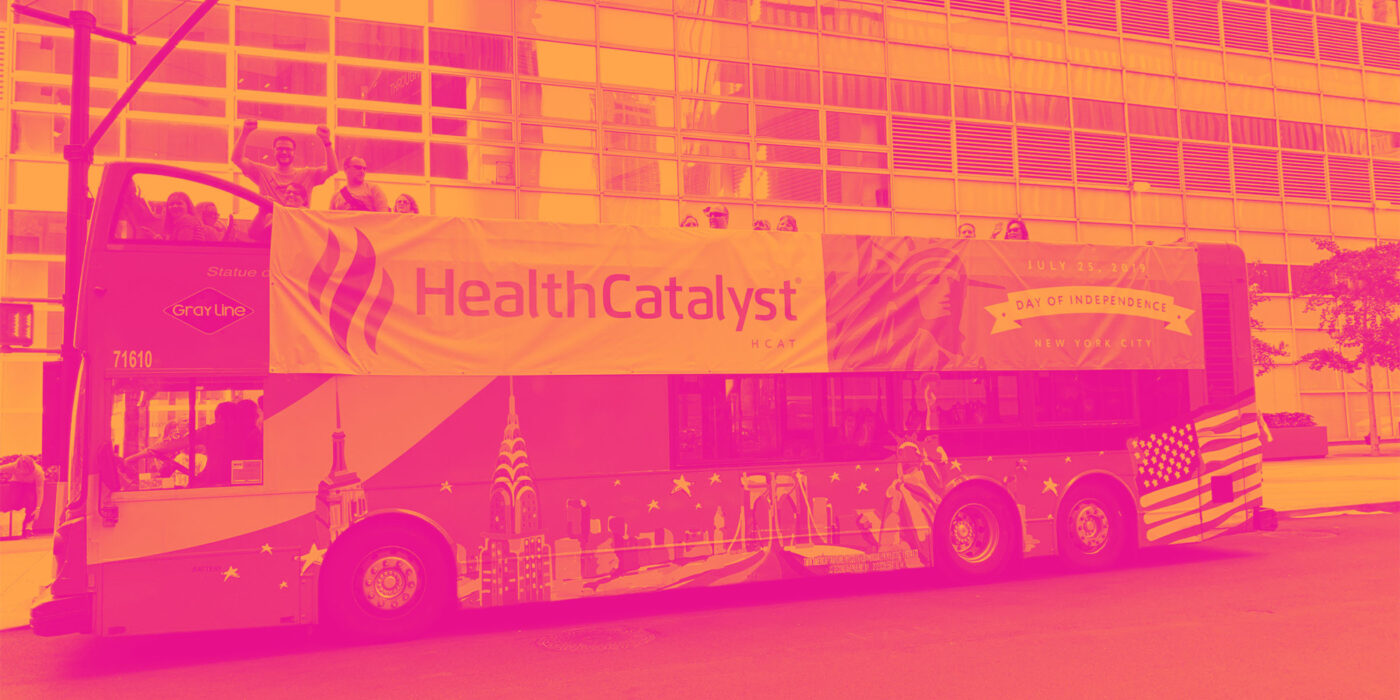
- Data Analytics company Health Catalyst (NASDAQ: HCAT) fell 3.6%. Is now the time to buy Health Catalyst? Access our full analysis report here, it’s free.
- HR Software company Paycom (NYSE: PAYC) fell 3.5%. Is now the time to buy Paycom? Access our full analysis report here, it’s free.
Zooming In On Health Catalyst (HCAT)
Health Catalyst’s shares are extremely volatile and have had 57 moves greater than 5% over the last year. In that context, today’s move indicates the market considers this news meaningful but not something that would fundamentally change its perception of the business.
The previous big move we wrote about was 7 days ago when the stock dropped 2.6% on the news that Anthropic released new models (Claude Fable 5 and Claude Mythos 5) which were described as built for "the hardest knowledge work and coding problems."
Mythos had been restricted for roughly two months under Project Glasswing, a managed rollout to select governments and enterprises designed to contain its cybersecurity risk profile before a wider release. That matters because the SaaSpocalypse thesis gets reinforced every time a more capable AI agent arrives. When Anthropic launched Claude Cowork in January, it triggered a $285 billion rout in software stocks in a single session, with Goldman's US software basket falling.
This is another iteration of the same logic: if an agent available for $20 a month can now complete long-run, multi-step knowledge work, the case for more expensive per-seat enterprise subscriptions gets harder to defend with each new model generation.
Adding to the weakness, US Central Command confirmed an American Apache helicopter had gone down near the coast of Oman, and Trump said the US "must respond" to what he described as an Iranian attack over the Strait of Hormuz. The Apache helicopter incident gave the software sector a macro headwind on top of those pressures. Software is a long-duration asset, its valuation is rooted in future cash flows, making it particularly exposed to any development that firms up the case for sustained higher interest rates. An Iranian attack on US military assets over the Strait of Hormuz is precisely that kind of development.
Health Catalyst is down 23% since the beginning of the year, and at $1.76 per share, it is trading 57.1% below its 52-week high of $4.09 from July 2025. Investors who bought $1,000 worth of Health Catalyst’s shares 5 years ago would now be looking at only $31.76.
ONE MORE THING: The $21 AI Application Stock Wall Street Forgot. While Wall Street obsesses over who’s building AI, one company is already using it to print money. And nobody’s paying attention.
AI chip stocks trade at ridiculous valuations. This company processes a trillion consumer signals monthly using AI and trades at a third of the price. The gap won’t last. The institutions will figure it out. You need to see this first. Read the FREE Report Before They Notice.