
IT distribution giant Ingram Micro (NYSE: INGM) reported revenue ahead of Wall Street’s expectations in Q1 CY2026, with sales up 13.7% year on year to $13.96 billion. On top of that, next quarter’s revenue guidance ($13.8 billion at the midpoint) was surprisingly good and 5.5% above what analysts were expecting. Its GAAP profit of $0.42 per share was 10.6% below analysts’ consensus estimates.
Is now the time to buy Ingram Micro? Find out by accessing our full research report, it’s free.
Ingram Micro (INGM) Q1 CY2026 Highlights:
- Revenue: $13.96 billion vs analyst estimates of $12.79 billion (13.7% year-on-year growth, 9.2% beat)
- EPS (GAAP): $0.42 vs analyst expectations of $0.47 (10.6% miss)
- Adjusted EBITDA: $331.2 million vs analyst estimates of $319.2 million (2.4% margin, 3.7% beat)
- Revenue Guidance for Q2 CY2026 is $13.8 billion at the midpoint, above analyst estimates of $13.08 billion
- Operating Margin: 1.6%, in line with the same quarter last year
- Free Cash Flow was -$1.01 billion compared to -$230.2 million in the same quarter last year
- Market Capitalization: $7.02 billion
Company Overview
Operating as the crucial link in the global technology supply chain with a presence in 57 countries, Ingram Micro (NYSE: INGM) is a global technology distributor that connects manufacturers with resellers, providing hardware, software, cloud services, and logistics expertise.
Revenue Growth
A company’s long-term sales performance is one signal of its overall quality. Even a bad business can shine for one or two quarters, but a top-tier one grows for years.
With $54.24 billion in revenue over the past 12 months, Ingram Micro is a behemoth in the business services sector and benefits from economies of scale, giving it an edge in distribution. This also enables it to gain more leverage on its fixed costs than smaller competitors and the flexibility to offer lower prices. However, its scale is a double-edged sword because finding new avenues for growth becomes difficult when you already have a substantial market presence. To accelerate sales, Ingram Micro likely needs to optimize its pricing or lean into new offerings and international expansion.
As you can see below, Ingram Micro struggled to increase demand as its $54.24 billion of sales for the trailing 12 months was close to its revenue five years ago. This shows demand was soft, a poor baseline for our analysis.
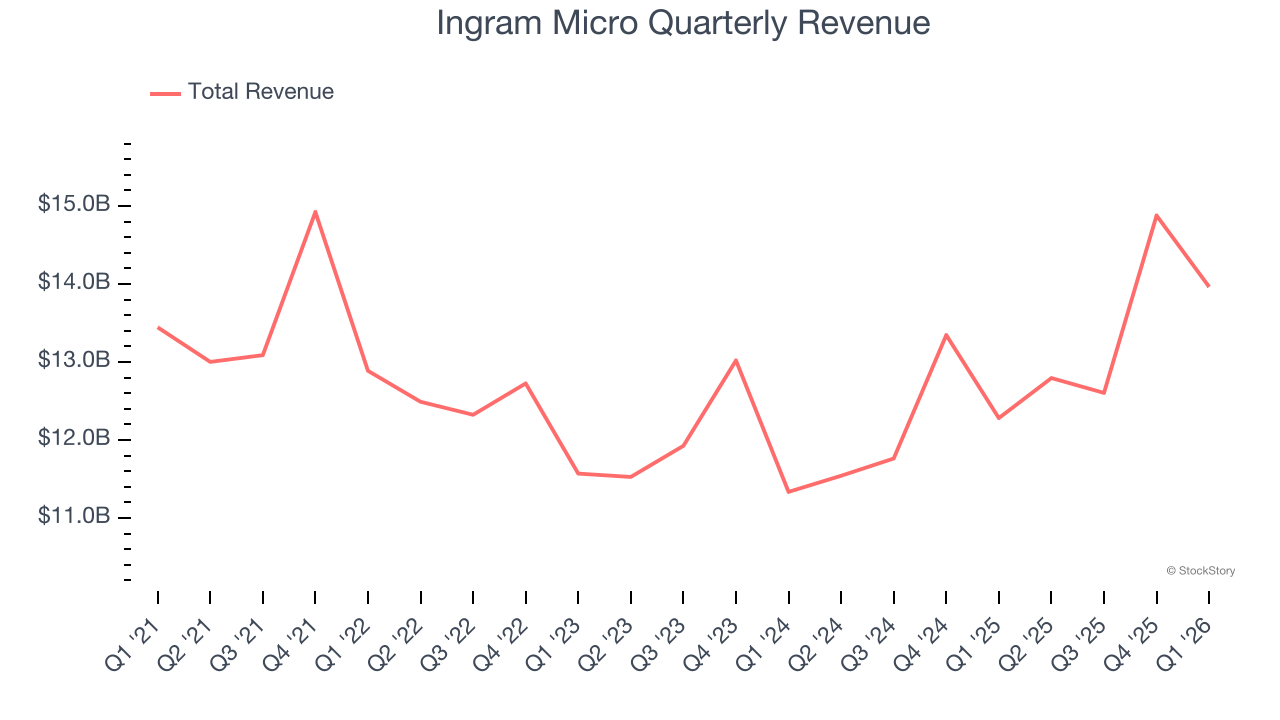
Long-term growth is the most important, but within business services, a half-decade historical view may miss new innovations or demand cycles. Ingram Micro’s annualized revenue growth of 6.5% over the last two years is above its five-year trend, suggesting some bright spots. 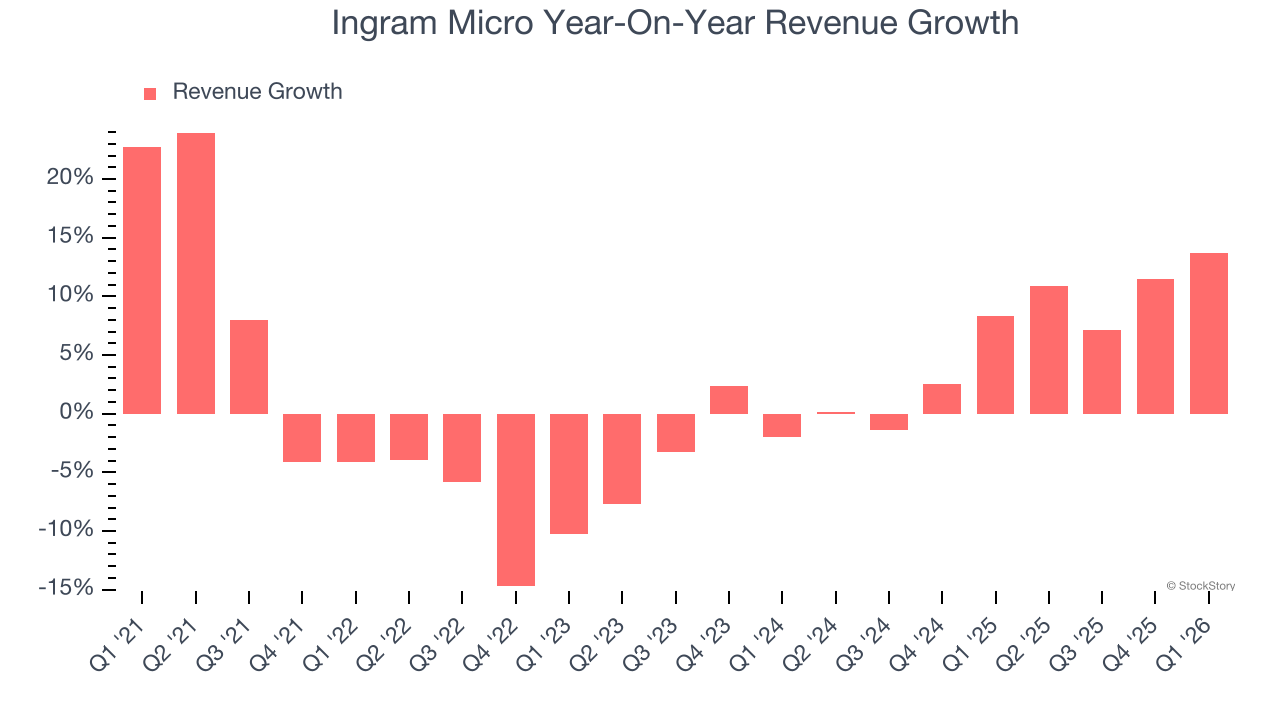
This quarter, Ingram Micro reported year-on-year revenue growth of 13.7%, and its $13.96 billion of revenue exceeded Wall Street’s estimates by 9.2%. Company management is currently guiding for a 7.9% year-on-year increase in sales next quarter.
Looking further ahead, sell-side analysts expect revenue to remain flat over the next 12 months, a deceleration versus the last two years. This projection is underwhelming and suggests its products and services will face some demand challenges.
ONE MORE THING: 3 Hidden Platforms Growing 3X Faster than Amazon, Google, and PayPal. Amazon, Google, and Meta all followed the same playbook: Dominate an ignored market. Build an unbeatable moat. Scale until you’re unstoppable.
These three platforms are running that exact playbook right now. The early investors in Amazon made fortunes. The early investors in these could do the same. Get All 3 Stocks Here for FREE.
Adjusted Operating Margin
Adjusted operating margin is an important measure of profitability as it shows the portion of revenue left after accounting for all core expenses – everything from the cost of goods sold to advertising and wages. It’s also useful for comparing profitability across companies because it excludes non-recurring expenses, interest on debt, and taxes.
Ingram Micro’s adjusted operating margin has generally stayed the same over the last 12 months, averaging 1.8% over the last five years. This profitability was inadequate for a business services business and caused by its suboptimal cost structure.
Analyzing the trend in its profitability, Ingram Micro’s adjusted operating margin might fluctuated slightly but has generally stayed the same over the last five years, which doesn’t help its cause.
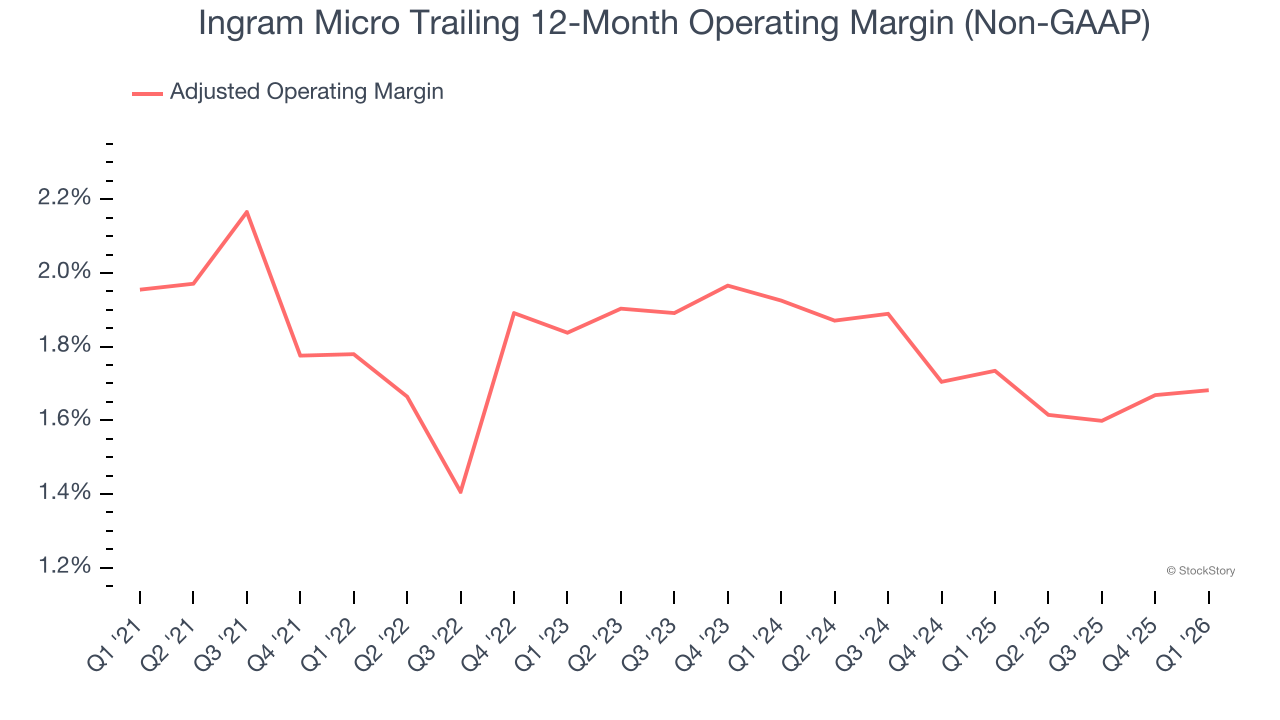
In Q1, Ingram Micro generated an adjusted operating margin profit margin of 1.7%, in line with the same quarter last year. This indicates the company’s overall cost structure has been relatively stable.
Earnings Per Share
Revenue trends explain a company’s historical growth, but the long-term change in earnings per share (EPS) points to the profitability of that growth – for example, a company could inflate its sales through excessive spending on advertising and promotions.
Ingram Micro’s full-year EPS dropped 28.1%, or 8.6% annually, over the last three years. We tend to steer our readers away from companies with falling revenue and EPS, where diminishing earnings could imply changing secular trends and preferences. If the tide turns unexpectedly, Ingram Micro’s low margin of safety could leave its stock price susceptible to large downswings.
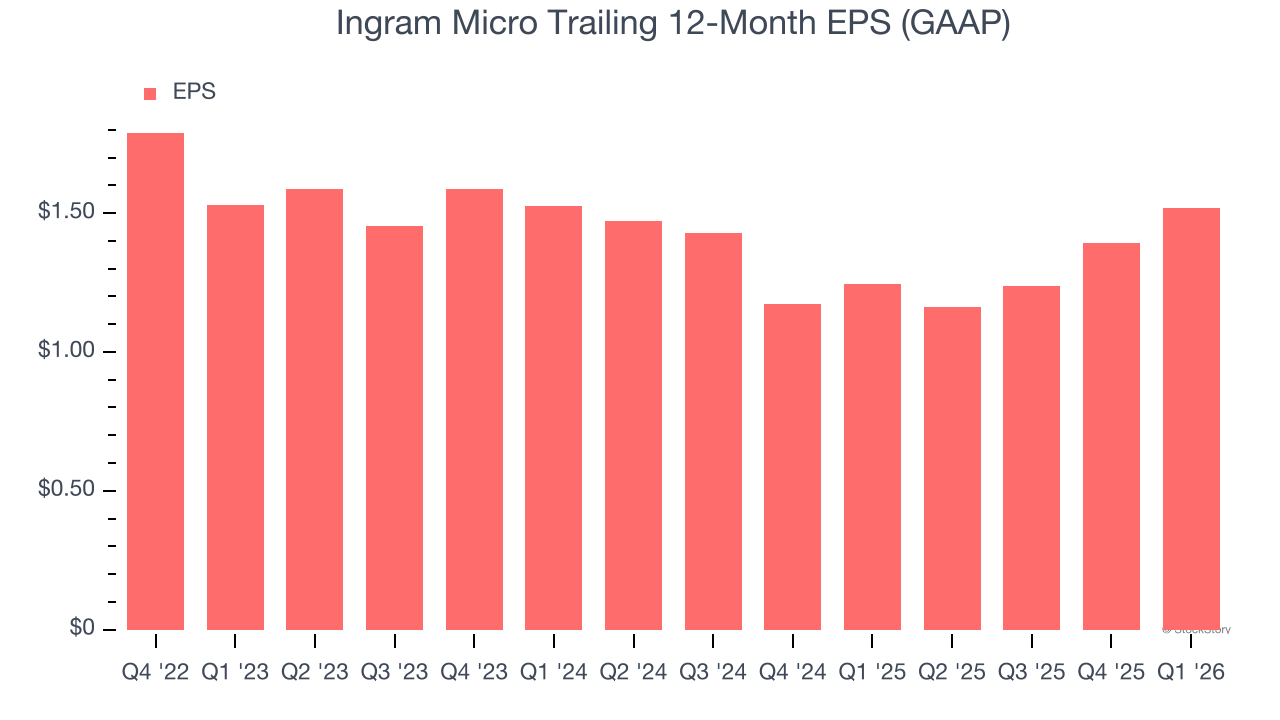
Like with revenue, we analyze EPS over a more recent period because it can provide insight into an emerging theme or development for the business.
For Ingram Micro, EPS didn’t budge over the last two years, but at least that was better than its three-year trend. We hope its earnings can grow in the coming years.
In Q1, Ingram Micro reported EPS of $0.42, up from $0.29 in the same quarter last year. Despite growing year on year, this print missed analysts’ estimates. Over the next 12 months, Wall Street expects Ingram Micro’s full-year EPS of $1.52 to grow 61.8%.
Key Takeaways from Ingram Micro’s Q1 Results
We were impressed by how significantly Ingram Micro blew past analysts’ revenue expectations this quarter. We were also glad its revenue guidance for next quarter trumped Wall Street’s estimates. On the other hand, its EPS missed. Overall, this print had some key positives. Investors were likely hoping for more, and shares traded down 11.8% to $27.10 immediately after reporting.
So should you invest in Ingram Micro right now? The latest quarter does matter, but not nearly as much as longer-term fundamentals and valuation, when deciding if the stock is a buy. We cover that in our actionable full research report which you can read here (it’s free).