Natural food company Hain Celestial (NASDAQ: HAIN) missed Wall Street’s revenue expectations in calendar Q3 2026 (fiscal Q1 2027), with revenue falling 29.3% year on year to $260.3 million. Its non-GAAP loss of $0.07 per share was 81.8% below analysts’ consensus estimates.
For more on Hain Celestial, read our free full research report.
Hain Celestial (HAIN) Q3 CY2026 highlights:
- Revenue $260.3 million vs S&P analyst consensus of $283 million (29.3% year-on-year decline, 8% miss)
- Adjusted EPS -$0.07 vs S&P analyst consensus of -$0.04 (81.8% miss)
- Adjusted EBITDA $17.58 million vs analysts’ consensus estimates of $18.91 million (6.8% margin, 7% miss)
- Operating margin -5.8%, down from 1.8% in the same quarter last year
- Free cash flow -$22.84 million compared to -$13.71 million in the same quarter last year
- Organic revenue fell 6.7% year on year
- Market capitalization $13.6 million
Lewis continued, “Receiving the final required regulatory approvals is an important step toward completing the sale of our International business. We remain in discussions with our lenders regarding our capital structure and with AURELIUS regarding a path forward for the transaction. If completed, the International sale would allow us to reduce debt and create a more focused North America business with strong brands in attractive categories. We will provide updates as material developments occur.”
Revenue growth
Reviewing a company’s long-term revenue performance reveals insights into its quality. Any business can experience short-term success, but top-performing ones sustain growth for years.
With $1.25 billion in revenue over the past 12 months, Hain Celestial is a small consumer staples company, which sometimes brings disadvantages compared to larger competitors benefiting from economies of scale and negotiating leverage with retailers.
Hain Celestial’s revenue declined by 11.3% per year over the last three years.
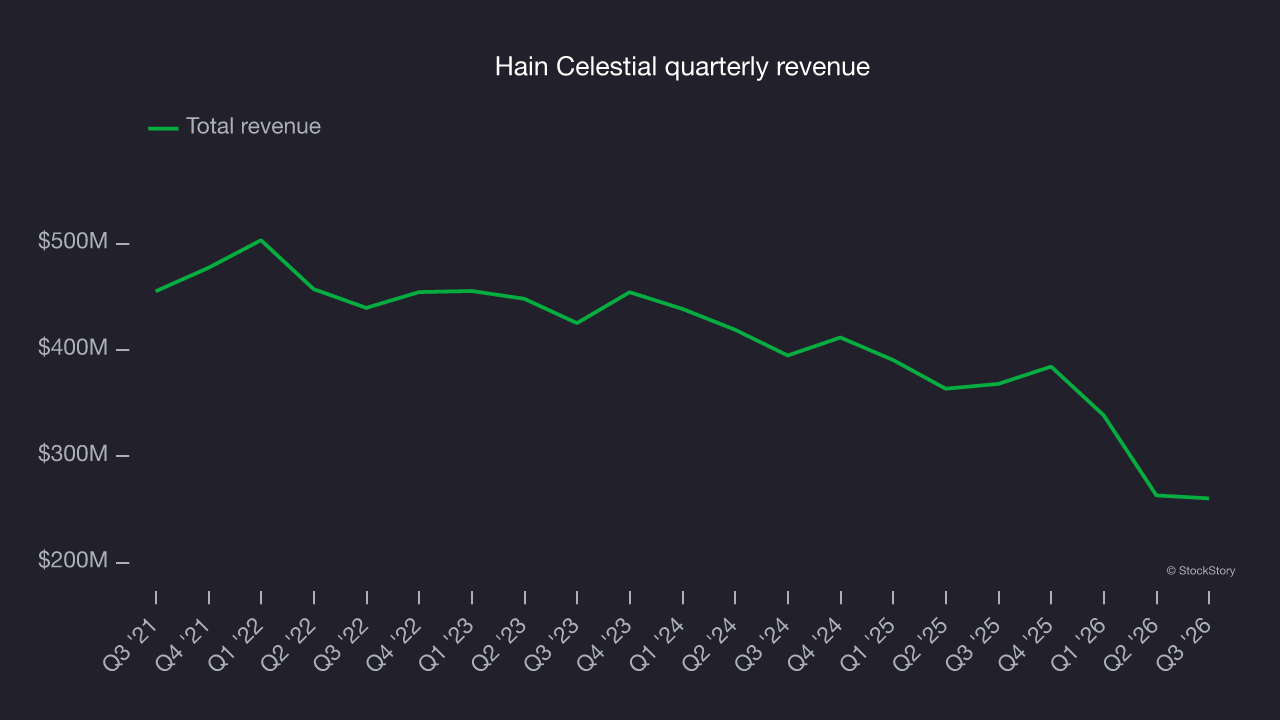
This quarter, Hain Celestial missed Wall Street’s consensus estimates and reported an uninspiring 29.3% year-on-year revenue decline, generating $260.3 million of revenue.
Looking ahead, sell-side analysts expect revenue to decline by 9.4% over the next 12 months, according to S&P. The company’s struggle with demand remains a concern.
Organic revenue growth
The most important measure of revenue growth is organic revenue growth. This metric captures a business’s performance excluding one-time events such as mergers, acquisitions and divestitures as well as foreign currency fluctuations.
Hain Celestial’s demand has been falling over the last eight quarters, and on average, its organic revenue has declined by 6.4% year on year. 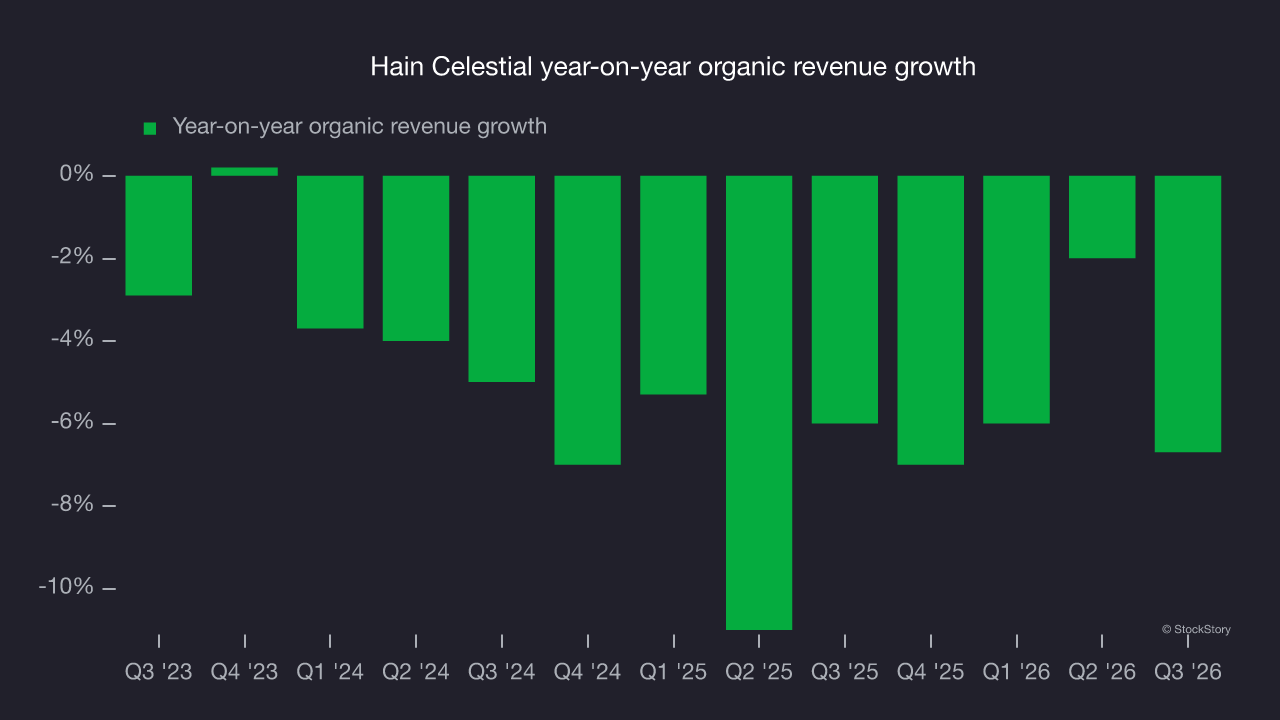
In the latest quarter, Hain Celestial’s organic revenue fell by 6.7% year on year. This performance was more or less in line with its historical levels.
Key takeaways from Hain Celestial’s Q3 results
Hain Celestial delivered a weaker quarter with few positives: Revenue missed Wall Street’s consensus estimates, and EBITDA also fell short. Shares tumbled 6.7% to $0.14 immediately after the results.
Hain Celestial’s latest earnings report disappointed. One quarter doesn’t define a company’s quality, so let’s explore whether the stock is a buy at the current price. The latest quarter is only one part of assessing longer-term business quality. Quality, when combined with valuation, can help determine if the stock is a buy. For more on Hain Celestial, read our full research report here (it’s free).