Digital media company Ziff Davis (NASDAQ: ZD) fell short of the market’s revenue expectations in Q3 2026, with revenue falling 20.5% year on year to $289.3 million. Its non-GAAP profit of $1.39 per share was 11.1% above analysts’ consensus estimates.
For more on Ziff Davis, read our free full research report.
Ziff Davis (ZD) Q3 2026 highlights:
- Revenue $289.3 million vs S&P analysts’ consensus estimates of $294.5 million (20.5% year-on-year decline, 1.8% miss)
- Adjusted EPS $1.39 vs S&P analysts’ consensus estimates of $1.25 (11.1% beat)
- Adjusted EBITDA $82.2 million vs analysts’ consensus estimates of $82.92 million (28.4% margin, 0.9% miss)
- Operating margin -11.6%, down from 7.8% in the same quarter last year
- Free cash flow -$23.04 million, down from $108.2 million in the same quarter last year
- Market capitalization $1.95 billion
“We delivered third quarter results in line with the expectations we set last quarter, including sequential revenue growth despite a challenging operating environment,” said Vivek Shah, CEO of Ziff Davis. “Through the first three quarters of 2026, we repurchased approximately $265 million of our shares, reducing our share count by nearly 14%, and we will keep pursuing opportunities to unlock additional shareholder value.”
Revenue growth
A company’s long-term revenue performance is one signal of its overall quality. Any business can deliver a good quarter or two, but the best consistently grow over the long haul.
With $1.25 billion in revenue over the past 12 months, Ziff Davis is a mid-sized business services company, which sometimes brings disadvantages compared to larger competitors benefiting from better economies of scale.
Ziff Davis’s demand was weak over the last five years. Its revenue fell by 1.6% annually.
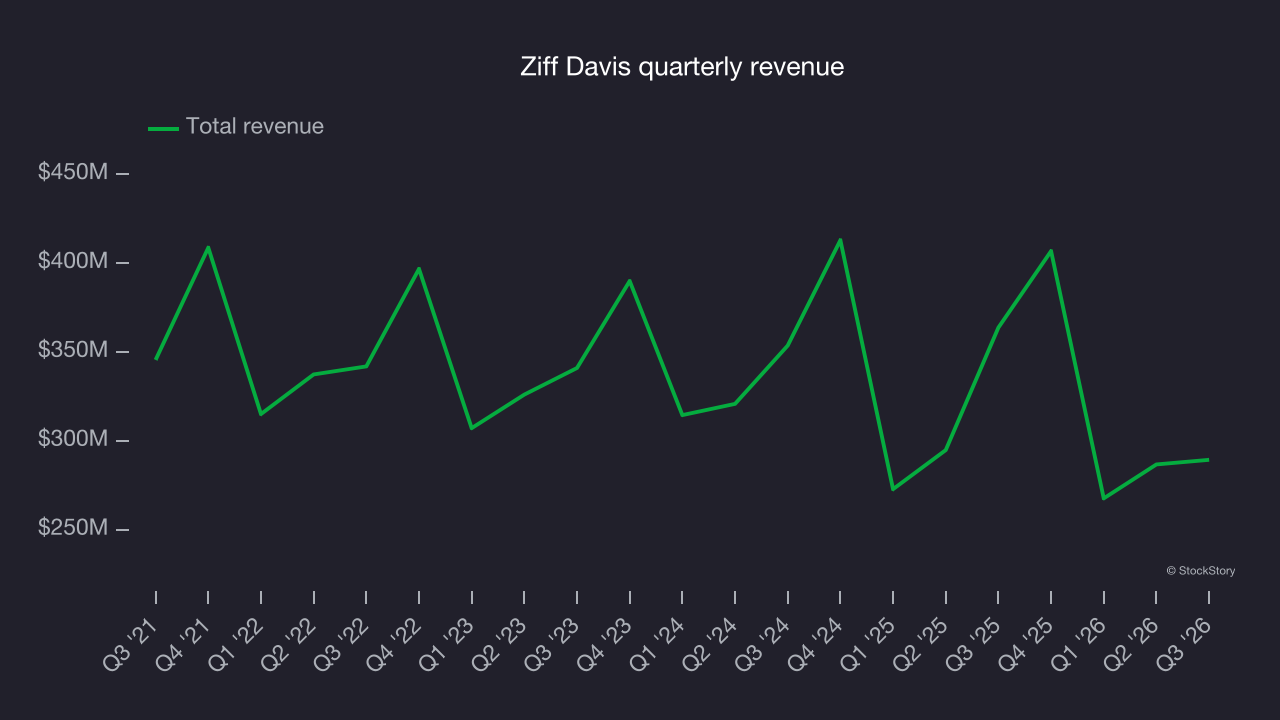
Long-term growth matters most, but within business services, a half-decade historical view may miss recent innovations or disruptive industry trends. Ziff Davis’s recent performance shows its demand remained suppressed as its revenue has declined by 4.8% annually over the last two years. 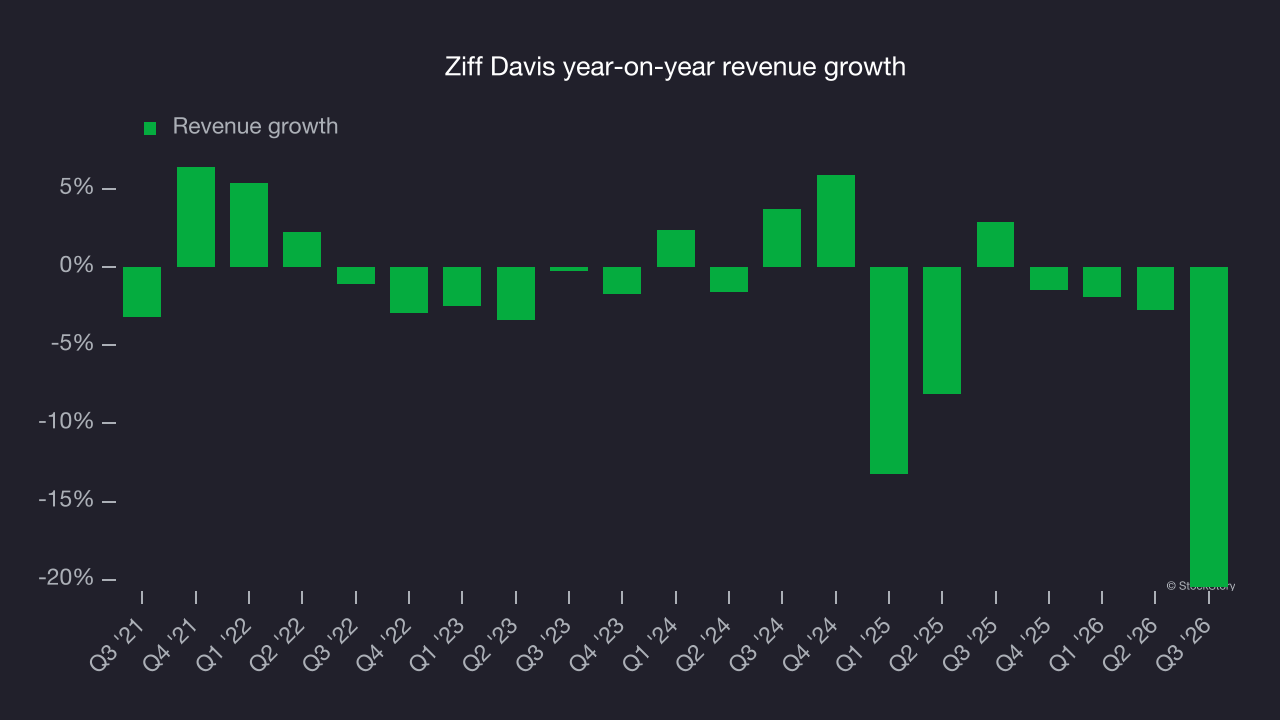
This quarter, Ziff Davis missed Wall Street’s consensus estimates and reported an uninspiring 20.5% year-on-year revenue decline, generating $289.3 million in revenue.
Looking ahead, sell-side analysts expect revenue to decline by 4.6% over the next 12 months, according to S&P, similar to its two-year rate. This projection is underwhelming and implies its newer products and services will not lead to better top-line performance yet.
Adjusted operating margin
Ziff Davis has performed well over the last five years. It demonstrated high profitability for a business services company, with an average adjusted operating margin of 26.8%.
Looking at the trend in its profitability, Ziff Davis’s adjusted operating margin decreased by 13.5 percentage points over the last five years. Even though its historical margin was healthy, shareholders will want to see Ziff Davis become more profitable in the future.
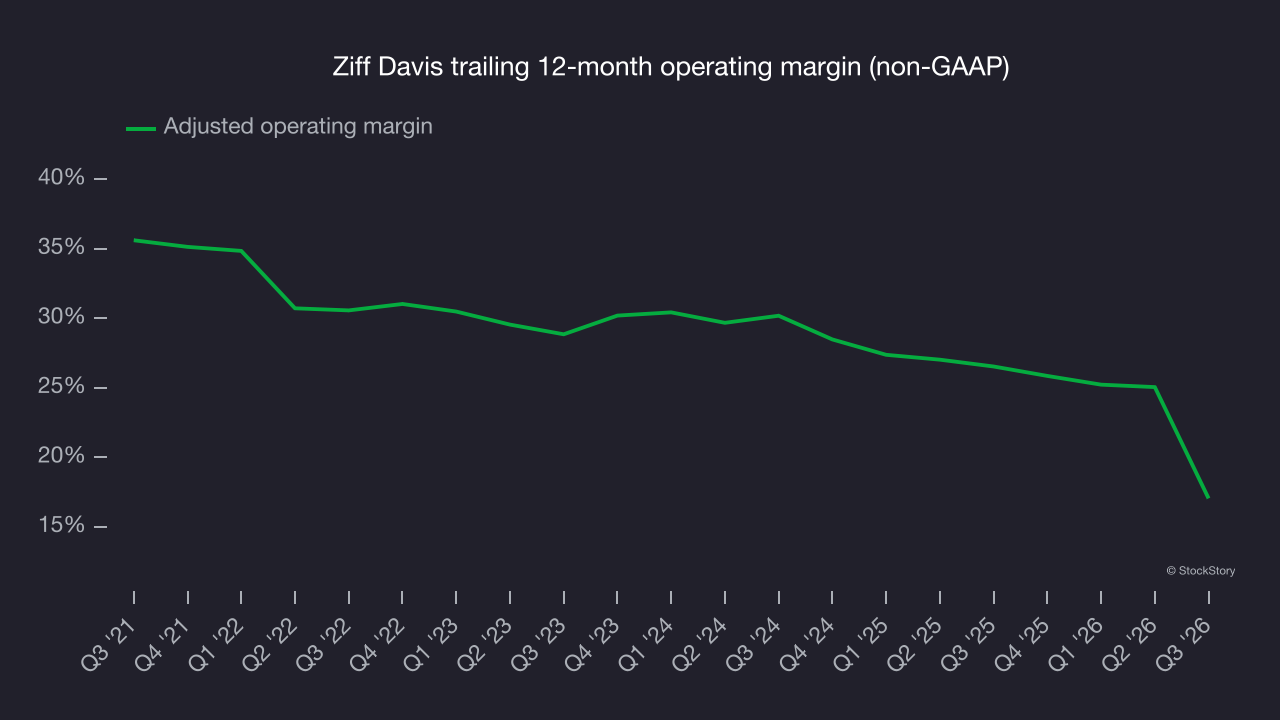
In Q3, Ziff Davis generated an adjusted operating margin of negative 7.2%, down 34.1 percentage points year on year. This contraction shows it was less efficient because its expenses increased relative to its revenue.
Earnings per share
Long-term changes in earnings per share, or EPS, matter for the same reason as long-term revenue growth. Compared to revenue, however, EPS highlights whether a company’s growth is profitable.
Ziff Davis’s EPS declined by 10.7% annually over the last five years, more than its revenue. This indicates the company struggled because its fixed cost base made it difficult to adjust to shrinking demand.
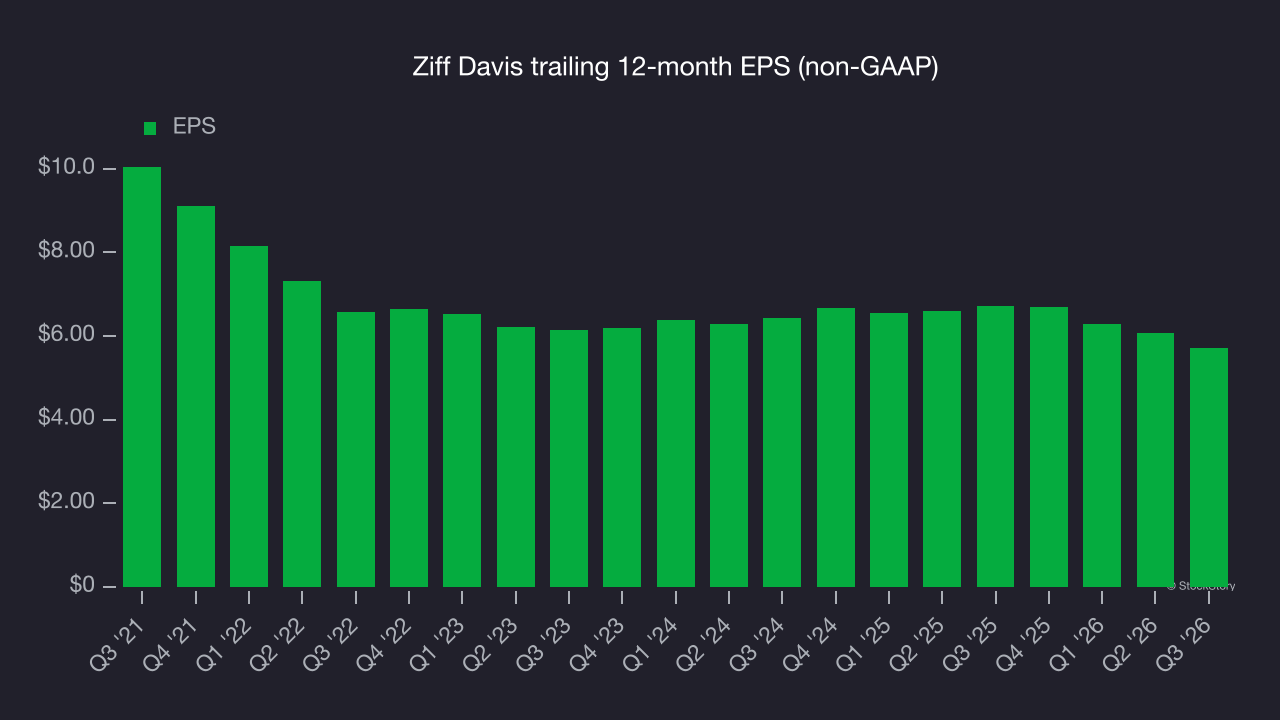
A closer look at Ziff Davis’s earnings helps explain the drivers of its performance. As mentioned earlier, Ziff Davis’s adjusted operating margin declined by 13.5 percentage points over the last five years. This was the most relevant factor (aside from the revenue impact) behind its lower earnings; interest expenses and taxes can also affect EPS but reveal less about a company’s fundamentals.
As with revenue, examining EPS over a more recent period can provide insight into an emerging theme or development for the business.
For Ziff Davis, its two-year annual EPS declines of 5.7% show it’s still underperforming. These were poor results by any measure.
In Q3, Ziff Davis reported adjusted EPS of $1.39, down from $1.76 in the same quarter last year. Despite falling year on year, this result comfortably beat analysts’ consensus estimates. Over the next 12 months, Wall Street expects Ziff Davis’s full-year EPS to stay about the same, moving from $5.71 to $5.74, according to S&P.
Key takeaways from Ziff Davis’s Q3 results
Ziff Davis delivered a mixed Q3: EPS topped analysts’ consensus estimates, but revenue fell short. Shares remained flat at $54.35 immediately after the results.
When deciding whether to buy the stock, consider the bigger picture of valuation, business quality and the latest earnings. Read the full research report here (it’s free).