Background screening provider First Advantage (NASDAQ: FA) beat Wall Street’s revenue expectations in Q3 2026, with revenue up 13.8% year on year to $465.8 million. The company’s full-year revenue guidance of $1.73 billion at the midpoint came in 1.6% above analysts’ consensus estimates. Its non-GAAP profit of $0.38 per share was 13.3% above analysts’ consensus estimates.
For more on First Advantage, read our free full research report.
First Advantage (FA) Q3 2026 highlights:
- Revenue $465.8 million vs S&P analysts’ consensus estimates of $437.7 million (13.8% year-on-year growth, 6.4% beat)
- Adjusted EPS $0.38 vs S&P analysts’ consensus estimates of $0.34 (13.3% beat)
- Adjusted EBITDA $136.5 million vs analysts’ consensus estimates of $125.2 million (29.3% margin, 9.1% beat)
- Revenue guidance The company lifted its revenue guidance for the full year to $1.73 billion at the midpoint from $1.69 billion, a 2.5% increase
- Adjusted EPS guidance Management raised its full-year adjusted EPS guidance to $1.32 at the midpoint, a 4.4% increase
- EBITDA guidance $493 million at the midpoint for the full year, above analysts’ consensus estimates of $483.3 million
- Operating margin 12.9%, up from 10.3% in the same quarter last year
- Free cash flow margin 8.7%, down from 14.4% in the same quarter last year
- Market capitalization $3.86 billion
“We delivered another quarter of outstanding performance, highlighted by nearly 14% revenue growth, increasing margins, strong cash flow, and robust earnings per share growth. Our results reflected sustained positive momentum across our revenue growth algorithm, with continued excellent base growth, solid new logo contribution, successful upsell and cross-sell activity, and consistently high retention. We continue to see broad-based growth across our diverse, balanced verticals, with strong performance from nearly every vertical in our Americas business. Our AI-enabled products continue to be key differentiators as we help our customers mitigate human capital risks and prevent fraud. Our go-to-market momentum and pipeline remain strong as we approach 2027,” said Scott Staples, Chief Executive Officer.
Revenue growth
A company’s long-term revenue performance can indicate its overall quality. Even a poor business can perform well for one or two quarters, but a high-quality one grows for years.
With $1.72 billion in revenue over the past 12 months, First Advantage is a mid-sized business services company, which sometimes brings disadvantages compared to larger competitors benefiting from better economies of scale. On the positive side, it can still achieve high growth rates because it’s working from a smaller revenue base.
First Advantage grew its revenue at a strong 21.2% compounded annual growth rate over the last five years. This shows First Advantage’s demand was higher than that of many business services companies.
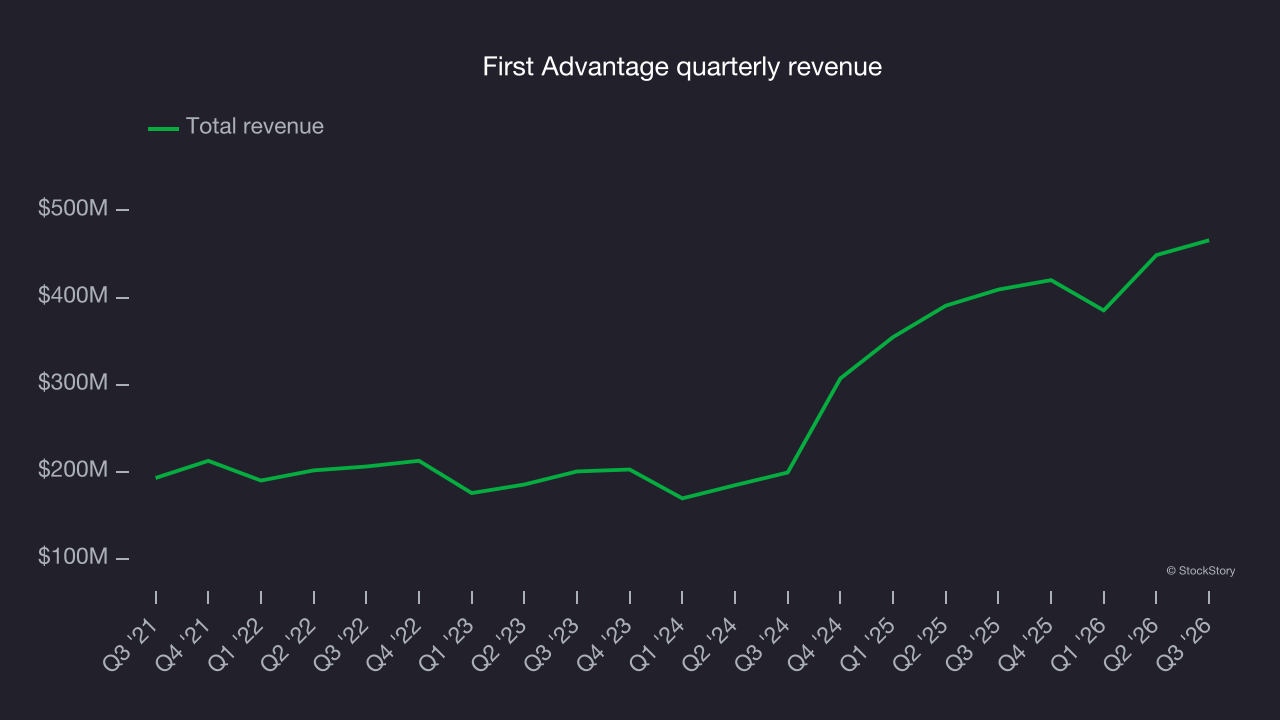
Long-term growth matters most, but within business services, a half-decade historical view may miss recent innovations or disruptive industry trends. First Advantage’s annualized revenue growth of 50.9% over the last two years is above its five-year trend, suggesting its demand was strong and recently accelerated. 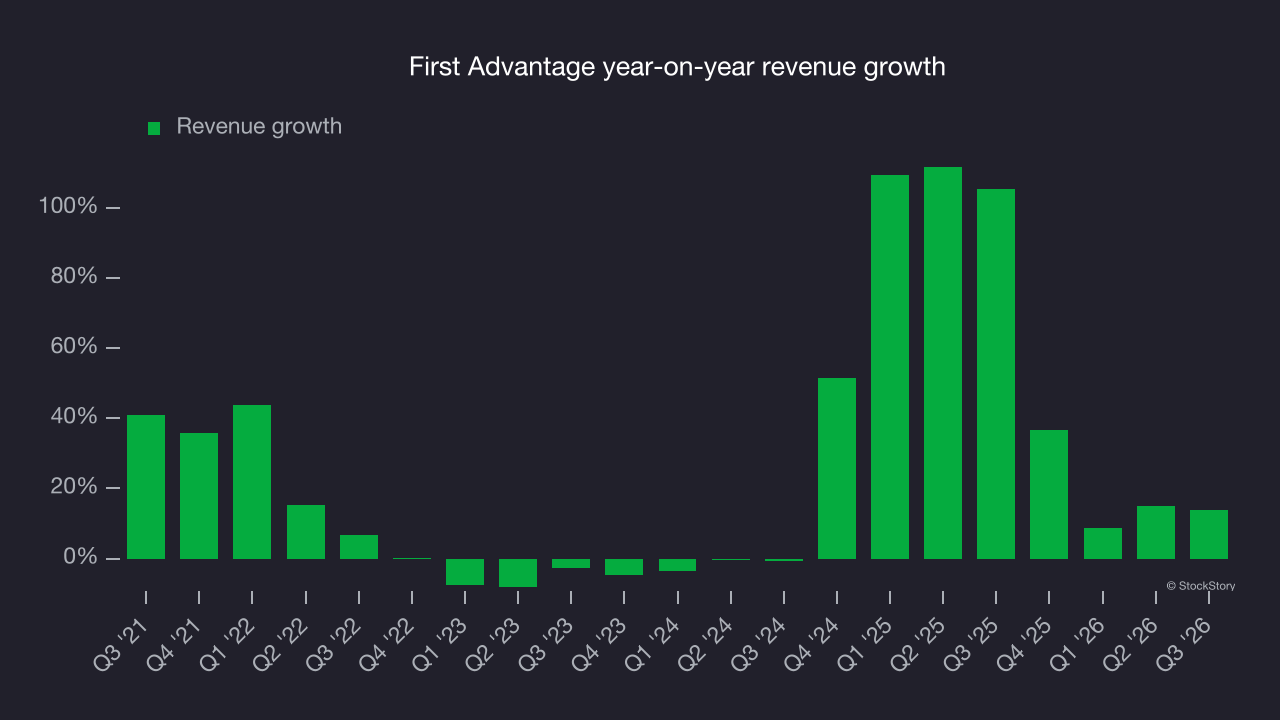
This quarter, First Advantage reported year-on-year revenue growth of 13.8%, and its $465.8 million of revenue exceeded Wall Street’s consensus estimates by 6.4%.
Looking ahead, sell-side analysts expect revenue to grow 3.8% over the next 12 months, according to S&P, a deceleration versus the last two years. This underwhelming projection indicates its products and services will see some demand headwinds. Still, the company is tracking well on other measures of financial health.
Adjusted operating margin
Adjusted operating margin is a key measure of profitability. Think of it as net income (the bottom line) excluding the impact of non-recurring expenses, taxes and interest on debt – items less connected to business fundamentals.
First Advantage’s adjusted operating margin has risen over the last 12 months and averaged 13.1% over the last five years. Its solid profitability for a business services company shows it manages its expenses efficiently and benefits from operating leverage as it scales.
First Advantage’s adjusted operating margin may have fluctuated slightly but has generally stayed the same over the last five years. This raises questions about the company’s expense base because its revenue growth should have given it leverage on its fixed costs, resulting in better economies of scale and profitability.
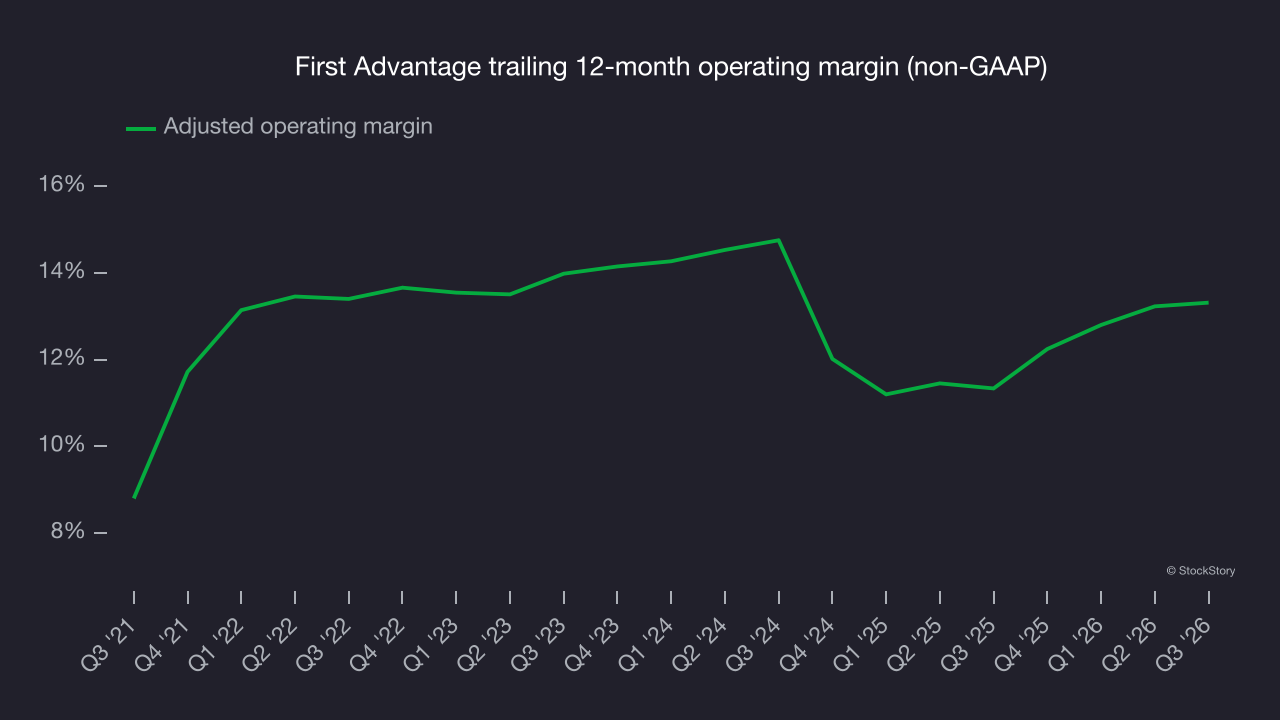
In Q3, First Advantage generated an adjusted operating margin of 14%, in line with the same quarter last year. This indicates the company’s overall cost structure has been relatively stable.
Earnings per share
We track the long-term change in earnings per share, or EPS, for the same reason as long-term revenue growth. Compared to revenue, however, EPS highlights whether a company’s growth is profitable.
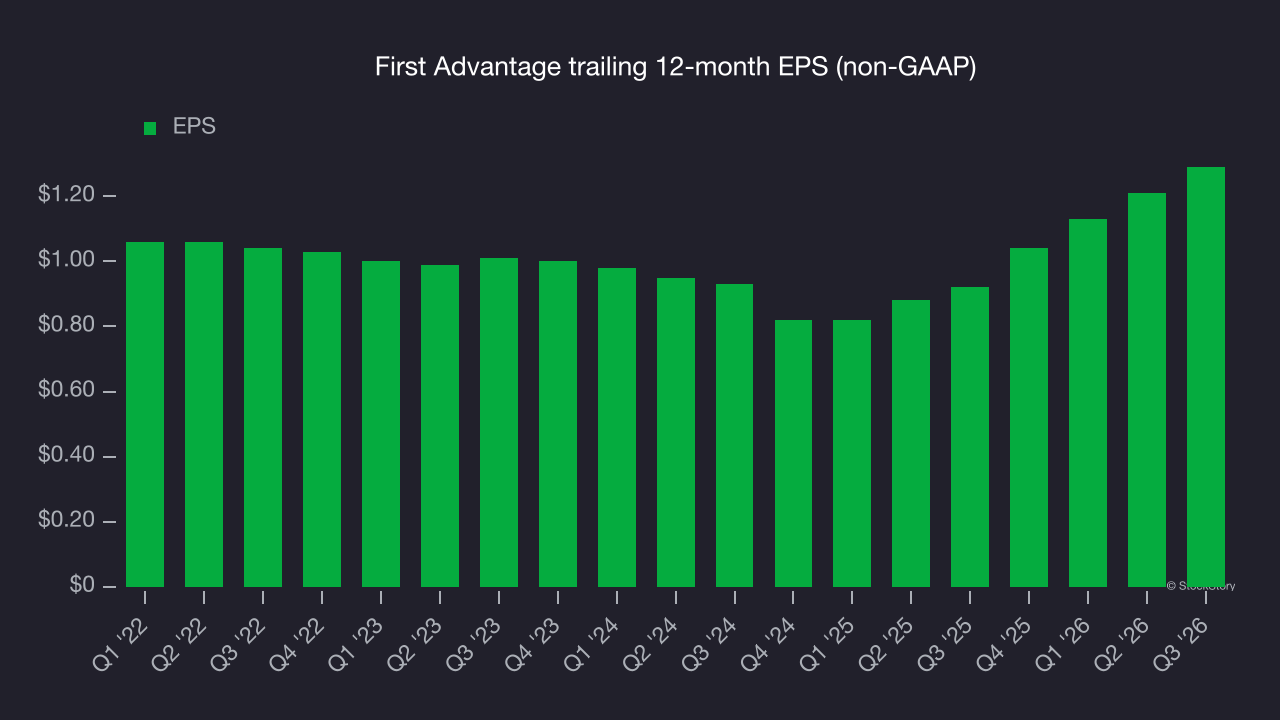
First Advantage’s EPS grew at an unimpressive 6.6% compounded annual growth rate over the last five years, lower than its 21.2% annualized revenue growth. However, its adjusted operating margin didn’t change during this time, telling us that non-fundamental factors such as interest and taxes affected its ultimate earnings.
Like with revenue, we analyze EPS over a more recent period because it can provide insight into an emerging theme or development for the business.
For First Advantage, its two-year annual EPS growth of 17.8% was higher than its five-year trend. This acceleration made it one of the faster-growing business services companies in recent history.
In Q3, First Advantage reported adjusted EPS of $0.38, up from $0.30 in the same quarter last year. This result easily cleared analysts’ consensus estimates. Over the next 12 months, Wall Street expects First Advantage’s full-year EPS to grow 11.1% from $1.29 to $1.43, according to S&P.
Key takeaways from First Advantage’s Q3 results
First Advantage delivered a strong Q3, with revenue well above analysts’ consensus estimates and EPS also topping Wall Street’s estimates. Shares edged higher 1.6% to $22.84 immediately after the report.
First Advantage reported solid earnings, but one quarter doesn’t necessarily make the stock a buy. What happened in the latest quarter matters, but not as much as longer-term business quality and valuation when deciding whether to invest in this stock. Read our full research report here (it’s free).