Collaboration software company Atlassian (NASDAQ: TEAM) reported calendar Q3 2026 (fiscal Q1 2027) results beating Wall Street’s revenue expectations, with revenue up 23.7% year on year to $1.77 billion. Guidance for next quarter’s revenue was better than expected at $1.83 billion at the midpoint, 0.8% above analysts’ consensus estimates. Its non-GAAP profit of $1.65 per share was 15.7% above analysts’ consensus estimates.
For more on Atlassian, read our full research report, available free.
Atlassian (TEAM) Q3 CY2026 highlights:
- Revenue $1.77 billion vs S&P analysts’ consensus estimates of $1.71 billion (23.7% year-on-year growth, 3.5% beat)
- Adjusted EPS $1.65 vs S&P analysts’ consensus estimates of $1.43 (15.7% beat)
- Adjusted operating income $575.8 million vs analysts’ consensus estimates of $492.3 million (32.5% margin, 17% beat)
- Revenue guidance $1.83 billion at the midpoint for Q4 CY2026, above analysts’ consensus estimates of $1.81 billion
- Operating margin 10.7%, up from -6.7% in the same quarter last year
- Free cash flow margin 26.1%, similar to the previous quarter
- Billings $1.50 billion at quarter end, up 22.1% year on year
- Market capitalization $48.07 billion
"Q1 was a strong start to fiscal 2027, with RPO up 44% and Teamwork Collection customers up 7x year-over-year," said Mike Cannon-Brookes, Atlassian’s CEO and co-founder. "Enterprise AI has hit an inflection point. Model power is table stakes. The advantage goes to platforms that bring people and AI agents together with shared context, deep collaboration, and confidence in the outcome. That’s what we’ve built. Our Teamwork Graph gives agents the context of how work actually gets done, and AMP brings them into teams as accountable teammates. We’ve never been better positioned, and we’re just getting started."
Revenue growth
A company’s long-term revenue performance is one signal of its overall quality. Any business can experience short-term success, but top-performing ones sustain growth for years. Over the last five years, Atlassian grew its revenue at a solid 25.2% compounded annual growth rate. Its growth beat the average software company and shows its offerings resonate with customers.
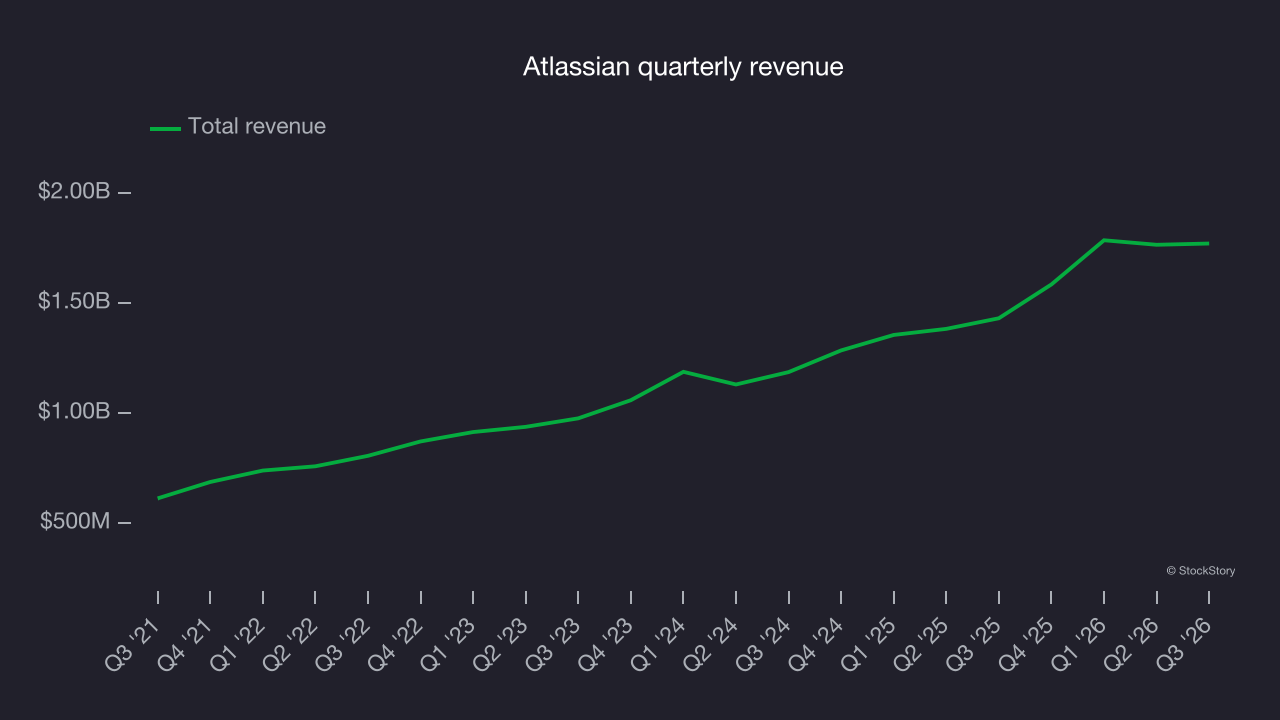
Long-term growth matters most, but within software, a half-decade historical view may miss recent innovations or disruptive industry trends. Atlassian’s annualized revenue growth of 23% over the last two years is below its five-year trend, but the results still suggest healthy demand. 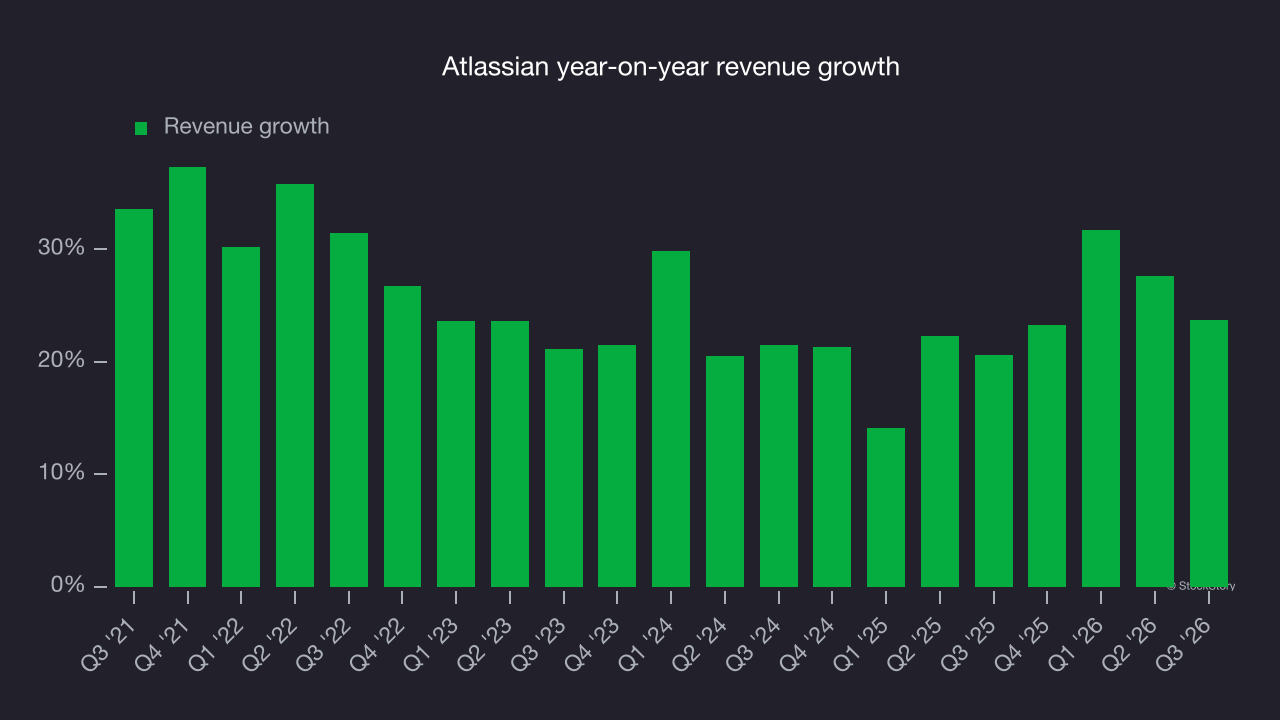
This quarter, Atlassian reported strong year-on-year revenue growth of 23.7%, and its $1.77 billion of revenue topped Wall Street’s consensus estimates by 3.5%. Company management is currently guiding for a 15.4% year-on-year increase in revenue next quarter.
Looking further ahead, sell-side analysts expect revenue to grow 11.4% over the next 12 months, according to S&P, a deceleration versus the last two years. This underwhelming projection implies its products and services will face some demand challenges. Still, the company is performing well on other measures of financial health.
Billings
Billings is a non-GAAP metric that is often called “cash revenue” because it shows how much money the company has collected from customers in a certain period. This is different from revenue, which must be recognized in pieces over the length of a contract.
Atlassian’s billings totaled $1.50 billion in Q3, and over the last four quarters, growth was strong, averaging 22.6% year on year. This alternative top-line metric grew more slowly than total revenue, meaning the company recognizes revenue faster than it collects cash – a headwind for its liquidity that could also signal a slowdown in future revenue growth. 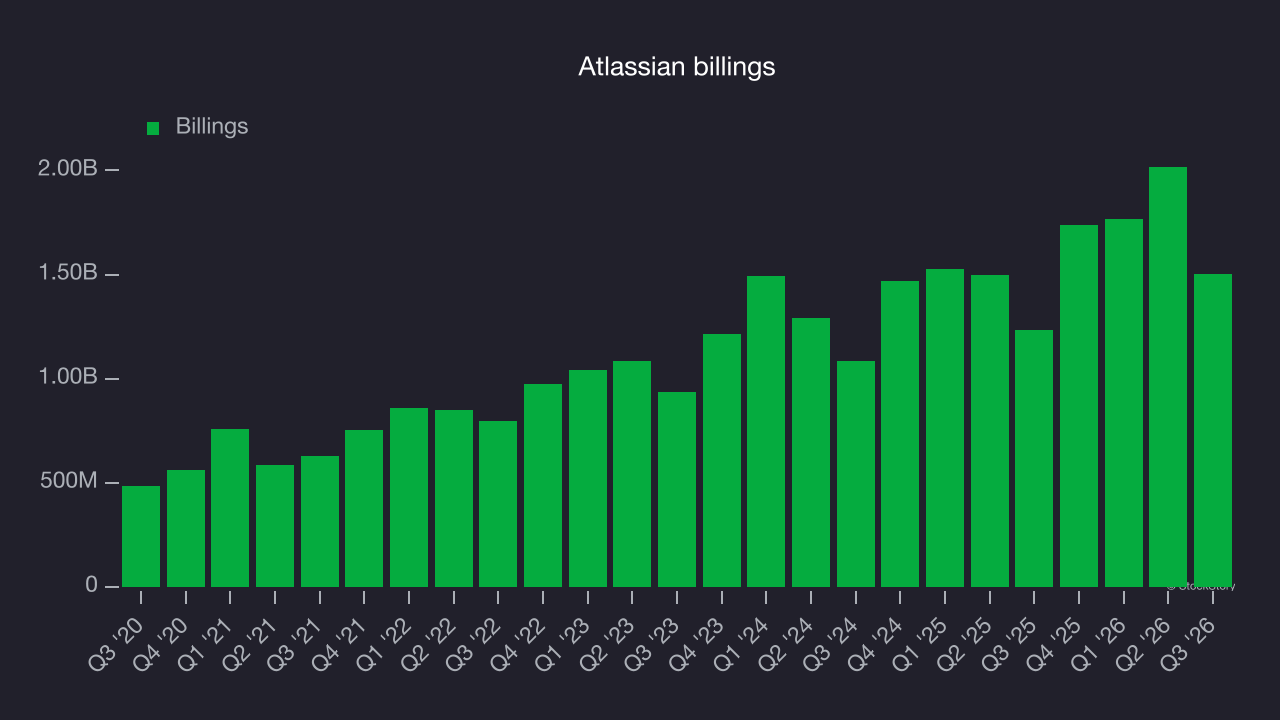
Customer acquisition efficiency
The customer acquisition cost, or CAC, payback period measures the months a company needs to recoup the money spent on acquiring a new customer. This metric helps assess how quickly a business can break even on its sales and marketing investments.
Atlassian is reasonably efficient at acquiring new customers, and its CAC payback period was 47 months this quarter. The company’s relatively fast recovery of its customer acquisition costs gives it the option to accelerate growth by increasing its sales and marketing investments.
Key takeaways from Atlassian’s Q3 results
Atlassian’s quarter had some key positives, with adjusted operating income beating analysts’ consensus estimates by a wide margin and revenue also topping Wall Street’s consensus. Billings, however, missed expectations. The market appeared to be hoping for more: Shares plunged 17.6% to $150.71 immediately after the report.
Is Atlassian a buy at the current price? The latest quarter does matter, but not nearly as much as longer-term fundamentals and valuation when deciding if the stock is a buy. For more on that, read our full research report here (it’s free).