Construction materials supplier Martin Marietta Materials (NYSE: MLM) reported revenue ahead of Wall Street’s expectations in Q3 2026, with revenue rising 28.3% year on year to $2.37 billion. The company expects the full year’s revenue to be around $7.8 billion, close to analysts’ consensus estimates. Its GAAP profit of $3.94 per share was 18.4% below analysts’ consensus estimates.
For more on Martin Marietta Materials, read our full research report, available free.
Martin Marietta Materials (MLM) Q3 2026 highlights:
- Revenue $2.37 billion vs S&P analysts’ consensus estimates of $2.23 billion (28.3% year-on-year growth, 6.5% beat)
- EPS (GAAP) $3.94 vs analysts’ consensus estimates of $4.83 (18.4% miss)
- Adjusted EBITDA $808 million vs analysts’ consensus estimates of $785.2 million (34.1% margin, 2.9% beat)
- Revenue guidance The company lifted its revenue guidance for the full year to $7.8 billion at the midpoint from $7.3 billion, a 6.8% increase
- EBITDA guidance $2.48 billion at the midpoint for the full year, below analysts’ consensus estimates of $2.57 billion
- Operating margin 18.5%, down from 27.4% in the same quarter last year
- Market capitalization $38.62 billion
Revenue growth
A company’s long-term revenue performance can indicate its overall quality. Any business can have short-term success, but a top-tier one grows for years. Martin Marietta Materials’s revenue grew at a mediocre 7.2% compounded annual growth rate over the last five years, falling short of the industrials sector benchmark.
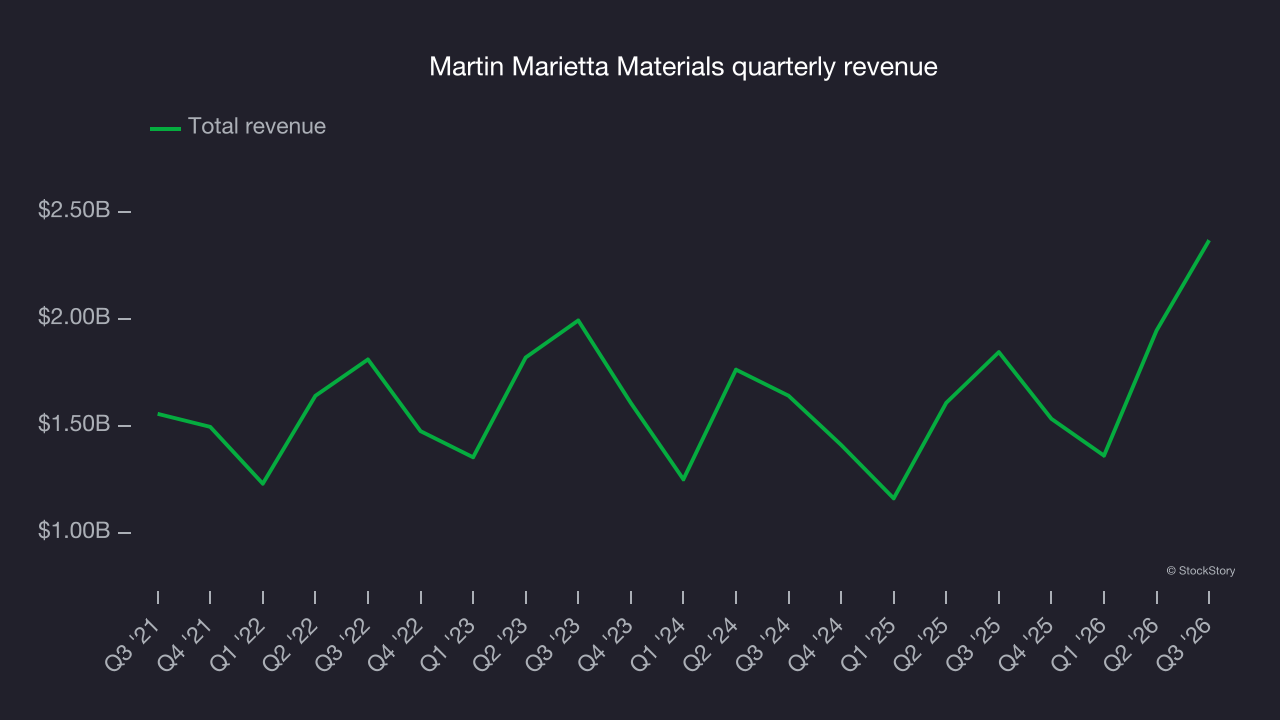
Long-term growth is the most important, but within industrials, a half-decade historical view may miss new industry trends or demand cycles. Martin Marietta Materials’s annualized revenue growth of 7.3% over the last two years aligns with its five-year trend, suggesting its demand was consistently weak. 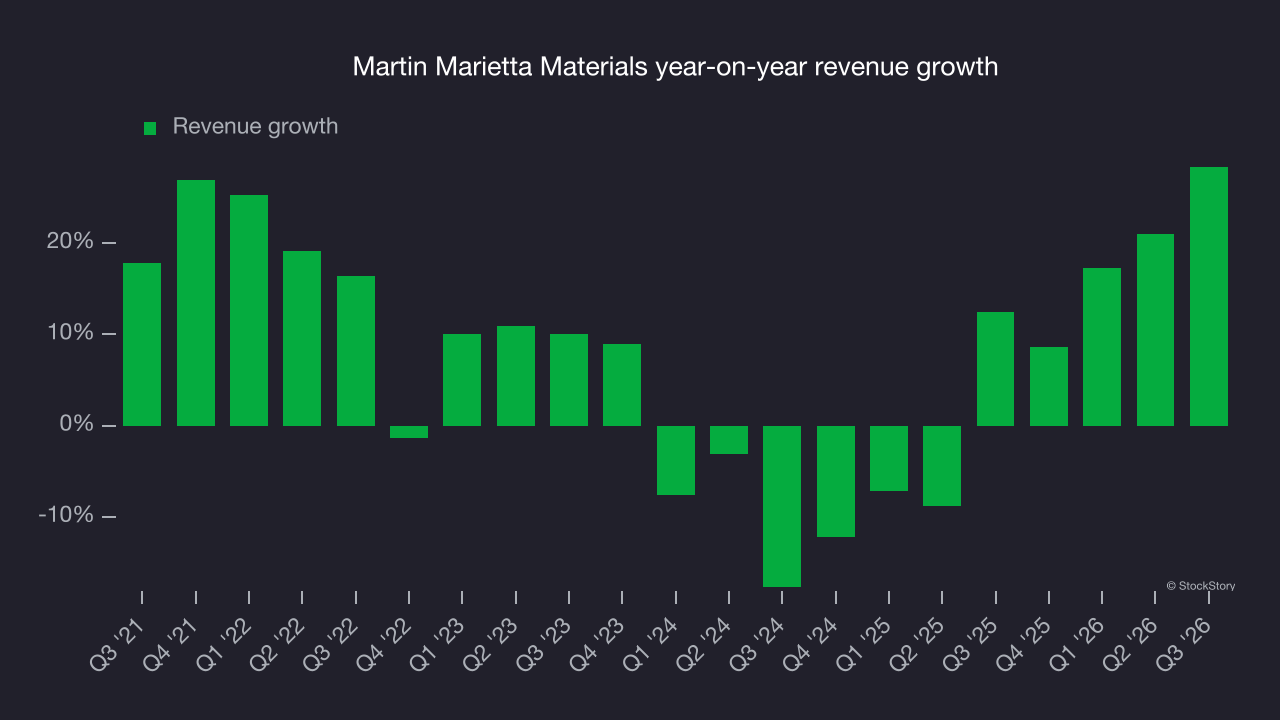
This quarter, Martin Marietta Materials reported strong year-on-year revenue growth of 28.3%, and its $2.37 billion of revenue topped Wall Street’s consensus estimates by 6.5%.
Looking ahead, sell-side analysts expect revenue to grow 21% over the next 12 months, according to S&P, an improvement versus the last two years. This strong growth projection indicates its newer products and services will fuel better revenue performance.
Operating margin
Martin Marietta Materials’s operating margin has stayed largely unchanged over the last 12 months, averaging 20.6% over the last five years. This profitability was notably high for an industrials business thanks to its efficient cost structure and economies of scale. This result was particularly impressive because of its low gross margin, which is mostly a factor of what it sells and requires substantial shifts to change meaningfully. Companies have more control over their operating margins, and high operating margins alongside low gross margins indicate well-managed operations.
Analyzing the trend in its profitability, Martin Marietta Materials’s operating margin might have fluctuated slightly but has generally stayed the same over the last five years. This raises questions about the company’s expense base because its revenue growth should have given it leverage on its fixed costs, resulting in better economies of scale and profitability.
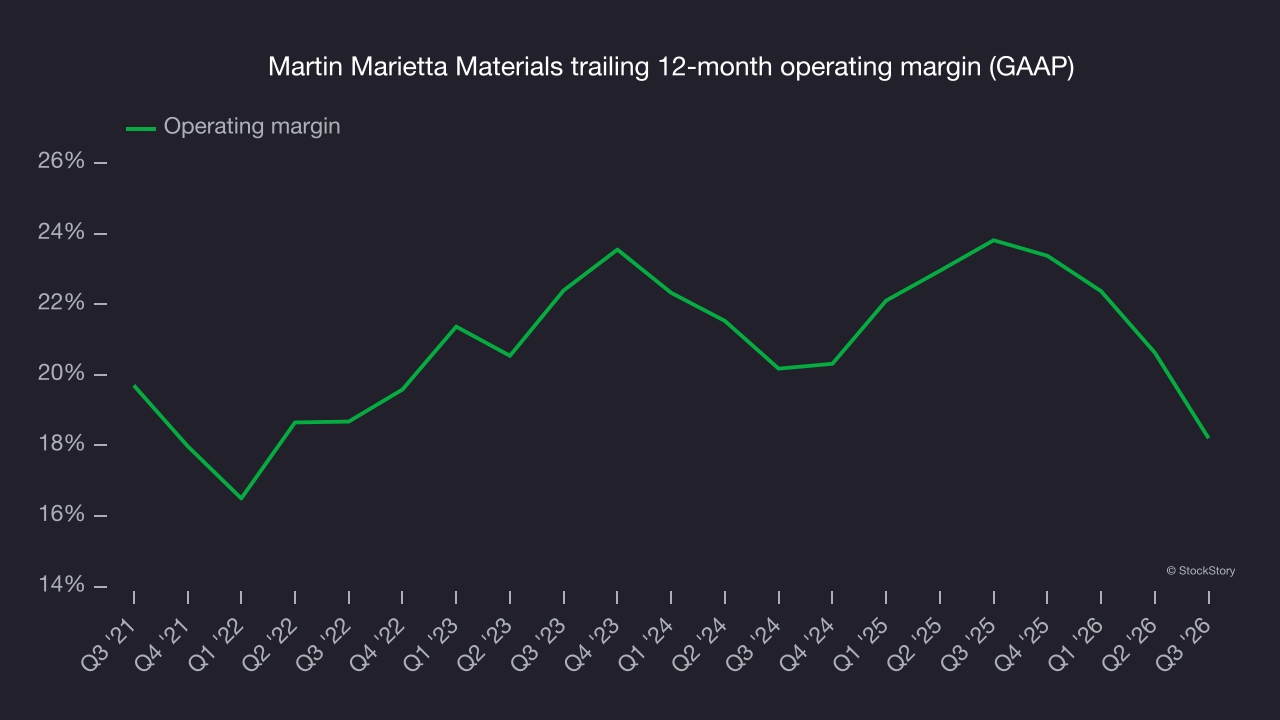
In Q3, Martin Marietta Materials generated an operating margin of 18.5%, down 8.9 percentage points year on year. Its operating margin decreased more than its gross margin, suggesting it was less efficient as expenses such as marketing, research and development and administrative overhead increased.
Earnings per share
Revenue trends explain a company’s historical growth, but the long-term change in earnings per share (EPS) points to the profitability of that growth. For example, a company could inflate its revenue through excessive spending on advertising and promotions.
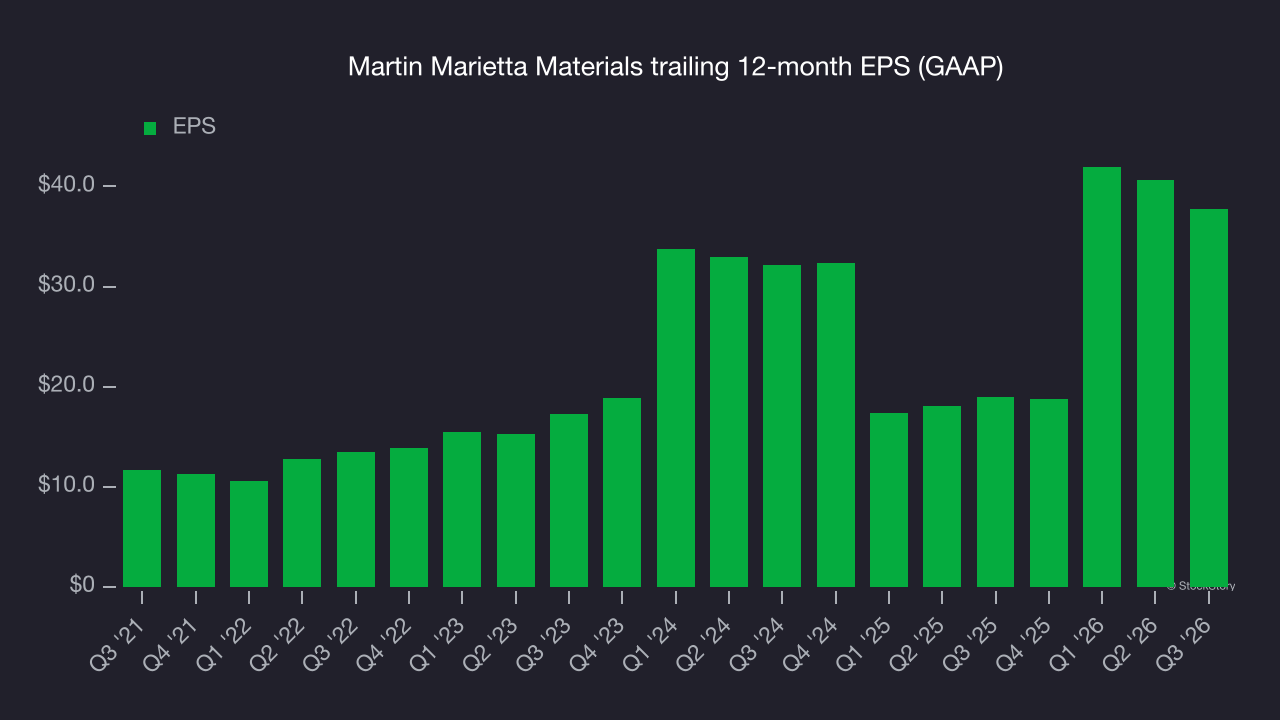
Martin Marietta Materials’s EPS grew at a 26.5% compounded annual growth rate over the last five years, higher than its 7.2% annualized revenue growth. However, that comparison warrants caution because its operating margin didn’t improve and it didn’t repurchase its shares, meaning the gap came from reduced interest expenses or taxes.
As with revenue, examining EPS over a shorter period can reveal a change in the business.
For Martin Marietta Materials, its two-year annual EPS growth of 8.4% was lower than its five-year trend.
In Q3, Martin Marietta Materials reported EPS of $3.94, down from $6.85 in the same quarter last year. This result missed analysts’ consensus estimates, but long-term EPS growth matters more than short-term movements. Over the next 12 months, Wall Street expects Martin Marietta Materials’s full-year EPS to shrink by 51.7% from $37.77 to $18.25, according to S&P.
Key takeaways from Martin Marietta Materials’s Q3 results
Martin Marietta Materials had a weaker quarter overall, with EPS missing Wall Street’s consensus estimates and full-year EBITDA guidance falling short of expectations. Revenue was a brighter spot, coming in well above analysts’ consensus estimates, and EBITDA also topped Wall Street’s consensus. Shares edged higher 1.4% to $551.41 immediately after the results.
Considering an investment in Martin Marietta Materials? The latest quarter matters, but longer-term business quality and valuation matter more when deciding whether to invest in the stock. Read the full research report here for more on those factors (it’s free).