Coffeehouse chain Starbucks (NASDAQ: SBUX) missed Wall Street’s revenue expectations in calendar Q3 2026 (fiscal Q4 2026), with revenue falling 4.5% year on year to $9.14 billion. Its non-GAAP profit of $0.80 per share was 13.4% above analysts’ consensus estimates.
For more on Starbucks, read our free full research report.
Starbucks (SBUX) Q3 CY2026 highlights:
- Revenue $9.14 billion vs S&P analysts’ consensus estimates of $9.23 billion (4.5% year-on-year decline, 0.9% miss)
- Adjusted EPS $0.80 vs S&P analysts’ consensus estimates of $0.71 (13.4% beat)
- Adjusted EPS guidance $3.20 at the midpoint for fiscal 2027, beating analysts’ consensus estimates by 2.3%
- Operating margin 10.8%, up from 2.9% in the same quarter last year
- Free cash flow margin 11%, up from 9.7% in the same quarter last year
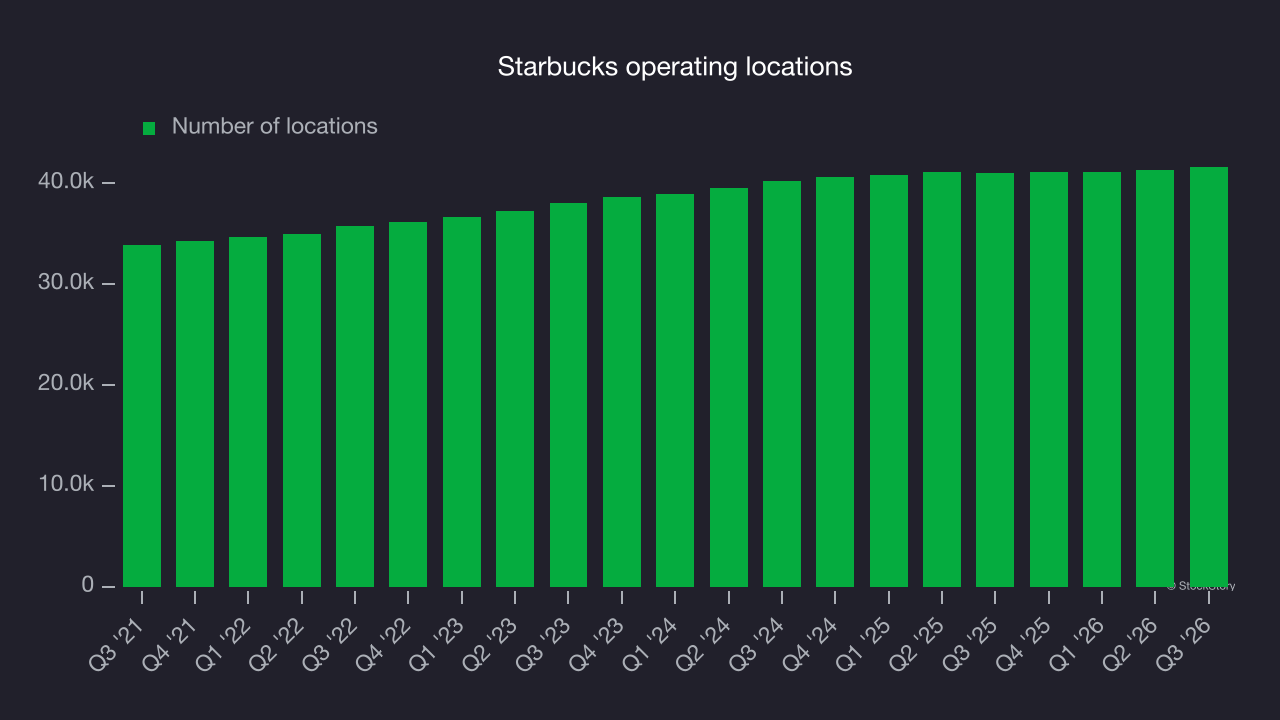
- Locations 41,607 at quarter end, up from 40,990 in the same quarter last year
- Same-store sales rose 7.2% year on year (1% in the same quarter last year)
- Market capitalization $117.6 billion
“We had a terrific quarter and a great year driven by our focus on the fundamentals and what has always set Starbucks apart: exceptional coffee, a moment of connection and a world-class customer experience. This gives me confidence our performance is durable,” commented Brian Niccol, chairman and chief executive officer. “Back to Starbucks started as our turnaround plan. Now, it's our growth plan.”
Revenue growth
Examining a company’s long-term performance can provide clues about its quality. Even a bad business can perform well for one or two quarters, but a top-tier one grows for years.
With $37.91 billion in revenue over the past 12 months, Starbucks is one of the most widely recognized restaurant chains and benefits from customer loyalty, an advantage many don’t have. Its scale also gives it negotiating leverage with suppliers, enabling it to source its ingredients at a lower cost. However, its scale is a double-edged sword because there are only a finite number of places to build restaurants, making it harder to find incremental growth. For Starbucks to boost its revenue, it likely needs to adjust its prices, launch new chains or expand in foreign markets.
Starbucks’s revenue grew at a tepid 5.2% compounded annual growth rate over the last seven years, but to its credit, it opened new restaurants and increased revenue at existing, established dining locations.
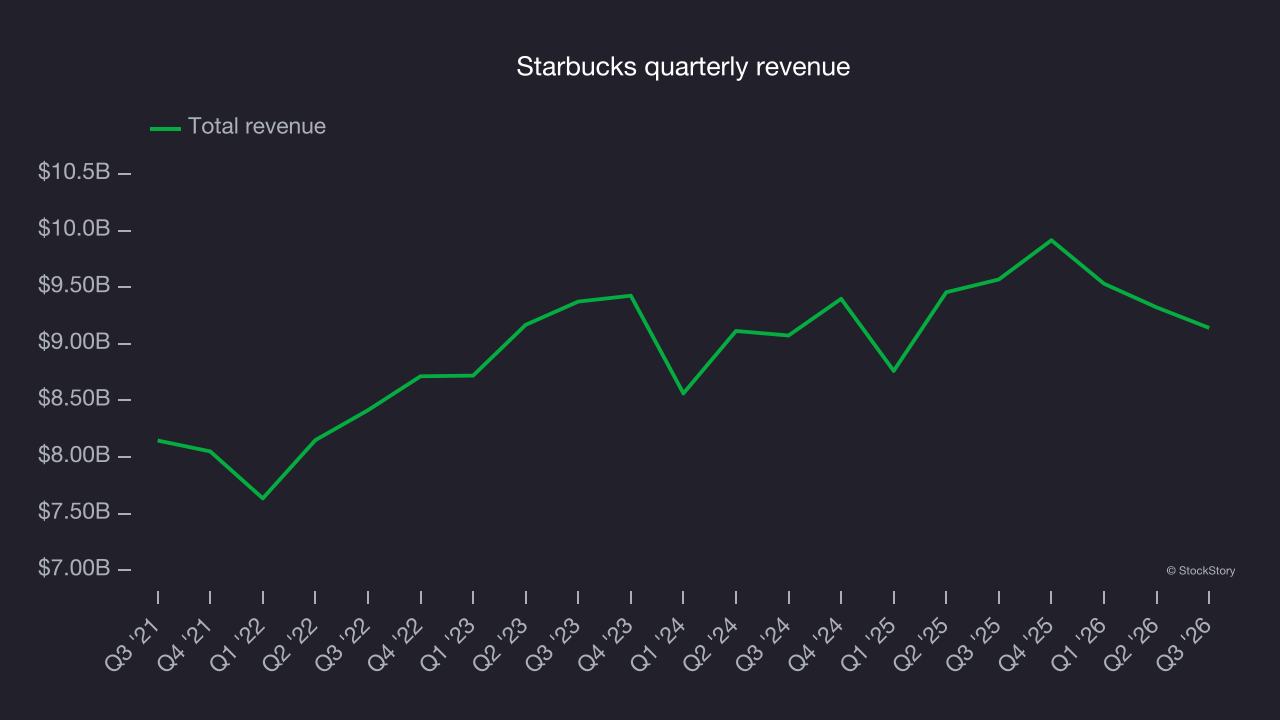
This quarter, Starbucks missed Wall Street’s consensus estimates and reported an uninspiring 4.5% year-on-year revenue decline, generating $9.14 billion of revenue.
Looking ahead, sell-side analysts expect revenue to grow 1.2% over the next 12 months, according to S&P, a deceleration versus the last seven years. This projection is underwhelming and indicates its menu offerings will see some demand headwinds.
Restaurant performance
Number of restaurants
The number of dining locations a restaurant chain operates is a critical driver of how quickly company-level revenue can grow.
Starbucks operated 41,607 locations in the latest quarter. It has opened new restaurants quickly over the last two years, averaging 2.5% annual growth, faster than the broader restaurant sector.
When a chain opens new restaurants, it usually means it’s investing for growth because there’s healthy demand for its meals and there are markets where its concepts have few or no locations.
Same-store sales
A company’s restaurant base only paints one part of the picture. When demand is high, it makes sense to open more. But when demand is low, it’s prudent to close some locations and use the money in other ways. Same-store sales offer insight into this topic by measuring organic growth at restaurants open for at least a year.
Starbucks’s demand rose over the last two years and slightly outpaced the industry. On average, the company’s same-store sales have grown by 2.4% per year. This performance suggests its rollout of new restaurants could be beneficial for shareholders. When a chain has demand, more locations should help it reach more customers and boost revenue growth.
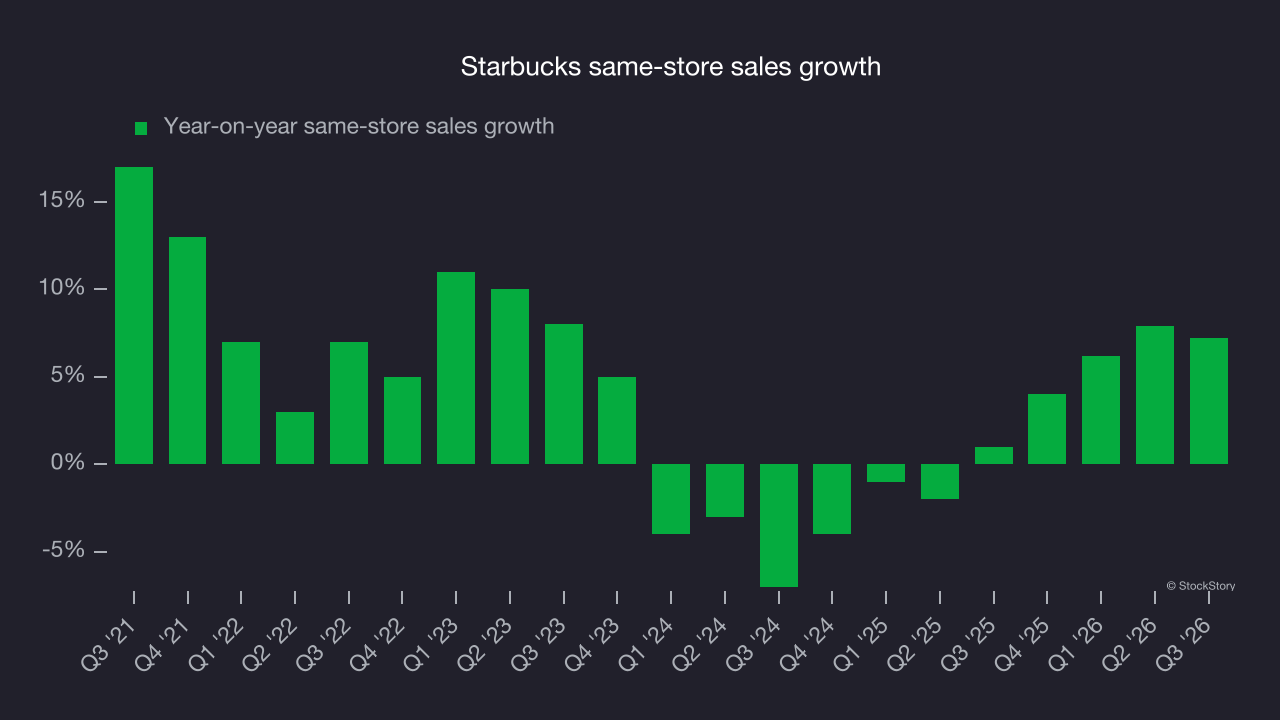
In the latest quarter, Starbucks’s same-store sales rose 7.2% year on year. This growth marked an acceleration from its historical levels, a positive sign.
Key takeaways from Starbucks’s Q3 results
Starbucks delivered a solid quarter, led by full-year EPS guidance above Wall Street’s consensus and same-store sales that beat analysts’ consensus estimates. Revenue, however, came in slightly below expectations. The market seemed to be hoping for more: shares fell 2.6% to $102.56 immediately after the report.
Is Starbucks a buy at its current price? That decision should take into account valuation, business quality and the latest earnings. For more on Starbucks, read our full research report here (it’s free).