Specialty flooring retailer Floor & Decor (NYSE: FND) met Wall Street’s revenue expectations in Q3 2026, with revenue rising 3% year on year to $1.21 billion. On the other hand, the company’s full-year revenue guidance of $4.8 billion at the midpoint came in 1% below analysts’ consensus estimates. Its GAAP profit of $0.61 per share was 9.4% above analysts’ consensus estimates.
For more on Floor And Decor, read our full research report for free.
Floor And Decor (FND) Q3 2026 highlights:
- Revenue $1.21 billion vs S&P analysts’ consensus estimates of $1.22 billion (3% year-on-year growth, in line)
- EPS (GAAP) $0.61 vs analysts’ consensus estimates of $0.56 (9.4% beat)
- Adjusted EBITDA $149.1 million vs analysts’ consensus estimates of $149 million (12.3% margin, in line)
- Revenue guidance The company lowered its revenue guidance for the full year to $4.8 billion at the midpoint from $4.88 billion, a 1.6% decrease
- GAAP EPS guidance $2.24 at the midpoint for the full year, beating analysts’ consensus estimates by 2.6%
- EBITDA guidance $542.5 million at the midpoint for the full year, below analysts’ consensus estimates of $556.2 million
- Operating margin 6.4%, in line with the same quarter last year
- Free cash flow margin 32.1%, up from 2.1% in the same quarter last year
- Market capitalization $5.06 billion
Brad Paulsen, Chief Executive Officer, stated, “We are pleased with our third-quarter performance, delivering 15% earnings per share growth despite a 1.4% decline in comparable store sales. The earnings growth we delivered this quarter underscores the resilience of our business model and our ability to drive profitability in a challenging demand environment. Maintaining strong profitability and cash flow generation enables us to continue investing through the cycle in initiatives that enhance the customer experience, strengthen our Pro offering, expand our store base, and advance our technology capabilities. We believe these investments represent meaningful competitive advantages that support market share gains and position us for long-term growth. In addition, our financial strength provides us with the flexibility to invest in our future while continuing to return capital to shareholders through our ongoing share repurchase program.”
Revenue growth
Reviewing a company’s long-term revenue performance reveals insights into its quality. Any business can deliver a good quarter or two, but the best consistently grow over the long term.
With $4.75 billion in revenue over the past 12 months, Floor And Decor is a small retailer, which sometimes brings disadvantages compared to larger competitors benefiting from economies of scale and negotiating leverage with suppliers.
Floor And Decor grew its revenue at a sluggish 2.5% compounded annual growth rate over the last three years.
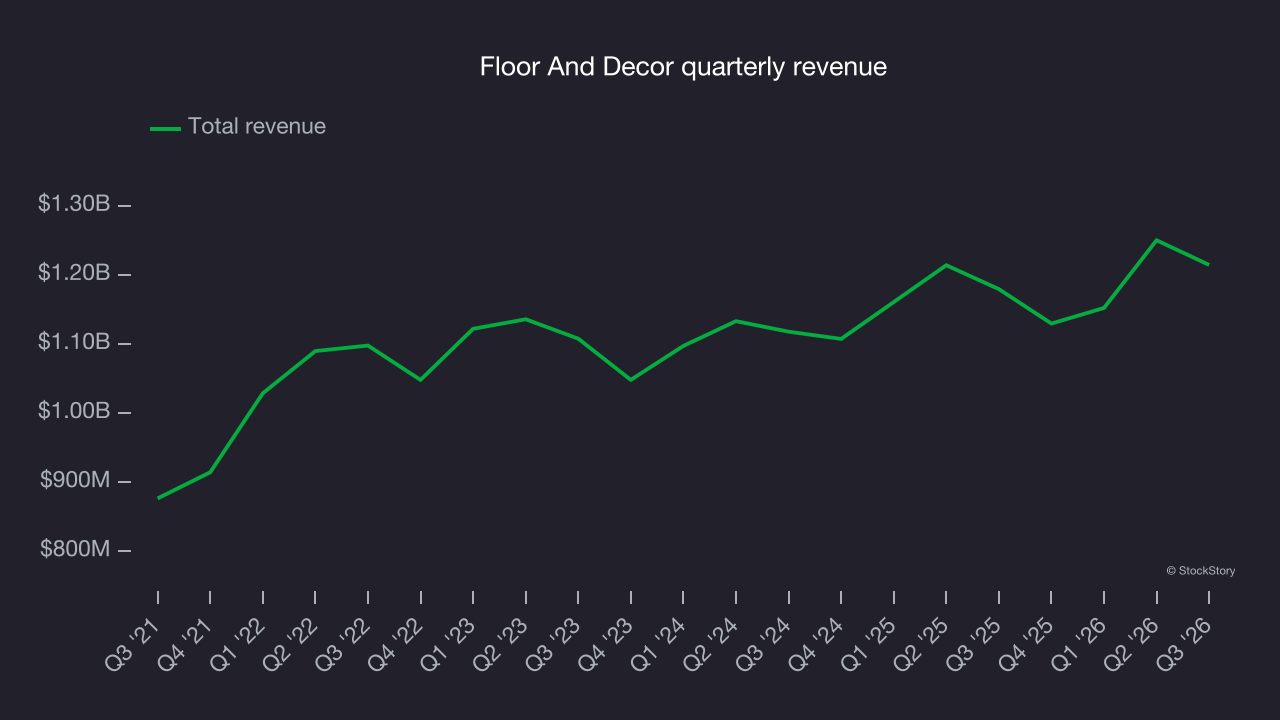
This quarter, Floor And Decor grew its revenue by 3% year on year, and its $1.21 billion of revenue was in line with Wall Street’s consensus estimates.
Looking ahead, sell-side analysts expect revenue to grow 6.1% over the next 12 months, according to S&P, an acceleration versus the last three years. This strong projection indicates its newer products will spur better top-line performance.
Store performance
Number of stores
A retailer’s store count influences how much it can sell and how quickly revenue can grow.
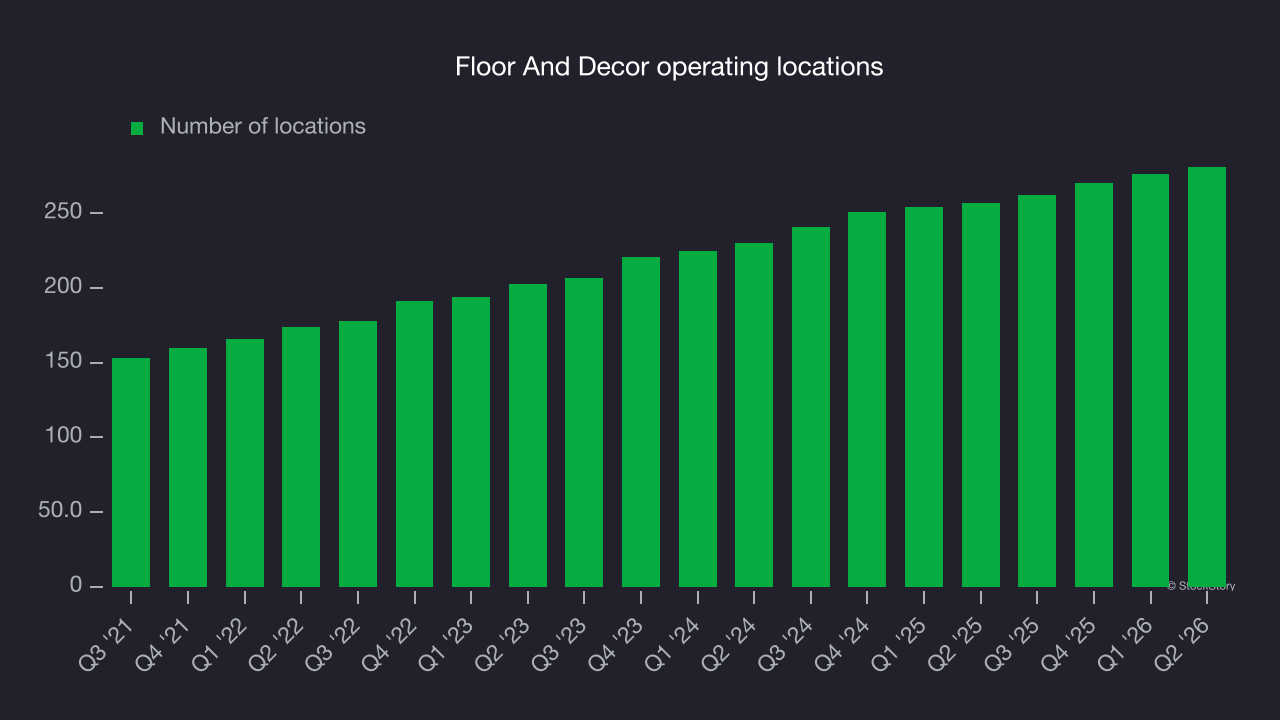
Over the last two years, Floor And Decor expanded its store count at an average annual rate of 10.4%, among the fastest in the consumer retail sector. This gives it a chance to scale into a mid-sized business over time.
When a retailer opens new stores, it usually means it’s investing for growth because demand is greater than supply, especially in areas where consumers may not have a store within reasonable driving distance.
Note that Floor And Decor reports its store count intermittently, so some data points are missing in the chart below.
Same-store sales
The change in a company’s store base only tells one side of the story. The other is the performance of its existing locations and e-commerce sales, which informs management teams whether they should expand or downsize their physical footprints. Same-store sales is an industry measure of whether revenue is growing at those existing stores and is driven by customer visits (often called traffic) and the average spending per customer (ticket).
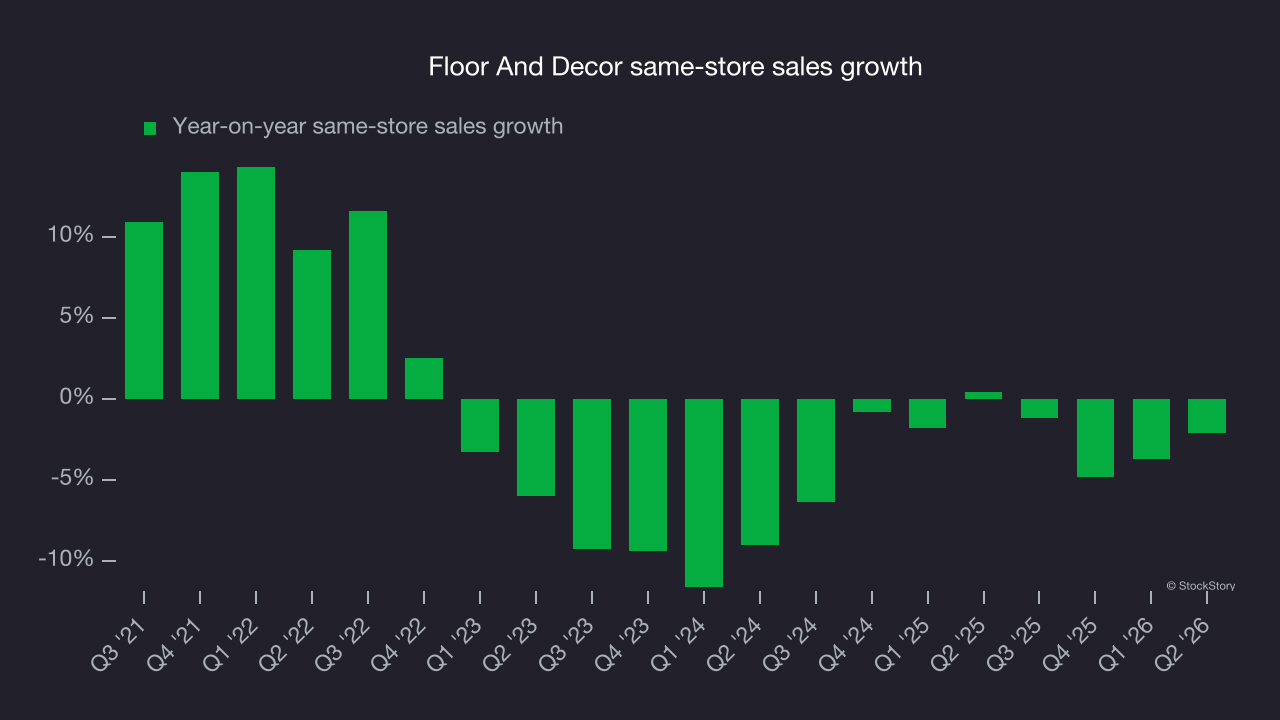
Floor And Decor’s demand has been shrinking over the last two years as its same-store sales have averaged 2% annual declines. This performance is concerning: it shows Floor And Decor relies on new stores to boost revenue. Same-store sales growth is preferable before a company takes on the costly, capital-intensive task of expanding its store base.
Note that Floor And Decor reports its same-store sales intermittently, so some data points are missing in the chart below.
Key takeaways from Floor And Decor’s Q3 results
Floor And Decor’s quarter could have been better despite an EPS beat against analysts’ consensus estimates. Full-year EBITDA guidance missed expectations, and full-year revenue guidance fell slightly short of Wall Street’s consensus. Shares fell 4.7% to $48 immediately after the results.
When deciding whether to invest in Floor And Decor, the latest quarter matters, but not as much as longer-term business quality and valuation. For more on Floor And Decor, read our full research report here (it’s free).