Online learning platform Coursera (NYSE: COUR) announced better-than-expected revenue in Q3 2026, with revenue up 94% year on year to $376.7 million. On the other hand, next quarter’s revenue guidance of $362 million was less impressive, coming in 2.7% below analysts’ consensus estimates. Its non-GAAP profit of $0.21 per share was 16.9% above analysts’ consensus estimates.
For more on Coursera, read the full research report for free.
Coursera (COUR) Q3 2026 highlights:
- Revenue $376.7 million vs S&P analysts’ consensus estimates of $368.5 million (94% year-on-year growth, 2.2% beat)
- Adjusted EPS $0.21 vs S&P analysts’ consensus estimates of $0.18 (16.9% beat)
- Adjusted EBITDA $61.5 million vs analysts’ consensus estimates of $54.99 million (16.3% margin, 11.8% beat)
- Revenue guidance $362 million at the midpoint for Q4 2026, below analysts’ consensus estimates of $372 million
- EBITDA guidance $57 million at the midpoint for Q4 2026, below analysts’ consensus estimates of $60.58 million
- Operating margin -7.7%, in line with the same quarter last year
- Free cash flow $4.6 million, up from -$32.6 million in the previous quarter
- Market capitalization $1.24 billion
“Organizations are investing at extraordinary scale in AI infrastructure, but the return on that investment depends on the people who know how to use it,” said Greg Hart, Coursera CEO. “Closing that skills gap is the opportunity we are positioning Coursera and Udemy to address, and we are on track to deliver our original 24-month synergy plan in just eight months as we create greater capacity to invest in innovation. Project Helix brings together the complementary strengths of Coursera and Udemy on an AI-native platform designed to deliver more personalized learning, verified skills pathways, and stronger connections between human capabilities and business outcomes.”
Revenue growth
Reviewing a company’s long-term revenue performance reveals insights into its quality. Any business can put up a good quarter or two, but the best consistently grow over the long haul. Over the last three years, Coursera grew its revenue at an impressive 20.6% compounded annual growth rate. Its growth beat the average consumer internet company and shows its offerings resonate with customers.
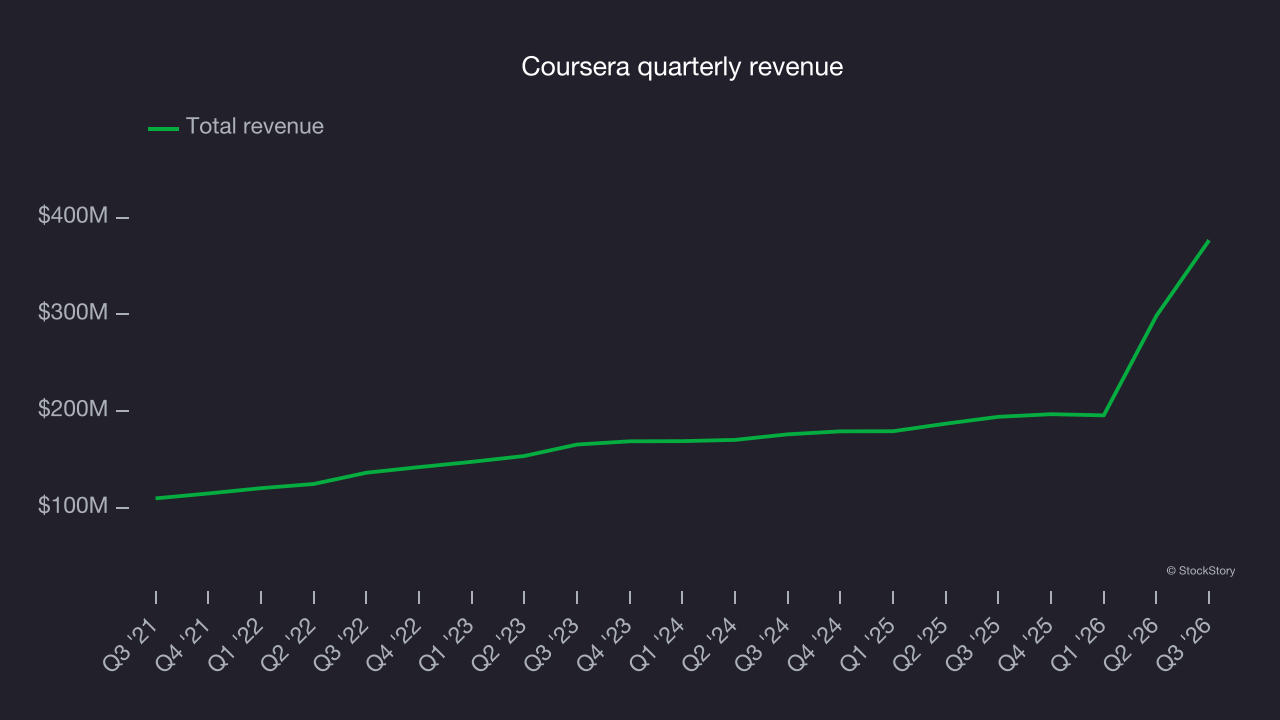
This quarter, Coursera reported strong year-on-year revenue growth of 94%, and its $376.7 million of revenue beat Wall Street’s consensus estimates by 2.2%. Company management is currently guiding for an 83.8% year-on-year increase in revenue next quarter.
Looking further ahead, sell-side analysts expect revenue to grow 39.9% over the next 12 months, according to S&P, an acceleration versus the last three years. This substantial growth projection suggests its newer products and services will fuel better top-line performance.
Free cash flow
Although EBITDA is valuable for assessing company performance, cash flow matters because accounting profits alone can’t pay the bills.
Coursera has shown mediocre cash profitability relative to peers over the last two years, giving the company fewer opportunities to return capital to shareholders. Its free cash flow margin averaged 3.4%, below expectations for a consumer internet business. The divergence from its good EBITDA margin stems from its capital-intensive business model, which requires Coursera to make large cash investments in working capital (i.e., stocking inventories) and capex (i.e., building new facilities).
Coursera’s margin dropped by 1.6 percentage points over the last few years. If the trend continues, it could signal the company is in the middle of an investment cycle.
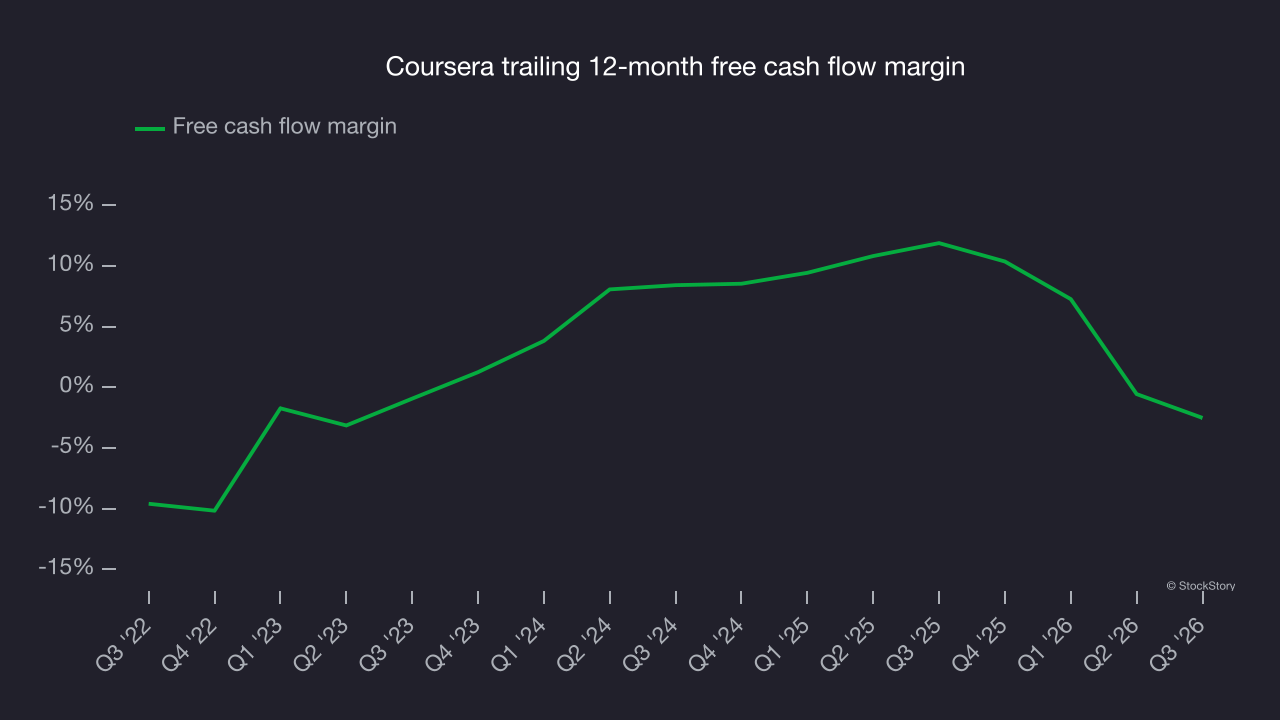
Coursera’s free cash flow totaled $4.6 million in Q3, equivalent to a 1.2% margin. Its free cash flow margin was 12.5 percentage points lower than in the same quarter last year, a concerning result given its longer-term trend.
Key takeaways from Coursera’s Q3 results
Coursera’s Q3 results beat expectations, but its outlook fell short: EBITDA topped analysts’ consensus estimates by a wide margin and revenue also beat Wall Street’s consensus, but next-quarter guidance missed estimates for both revenue and EBITDA. The disappointing outlook left this a quarter that could have been better overall. Shares tumbled 8% to $4.27 immediately after the report.
Coursera’s latest quarter was underwhelming. One earnings report doesn’t define a company’s quality, though, so let’s examine whether the stock is a buy at the current price. The latest quarter matters, but not nearly as much as longer-term fundamentals and valuation when making that decision. For more on Coursera, read the full research report here (it’s free).