Water heating and treatment solutions company A.O. Smith (NYSE: AOS) missed Wall Street’s revenue expectations in Q3 2026, with revenue flat year on year at $940.5 million. Its non-GAAP profit of $0.93 per share was 3.9% above analysts’ consensus estimates.
For more on A. O. Smith, read our free full research report.
A. O. Smith (AOS) Q3 2026 highlights:
- Revenue $940.5 million vs S&P analysts’ consensus estimates of $961 million (flat year on year, 2.1% miss)
- Adjusted EPS $0.93 vs S&P analysts’ consensus estimates of $0.89 (3.9% beat)
- Operating margin 18.6%, in line with the same quarter last year
- Free cash flow margin 17.3%, down from 25.5% in the same quarter last year
- Market capitalization $8.27 billion
"Separately, earlier this week we announced definitive agreements with CPE to acquire an 81% interest in our China business," Shafer continued. "Our team in China has built a leading premium brand over more than three decades, and CPE is well positioned to lead that business forward. For A. O. Smith, this transaction completes our strategic assessment and enables us to focus our capital and resources on our highest-return opportunities and sustainable value creation. At the same time, our retained 19% stake and long-term brand license give our shareholders the opportunity to benefit from future growth in China under CPE's leadership."
Revenue growth
Reviewing a company’s long-term revenue performance reveals insights into its quality. Any business can deliver a good quarter or two, but many enduring ones grow for years. A. O. Smith’s revenue grew at a sluggish 2.4% compounded annual growth rate over the last five years, falling short of our benchmarks.
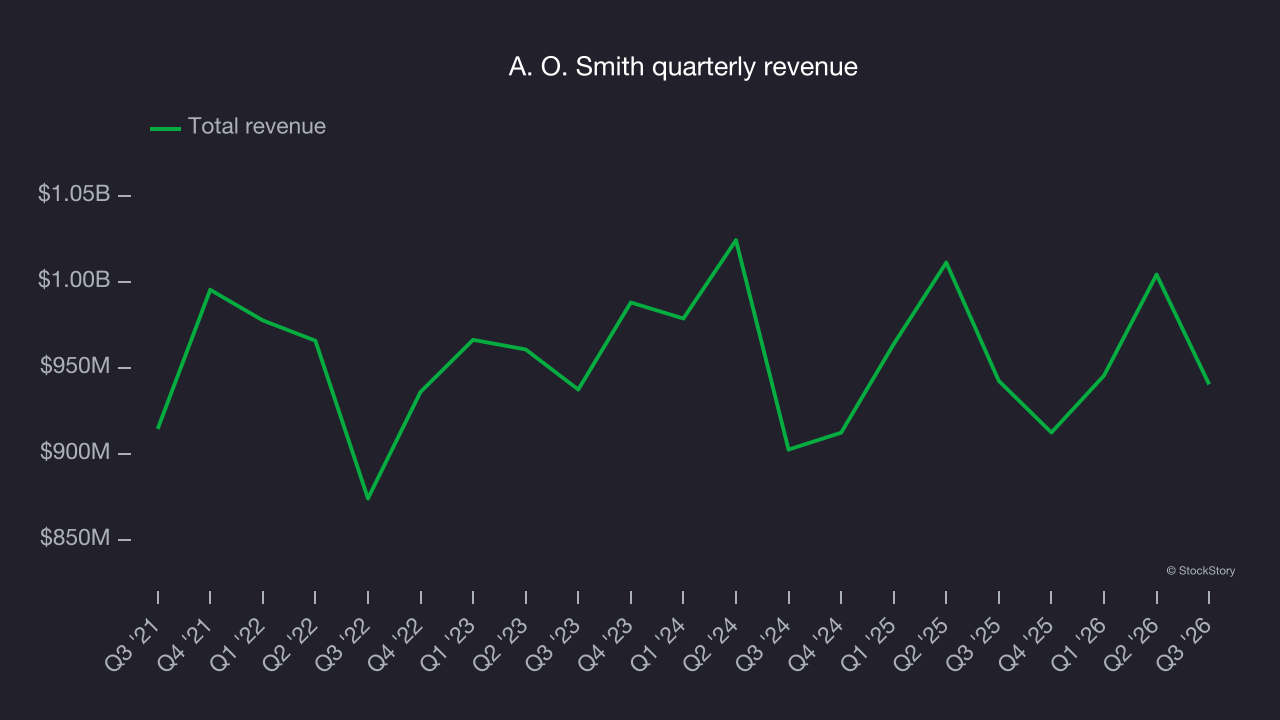
Long-term growth is the most important, but within industrials, a half-decade historical view may miss new industry trends or demand cycles. A. O. Smith’s performance shows it grew in the past but relinquished its gains over the last two years, as its revenue fell by 1.2% annually. 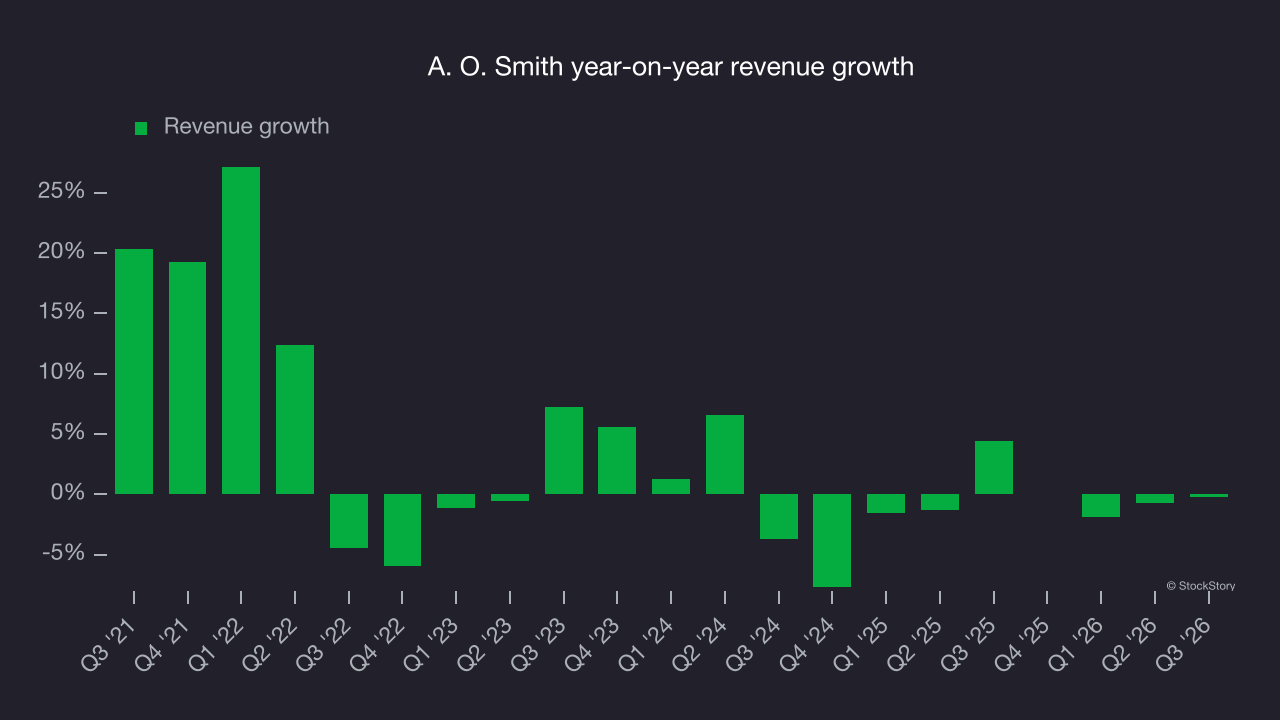
This quarter, A. O. Smith’s $940.5 million of revenue was flat year on year, falling short of Wall Street’s consensus estimates.
Looking ahead, sell-side analysts expect revenue to grow 5.3% over the next 12 months, according to S&P. While this projection suggests its newer products and services will fuel better top-line performance, it is still below average for the sector.
Operating margin
A. O. Smith’s operating margin has been roughly stable over the last 12 months, averaging 18.3% over the last five years. This profitability was high for an industrials business thanks to its efficient cost structure and economies of scale. That result is unsurprising, as its high gross margin provides a favorable starting point.
Looking at the trend in its profitability, A. O. Smith’s operating margin might have fluctuated slightly but has generally stayed the same over the last five years. This raises questions about the company’s expense base because its revenue growth should have given it leverage on its fixed costs, resulting in better economies of scale and profitability.
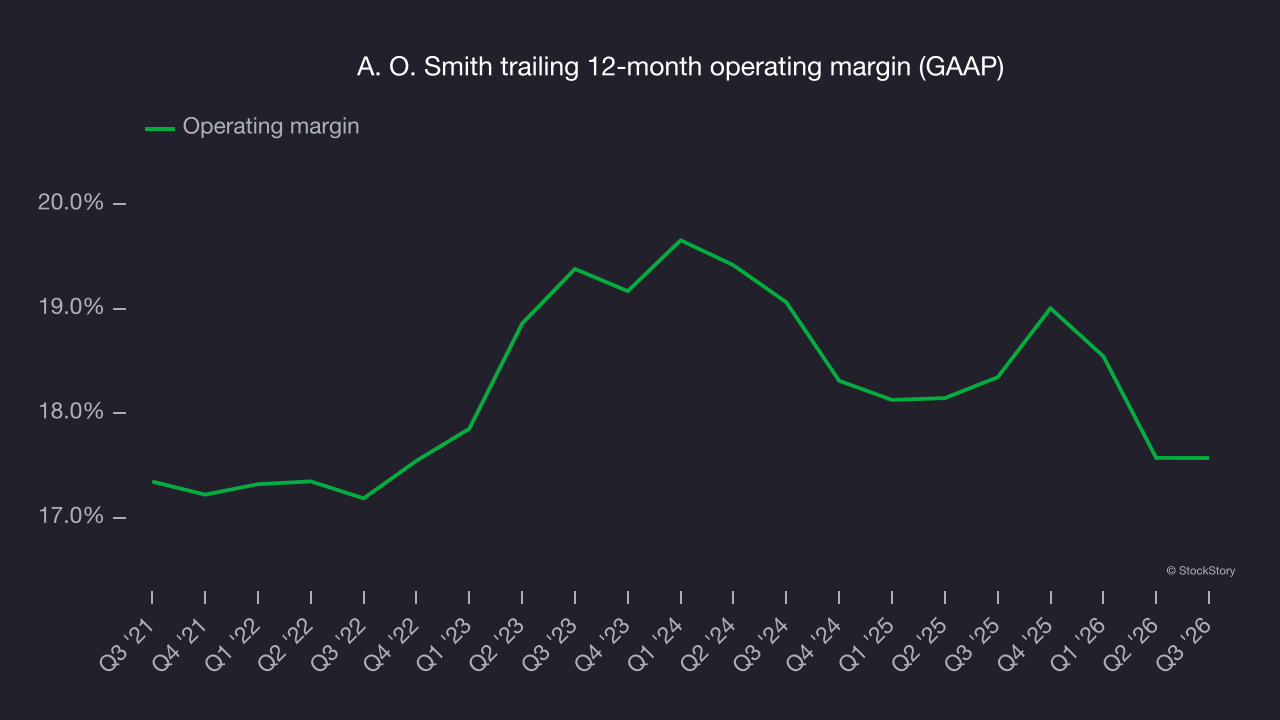
This quarter, A. O. Smith generated an operating margin of 18.6%, in line with the same quarter last year. This indicates the company’s cost structure has recently been stable.
Earnings per share
We track the long-term change in earnings per share (EPS) for the same reason as long-term revenue growth. Compared to revenue, however, EPS highlights whether a company’s growth is profitable.
A. O. Smith’s EPS grew at a 5.1% compounded annual growth rate over the last five years. This performance was better than its revenue growth but doesn’t tell us much about its business quality because its operating margin improvement lagged that of peers.
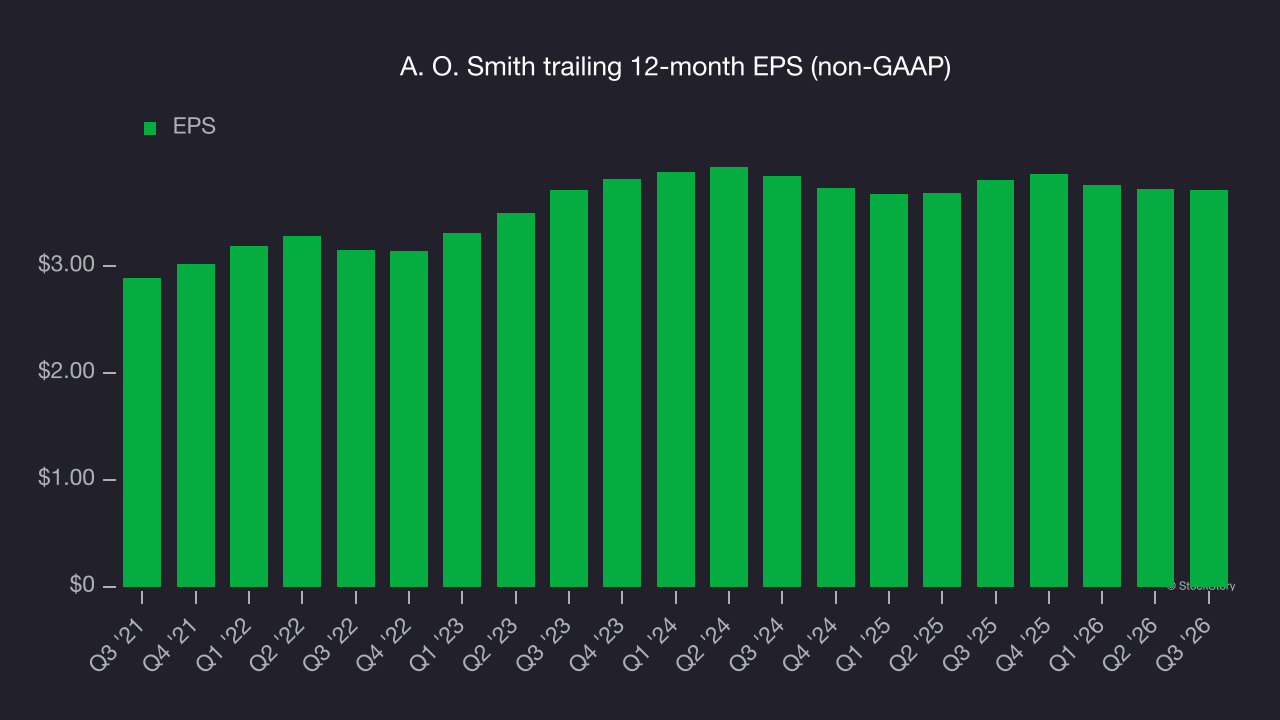
A closer look at A. O. Smith’s earnings helps explain its performance. A five-year view shows that A. O. Smith has repurchased its stock, shrinking its share count by 15.3%. Its EPS outperformed its revenue not because of increased operational efficiency but financial engineering, as buybacks boost per share earnings. 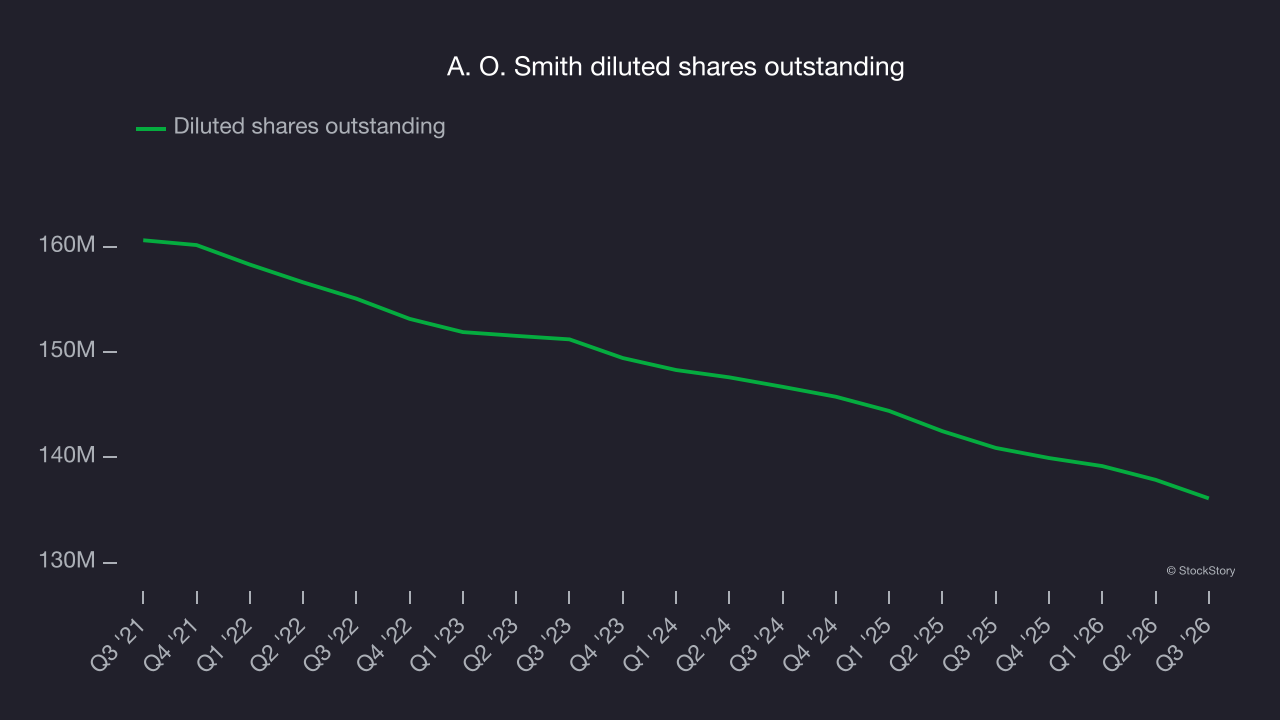
As with revenue, we analyze EPS over a more recent period because it can provide insight into an emerging theme or development for the business.
For A. O. Smith, its two-year annual EPS declines of 1.8% show it’s continued to underperform. These results were poor by any measure.
In Q3, A. O. Smith reported adjusted EPS of $0.93, in line with the same quarter last year. This result beat analysts’ consensus estimates by 3.9%. Over the next 12 months, Wall Street expects A. O. Smith’s full-year EPS to grow 5.9% from $3.71 to $3.93, according to S&P.
Key takeaways from A. O. Smith’s Q3 results
A. O. Smith’s EPS beat analysts’ consensus estimates, but revenue fell short, leaving room for improvement this quarter. Shares fell 3% to $59.05 immediately after the results.
A. O. Smith had an underwhelming quarter, but is the stock a buy at the current price? What happened in the latest quarter matters, but not as much as longer-term business quality and valuation, when deciding whether to invest in this stock. For more on A. O. Smith, read the full research report here (it’s free).