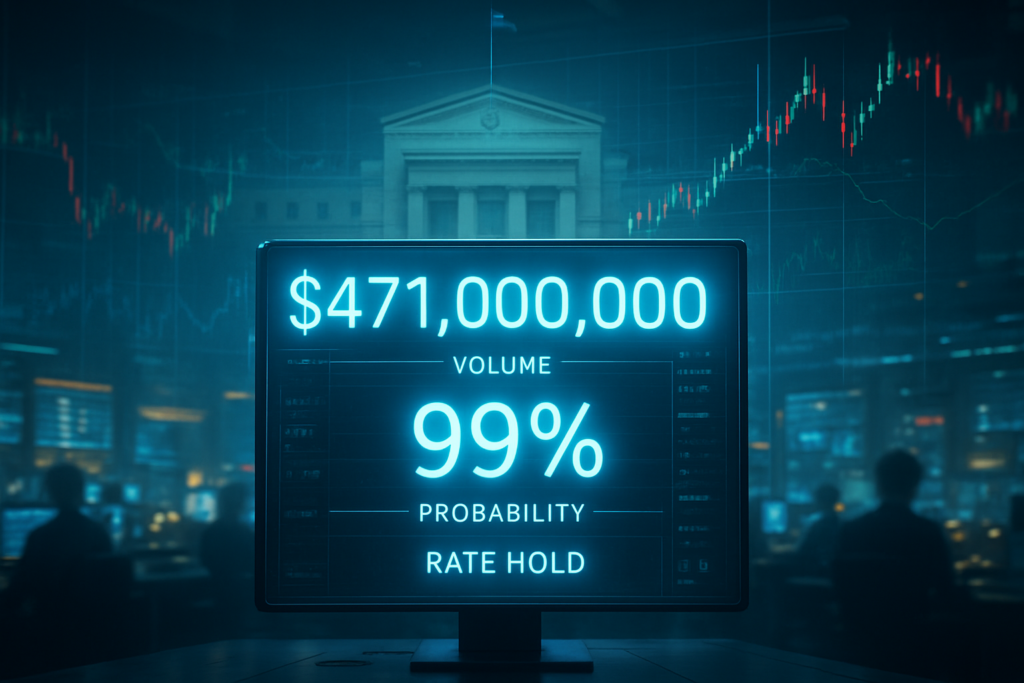
With the first Federal Reserve meeting of 2026 just days away, prediction markets have reached a state of near-total consensus. Traders are placing massive bets that the Federal Open Market Committee (FOMC) will opt to keep interest rates steady at its January 27–28 meeting, halting the cycle of rate cuts that defined the latter half of 2025.
The scale of the "hold" prediction is staggering, not just in its probability but in the capital backing it. On Polymarket, the world’s largest decentralized prediction platform, the volume for the January interest rate decision has surged to a massive $471 million. As of January 24, 2026, the market assigns a 99% probability to a "No Change" outcome, effectively pricing out any chance of a 25 or 50 basis point decrease, both of which are currently trading at 1% or less.
The Market: What's Being Predicted
The central question facing traders is whether the Fed will maintain the federal funds rate at its current range of 3.50%–3.75%. While traditional financial instruments like Fed Funds Futures have long been the gold standard for these forecasts, the rise of prediction markets has shifted the landscape. On Polymarket, the "Fed Interest Rate Decision: January 2026" contract has become one of the most liquid markets on the platform, drawing in hundreds of millions in volume from a global pool of retail and crypto-native participants.
The conviction on Polymarket is slightly higher than that of institutional tools. For comparison, the FedWatch tool provided by the CME Group (NASDAQ: CME) currently shows a 95.4% chance of a hold and a 4.6% chance of a 25 basis point cut. While both indicate a high degree of certainty, the "99% club" on prediction markets suggests that speculators are even more convinced than the professional hedgers using CME’s futures contracts.
Meanwhile, on the U.S.-regulated exchange Kalshi, the odds tell a similar story. Contracts for the Fed maintaining the current rate are trading at roughly 99 cents, reflecting a 99% implied probability. The liquidity on these platforms has become so deep that even large "whale" trades struggle to move the needle against the overwhelming tide of the "hold" consensus.
Why Traders Are Betting
The shift toward a definitive pause is driven by a complex "data-dependent" narrative that has become increasingly muddled. Throughout late 2025, the Fed enacted three consecutive rate cuts to support a cooling labor market. However, by the start of 2026, the economic picture began to blur. Core Personal Consumption Expenditures (PCE), the Fed’s preferred inflation metric, remains "sticky" at 2.8%—well above the 2% target.
Traders are also reacting to the "data holes" created by a brief but disruptive government shutdown in late 2025. This shutdown delayed several key economic reports, leaving the Fed with incomplete information. Most market participants believe Chair Jerome Powell will prefer a "wait-and-see" approach rather than risk another cut while inflation remains stubborn and official data is unreliable.
Furthermore, political risk is looming large over the central bank. With Jerome Powell’s term as Chair set to expire in May 2026, and rumors of potential replacements swirling in Washington, the FOMC is perceived to be in a defensive crouch. Traders are betting that the committee will avoid any bold policy moves that could be interpreted as politically motivated or overly aggressive during a sensitive transition period.
Broader Context and Implications
The $471 million volume on Polymarket is a testament to the growing institutionalization of prediction markets as a serious financial forecasting tool. These markets are often praised for their "wisdom of the crowd" effect, which can sometimes process breaking news—such as leaked political rumors or localized economic indicators—faster than traditional banking models.
Historically, when prediction markets hit a 99% probability for a Fed decision this close to the meeting date, they are rarely wrong. However, the real-world implications of a hold are significant. A pause in January signals to the broader economy that the "easy money" era of late 2025 is over for now. This has direct consequences for mortgage rates, corporate borrowing costs, and the overall performance of the S&P 500 (NYSE: SPY).
This market also highlights the regulatory evolution of the space. Following Kalshi’s legal victories against the CFTC in 2024 and 2025, prediction markets have moved from the fringe to the mainstream of political and economic forecasting. The fact that nearly half a billion dollars is being wagered on a single Fed meeting underscores the massive appetite for these direct-betting instruments.
What to Watch Next
As we approach the January 28 announcement, any sudden "Fed leak" or unexpected comment from a committee member could cause a late-stage tremor in the markets. Traders should keep a close eye on the "Statement" language. Even if the rate remains unchanged as expected, the "hawkish" or "dovish" tone of the accompanying text will set the odds for the next meeting in March.
The most critical date to monitor is Wednesday, January 28, at 2:00 PM EST. The release of the FOMC statement will provide the ultimate resolution for these multi-million dollar contracts. Immediately following, at 2:30 PM, Chair Powell’s press conference will be scrutinized for clues regarding the Fed's stance on the 2.8% inflation floor and the upcoming leadership transition in May.
Bottom Line
The prediction markets have spoken: the January 2026 FOMC meeting is expected to be a non-event in terms of rate movements. The 99% probability of a hold across Polymarket and Kalshi represents a rare moment of total market unity, backed by nearly $500 million in skin-in-the-game.
This level of certainty suggests that traders have fully absorbed the impact of sticky inflation and the data distortions from the recent government shutdown. While the "hold" itself may be predictable, the true value of these markets lies in their ability to quantify sentiment in real-time. As the Fed enters its "blackout period" before the meeting, these prediction markets remain the only living, breathing indicator of where the money is moving.
This article is for informational purposes only and does not constitute financial or betting advice. Prediction market participation may be subject to legal restrictions in your jurisdiction.
PredictStreet focuses on covering the latest developments in prediction markets. Visit the PredictStreet website at https://www.predictstreet.ai/.