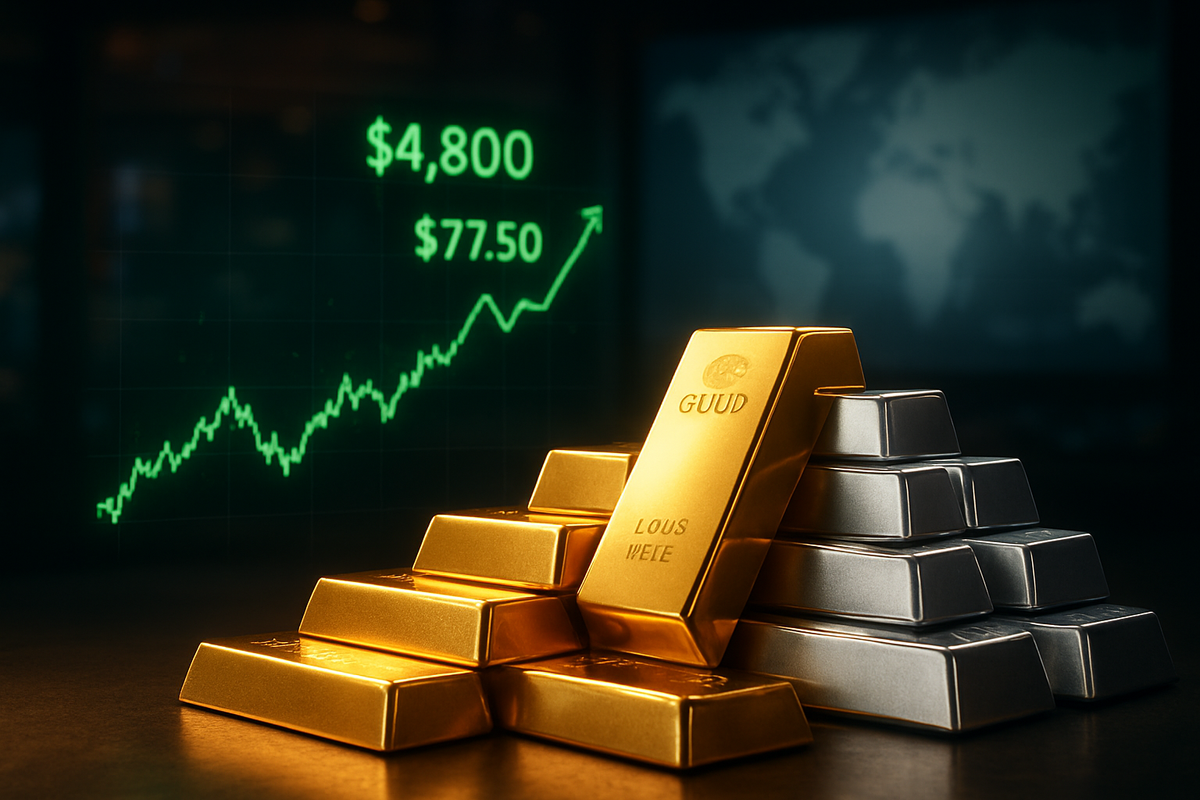
Precious metals markets experienced a dramatic resurgence today as President Donald Trump announced a surprise two-week ceasefire in the ongoing conflict with Iran, bringing a momentary halt to a war that has roiled global energy and financial markets for much of the spring. Following the announcement from the White House, gold prices surged to test the critical $4,800 per ounce level, while silver rallied sharply to hit nearly $77.50 per ounce. The bounce marks a significant reversal from the "Geopolitical Paradox" liquidations seen in March, signaling that investors are once again turning to hard assets as the immediate threat of a wider regional conflagration recedes—albeit briefly.
The ceasefire, brokered through intense back-channel negotiations involving regional intermediaries, aims to allow for humanitarian aid and a "cooling-off period" following the U.S.-led military operation "Epic Fury" and subsequent Iranian retaliations. For the markets, the news provided a necessary reprieve. While safe-haven assets typically thrive on uncertainty, the sheer intensity of the recent conflict had previously triggered a liquidity squeeze, forcing many institutional players to sell gold and silver to cover losses in the energy and tech sectors. Today’s price action suggests a return to more traditional market mechanics, where a stabilization of safe-haven demand is actually driving prices higher as the "fear of the unknown" is replaced by a calculated re-entry into the metals.
Ceasefire Breaks the Cycle of "Epic Fury"
The announcement of a 14-day truce comes at a pivotal moment in the 2026 calendar. Since the commencement of Operation Epic Fury in mid-March, the Middle East has been locked in a high-intensity conflict that saw the closure of the Strait of Hormuz and a devastating "Hormuz Shock" to global LNG supplies. This volatility initially caused a counterintuitive crash in precious metals; as Brent crude spiked past $110 per barrel, the resulting surge in Treasury yields and the U.S. Dollar made non-yielding assets like gold less attractive. However, with the April 2026 ceasefire, the downward pressure from the "Dollar-Yield" pincer has eased, allowing gold to climb back from its March lows of $4,600 to the current $4,800 resistance level.
The timeline leading to this moment has been breathless. Following the strikes on Iranian energy infrastructure on March 19, the global economy braced for hyper-inflation. President Trump’s intervention today, delivered via a televised address, emphasized a "strategic pause" to evaluate the impact of the sanctions and military strikes. Key stakeholders, including the major OPEC+ nations and European allies, have expressed cautious optimism. Market participants responded almost instantly, with gold futures on the COMEX seeing a massive influx of volume within minutes of the President's remarks. Silver, often the more volatile sibling of gold, saw an even more aggressive percentage gain, reclaiming ground after its collapse from January highs near $120.
Initial market reactions indicate that the "ceasefire rally" is a relief trade. Traders who were forced into cash or energy-linked equities during the peak of the fighting are now rotating back into precious metals as a hedge against the inevitable inflationary aftermath of the war. "The market was oversold in terms of gold and silver," noted one senior strategist. "The ceasefire provides the stability required for investors to look at the long-term debasement of currency that this war has accelerated, rather than just worrying about the next 24 hours of missile strikes."
Mining Giants and Producers Find New Footing
The rebound in spot prices has breathed new life into the major producers, many of which had seen their stock prices languish despite high commodity prices due to rising operational costs and geopolitical risk. Newmont Corporation (NYSE: NEM), the world’s largest gold producer, saw its shares climb as gold flirted with the $4,800 mark. Newmont’s extensive global footprint makes it a primary beneficiary of stabilized demand, and today's move has helped the stock reclaim its position as a preferred vehicle for institutional gold exposure.
Similarly, Barrick Gold (NYSE: GOLD) has seen a positive uptick, with investors focusing on its high-margin North American assets as a safer alternative to riskier emerging-market operations. For silver producers, the impact has been even more pronounced. Pan American Silver (NYSE: PAAS), now the dominant primary silver miner following its integration of key Mexican assets, surged on the news of silver hitting $77.50. The company’s increased production capacity is perfectly timed for a market that is currently grappling with a structural silver deficit exacerbated by the Middle East conflict's impact on industrial shipping.
On the other hand, traditional "energy-weighted" portfolios may see a short-term cooling as the "war premium" is stripped out of oil prices. However, streaming and royalty companies like Wheaton Precious Metals (NYSE: WPM) are emerging as clear winners. These companies benefit from the price surge without the direct exposure to the rising energy costs that traditional miners face. Meanwhile, pure-play silver miners like First Majestic Silver (NYSE: AG) are seeing retail interest return, as the $77.50 level for silver is viewed as a "floor" by many technical analysts in this new high-inflation era.
A New Paradigm in Global Finance
The current surge in metals fits into a broader 2026 trend characterized by the "Geopolitical Paradox." Unlike the early 2000s, where gold was a simple "fear trade," in 2026, precious metals are competing with high-yielding government debt and energy-linked assets. The ceasefire is significant because it suggests that the "Hormuz Shock" may not lead to an immediate global depression, but rather a prolonged period of high inflation. This environment is historically the most fertile ground for gold and silver, as they act as a store of value when fiat currencies lose purchasing power rapidly.
Furthermore, the ceasefire highlights a potential shift in policy. If the Trump administration can parlay this two-week pause into a more permanent diplomatic solution, the regulatory focus may shift back to domestic energy production and infrastructure. However, the precedent set by the "Epic Fury" liquidations remains a warning to investors: in modern warfare, the immediate need for liquidity can temporarily trump the "safe-haven" status of gold. This event has shown that the correlation between geopolitical tension and gold prices is no longer a straight line, but a complex curve influenced by energy costs and central bank interest rate trajectories.
Historically, events like the 1973 oil embargo or the 1990 Gulf War provided similar spikes, but the scale of the 2026 conflict—involving direct strikes on major energy exporters—has pushed prices to levels that were unthinkable just five years ago. The move toward $4,800 gold is not just a reaction to war, but a reflection of a global financial system that is increasingly de-dollarizing in response to the weaponization of finance and the instability of the Middle East.
The Path Forward: Volatility or Stability?
The short-term outlook depends entirely on whether the ceasefire holds beyond the 14-day window. If the pause leads to genuine negotiations, we could see gold stabilize in the $4,500 to $5,000 range, providing a predictable environment for miners to operate. However, if the ceasefire is viewed merely as a tactical reset for further military action, the market should prepare for another round of extreme volatility. Investors should watch for a "short-squeeze" in silver if prices break $80, as many industrial users may rush to lock in supply before any potential resumption of hostilities.
Strategically, mining companies will likely focus on cost-containment and securing their supply chains for critical inputs like explosives and diesel, which remain expensive. The opportunity for investors lies in identifying companies with the best "all-in sustaining costs" (AISC). In a world of $4,800 gold, even high-cost mines become incredibly profitable, but the real winners will be those that can maintain production through the ongoing logistics challenges of the 2026 geopolitical landscape.
Potential scenarios include a "Grand Bargain" that could see gold prices retract slightly as the "peace dividend" is paid out, or a "Second Shock" that could propel gold toward the $5,400 targets set by major investment banks. For now, the market is in a "wait-and-see" mode, with the $4,800 level serving as the psychological battleground for the next phase of the bull market.
Final Takeaways for the Strategic Investor
The ceasefire announcement by President Trump has provided a critical lifeline to the precious metals market, allowing gold and silver to recover from a bruising March. The surge to $4,800 and $77.50, respectively, marks a return of safe-haven demand that is now "stabilizing" as the market digests the long-term inflationary consequences of the Iran war. This event underscores the resilience of hard assets in an era of unprecedented geopolitical and economic upheaval.
Moving forward, the market will remain hyper-sensitive to any rhetoric coming out of Washington or Tehran. Investors should closely monitor the "gold-to-silver ratio," which has tightened significantly during this rally, often a sign of a robust and healthy bull market in metals. The core takeaway is that while the ceasefire is temporary, the fundamental drivers of the 2026 commodity supercycle—high debt, energy scarcity, and geopolitical realignment—remain firmly in place.
In the coming months, watch for the earnings reports from Agnico Eagle Mines (NYSE: AEM) and other tier-one producers to see how the price surge is translating to the bottom line. The 2026 precious metals market is not for the faint of heart, but for those navigating this "Geopolitical Paradox," the current rebound offers a glimpse of the significant upside that remains if the global order continues its current trajectory of fragmentation and revaluation.
This content is intended for informational purposes only and is not financial advice.