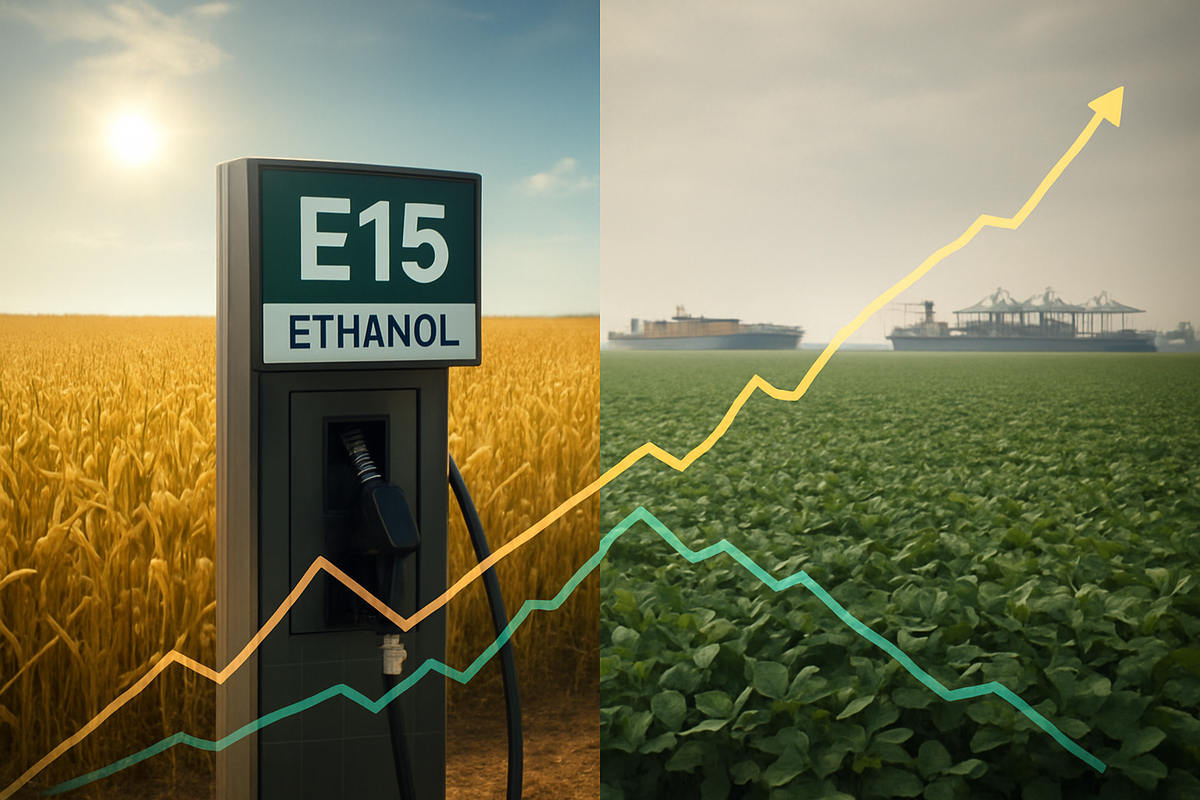
As the 2026 spring planting season approaches, a sharp divergence has emerged in the U.S. grain markets, driven by a volatile mix of geopolitical tension, shifting domestic energy policy, and record-breaking harvests in the Southern Hemisphere. While corn futures have found a firm floor, bolstered by a significant rally in crude oil and recent federal intervention to support ethanol consumption, soybean futures are grappling with the weight of a massive global supply overhang.
The divergence was underscored this week as May corn futures settled into a resilient range between $4.62 and $4.67 per bushel, a ten-month high that reflects a growing "biofuel pull" in the energy sector. In contrast, soybeans have faced steady downward pressure, as market participants digest news of a historic Brazilian harvest and expectations for expanded U.S. acreage. This split is forcing traders and farmers alike to reconsider the traditional relationship between the two primary American row crops as they navigate a landscape where grain is increasingly viewed as a strategic energy asset.
Policy Shifts and the Biofuel Pull
The catalyst for corn’s recent resilience arrived on March 25, 2026, when EPA Administrator Lee Zeldin issued a temporary emergency waiver allowing for the summertime sale of E15 gasoline (a 15% ethanol blend). This marks the fifth consecutive year such a waiver has been granted, effectively bypassing air quality regulations that typically restrict the higher ethanol blend during the warmer months. The move is designed to provide "relief at the pump" amid a global energy crunch, but its immediate effect has been to secure a massive demand window for the roughly 5.6 billion bushels of corn dedicated to fuel production each year.
The waiver coincides with a dramatic surge in crude oil prices, which have spiked following a series of escalations in the Middle East, including disruptions in the Strait of Hormuz—an event some analysts are calling "Operation Epic Fury." With Brent crude prices soaring past $95 per barrel and occasionally touching $119 in intraday trading, ethanol has become a highly attractive blending component for refiners looking to lower costs. This energy-driven demand has effectively offset the bearish sentiment usually associated with high interest rates and global economic cooling.
Meanwhile, the soybean market is facing a starkly different reality. In Brazil, the 2025/2026 harvest is reaching its peak, with production estimates ranging from 177.6 million to 184.7 million tons—figures that would set a new global record. This flood of supply from South America has allowed major importers, particularly China, to bypass U.S. markets despite localized logistics issues in the Amazon basin. Domestic pressure is also mounting as U.S. farmers, lured by the relative profitability of soybeans over corn in early 2026, are projected to plant upwards of 85 million acres of beans this spring, a significant increase from previous years.
Winners and Losers in the New Ag-Energy Complex
The ripple effects of this market split are being felt across the balance sheets of major agribusiness and energy firms. Green Plains Inc. (NASDAQ: GPRE) stands out as a clear beneficiary of the EPA’s E15 waiver. As one of the nation’s leading ethanol producers, the company relies heavily on consistent summer demand to maintain margins. The emergency waiver ensures that their primary product remains a staple of the American fuel supply during the peak driving season, effectively turning corn’s price floor into a profit ceiling for biofuel refiners.
Similarly, Bunge Global SA (NYSE: BG) is well-positioned to capitalize on the current volatility. As a global giant in oilseed processing and grain trading, Bunge benefits from the massive throughput required by the record Brazilian soybean harvest. While lower soybean prices may compress some margins, the high volume of trade and the global "biofuel pull" for soybean oil—used extensively in renewable diesel—provides a diversified revenue stream that offsets the weakness in raw grain prices.
On the other hand, agricultural equipment manufacturers like Deere & Company (NYSE: DE) are facing a more challenging environment. High input costs, driven by the same energy spike that is supporting corn, have squeezed farmer net income. Surging diesel and nitrogen fertilizer prices mean that even if corn prices remain steady near $4.67, the actual profitability for the average grower is being eroded. This has cooled demand for high-end machinery, as many producers opt to repair existing equipment rather than invest in new fleets during a period of high interest rates and narrow margins.
Broader Significance: Decoupling and Strategic Reserves
This divergence highlights a broader shift in how agricultural commodities are valued in the mid-2020s. We are witnessing a fundamental "decoupling" where corn is no longer just a food and feed crop but is increasingly traded as a strategic energy hedge. The recurring nature of the E15 emergency waiver suggests that the U.S. government now views the corn-to-ethanol pipeline as a critical component of national energy security, particularly when traditional oil markets are destabilized by overseas conflict.
This policy-driven support for corn creates a complex environment for global trade. As the U.S. leans further into biofuels, it risks ceding a larger portion of the global food-grade grain market to competitors like Brazil and Argentina. This trend is already visible in the soybean sector, where Brazil’s dominance is becoming nearly absolute during the Southern Hemisphere’s harvest window. The long-term implication is a bifurcated global market: a domestic U.S. market geared toward energy and specialized exports, and a South American market focused on high-volume, low-cost commodity supply for the Eastern Hemisphere.
Furthermore, the shift in U.S. acreage—away from corn and toward soybeans—reflects the growing influence of the renewable diesel industry. Companies like Darling Ingredients (NYSE: DAR) and Valero Energy Corporation (NYSE: VLO) have invested billions into processing facilities that turn soybean oil and animal fats into "green" diesel. This industrial demand is now a primary driver of planting decisions, often outweighing traditional export signals. The 2026 season may be remembered as the year when the "fuel versus food" debate was settled in favor of the fuel tank.
Future Outlook: Weather Risks and Regulatory Permanence
Looking ahead to the remainder of 2026, the primary variable for the grain markets will be the weather across the U.S. Midwest. With corn acreage projected to decline to approximately 94 million acres, any significant drought or planting delay could send May and July futures well beyond the current $4.67 resistance level. Conversely, the soybean market will remain under pressure until the "wall of supply" from Brazil is fully absorbed by global markets.
Investors should also keep a close eye on the regulatory landscape following the summer E15 waiver. There is growing pressure from farm-state legislators to make the year-round sale of E15 permanent at the federal level, a move that would provide even more long-term support for corn prices and companies like Archer-Daniels-Midland (NYSE: ADM). Such a policy shift would solidify the "energy floor" for corn and could lead to a permanent realignment of crop rotations across the Corn Belt.
Market Wrap-Up: The Divergence Defines 2026
In summary, the U.S. grain market in late March 2026 is a study in contrasts. Corn has found its footing at the intersection of energy policy and geopolitical risk, while soybeans remain tethered to the gravity of record global production. The EPA’s E15 waiver and $95-plus oil have transformed corn into a resilient energy asset, providing a lifeline to ethanol producers and a hedge for traders.
As the planting season begins, the market will transition from focusing on policy to focusing on the soil. For investors, the key will be monitoring the $4.60 floor for corn and the potential for a "soybean glut" if U.S. yields match the record-breaking pace seen in Brazil. The divergence between these two staples is more than a seasonal anomaly; it is a preview of a new era in agriculture where the pump is just as important as the pantry.
This content is intended for informational purposes only and is not financial advice.