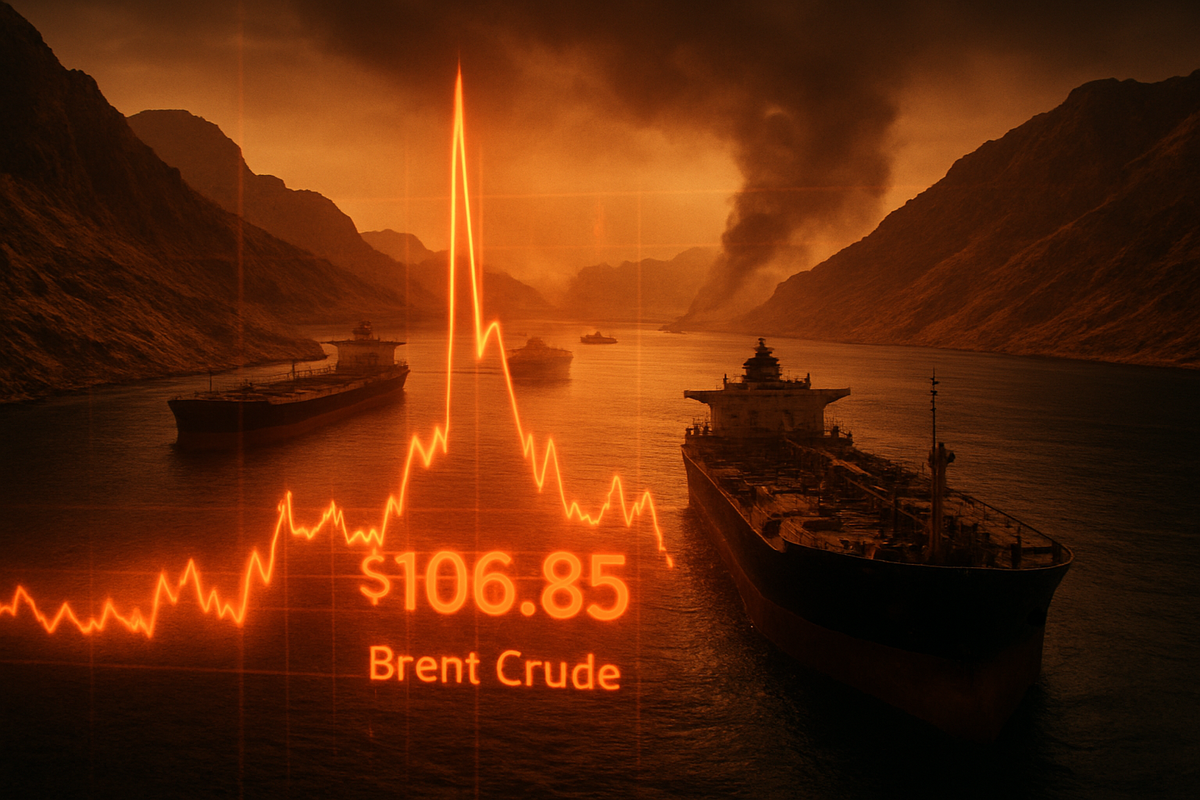
The global energy landscape has been pushed to the brink of collapse this month as Brent crude oil prices soared to $106.85 per barrel, marking a staggering 45% gain in just thirty days. The catalyst for this historic price shock is a total blockade of the Strait of Hormuz by Iranian naval forces, a move that has effectively severed the world’s most vital artery for petroleum and liquefied natural gas (LNG). With approximately 20% of the world’s daily oil consumption and nearly a quarter of global LNG trade now trapped behind the Iranian-controlled chokepoint, markets are bracing for a prolonged period of scarcity and economic volatility.
The surge in Brent has outpaced West Texas Intermediate (WTI), which is currently trading near $92.80 per barrel. This widening $14 spread highlights a fragmented market where the United States remains somewhat insulated by its domestic production, while the rest of the world—particularly Europe and Asia—scrambles for any available non-Middle Eastern barrels. As diplomatic channels between Washington, Jerusalem, and Tehran remain shuttered, the risk of a wider regional conflict looms, casting a long shadow over the global recovery and threatening to ignite a new wave of hyper-inflation across the developed world.
The "Epic Fury" Fallout and the Closure of the Strait
The current crisis traces its origins to late February 2026, when a combined military campaign known as "Operation Epic Fury" was launched by the United States and Israel. The operation targeted several of Iran's most sensitive nuclear and military installations. Following the reported death of Iran's Supreme Leader on February 28, the Iranian Revolutionary Guard Corps (IRGC) executed a pre-planned retaliation: the complete closure of the Strait of Hormuz. By March 5, commercial shipping had ground to a halt as Iran deployed advanced naval mines and anti-ship missile batteries along the coastline, declaring the waters a "sovereign combat zone."
Diplomatic efforts to resolve the standoff have been a series of public failures. Throughout mid-March, intermediaries from Oman, Turkey, and Pakistan attempted to broker a ceasefire, but negotiations collapsed when Iran rejected a 15-point U.S. proposal. Tehran has demanded full reparations for the "Epic Fury" strikes and a total withdrawal of Western naval assets from the Persian Gulf—terms that the U.S. State Department labeled "non-starters." The breakdown of these talks on March 20 sent oil prices on their final, most aggressive leg up to the current $106 level.
The immediate market reaction has been one of panic and "force majeure" declarations. Major regional producers, including Saudi Arabia, Kuwait, and the UAE, have been forced to shut in millions of barrels of production as onshore storage facilities reached capacity. While some oil is being diverted through Saudi Arabia's East-West pipeline, its capacity is a mere fraction of what normally flows through the Strait. Meanwhile, QatarEnergy, the world's leading LNG exporter, has suspended all shipments, leaving major economies like Japan and South Korea in a state of energy emergency.
Market Winners and Losers: A Great Decoupling
In the equity markets, the blockade has created a sharp divergence between energy producers with Atlantic Basin assets and those reliant on Middle Eastern logistics. Equinor (NYSE: EQNR) has emerged as a primary beneficiary, with its North Sea production and direct pipeline links to Europe becoming the continent’s most valuable energy lifeline. Similarly, U.S.-based explorers like Devon Energy (NYSE: DVN), Diamondback Energy (NASDAQ: FANG), and Coterra Energy (NYSE: CTRA) have seen their valuations soar. These companies are generating record free cash flow at $90+ WTI, with their "safe-haven" domestic production becoming a premium asset for global investors.
Downstream players are facing a more complex environment. Refiners such as Valero Energy (NYSE: VLO) and PBF Energy (NYSE: PBF) are seeing unprecedented "crack spreads"—the difference between the price of crude and the price of refined products like gasoline. While their input costs have risen, the scarcity of fuel has driven retail prices even higher, though those refiners dependent on heavy Brent-linked imports are finding their margins squeezed compared to their WTI-fed peers. Additionally, CF Industries (NYSE: CF) has seen a massive uptick in demand, as global fertilizer production (which relies heavily on natural gas) has been decimated by the loss of Qatari LNG.
The defense and shipping sectors are also seeing significant volatility. Lockheed Martin (NYSE: LMT) and RTX Corporation (NYSE: RTX) have rallied to all-time highs as the Pentagon orders a rapid replenishment of munitions used in the opening salvos of the conflict. In shipping, FLEX LNG (NYSE: FLNG) has seen its day rates triple as the few remaining available LNG tankers are rerouted around the Cape of Good Hope, a much longer and more expensive journey that creates a "ton-mile" boom for the industry. Conversely, consumer-facing giants like Amazon (NASDAQ: AMZN) and major airlines are seeing their stock prices crater as the prospect of $5-per-gallon jet fuel and soaring shipping costs threatens to derail consumer spending.
Broader Implications: Inflation and Geopolitical Shifts
This event represents a fundamental shift in the global energy security paradigm. For the past decade, the "shale revolution" in the U.S. had convinced many that the world was no longer beholden to Middle Eastern stability. The current blockade has shattered that illusion, proving that 20% of the world's supply cannot be easily replaced by U.S. exports or renewable energy in the short term. The resulting price shock is expected to add at least 2.5% to global CPI figures by the end of the second quarter, potentially forcing central banks to resume interest rate hikes even as economic growth stalls.
Furthermore, the "selective blockade"—where Iran has reportedly allowed some Chinese and Russian vessels to pass for a "transit fee"—could accelerate the bifurcation of the global economy. If China continues to receive discounted Iranian and Persian Gulf oil while the West pays $100+ prices, the competitive disadvantage for Western manufacturing could be permanent. This mirrors the historical oil shocks of 1973 and 1979, but with the added complexity of a modern, interconnected supply chain that relies on just-in-time delivery and low-cost logistics.
The regulatory response is also likely to be swift. We are already seeing calls in the U.S. Congress for a permanent ban on crude exports to ensure domestic supply, a move that would further isolate the global Brent market and potentially lead to even higher international prices. At the same time, the crisis is providing a desperate impetus for the "green transition." However, the irony is not lost on market participants: the very metals and minerals needed for EVs and solar panels are also seeing their shipping costs skyrocket due to the same energy crisis they are meant to solve.
The Path Forward: Escalation or Resolution?
The immediate question for investors is whether this blockade will be broken by force. The U.S. Navy’s Fifth Fleet is currently massing in the Arabian Sea, and analysts suggest that a "tanker convoy" system, similar to the 1980s "Operation Earnest Will," may be imminent. However, the risk of a full-scale naval war in the Gulf is keeping insurance premiums at levels that make commercial shipping nearly impossible even if the Strait were nominally "open."
In the short term, expect Brent to test the $120 level if a military solution is attempted and fails to achieve a quick opening. Conversely, a surprise diplomatic breakthrough—perhaps mediated by China—could see $30 of "geopolitical premium" evaporate from the price of crude overnight. Strategic Petroleum Reserve (SPR) releases from IEA member nations are expected to be announced within the week, but with reserves already at multi-decade lows in several countries, the market's faith in these "paper barrels" to suppress prices is waning.
Final Assessment: A New Era of Energy Volatility
The surge of Brent crude to $106.85 is more than just a price spike; it is a symptom of a fractured global order. The blockade of the Strait of Hormuz has exposed the fragile underpinnings of the world’s energy supply and forced a re-evaluation of risk in every sector of the market. As we move deeper into 2026, the era of cheap, reliable energy appears to be a relic of the past, replaced by a landscape defined by geopolitical leverage and supply-chain nationalism.
Investors should maintain a high degree of caution. While energy and defense stocks like Occidental Petroleum (NYSE: OXY) and Northrop Grumman (NYSE: NOC) offer a hedge against further escalation, the broader market remains highly vulnerable to a "stagflationary" shock. The key metrics to watch in the coming months will be the success of U.S. naval escorts, any shift in China’s diplomatic stance toward Tehran, and the weekly inventory draws at Cushing, Oklahoma. For now, the world remains at the mercy of a narrow strip of water, and the price of that vulnerability has never been higher.
This content is intended for informational purposes only and is not financial advice.