FRANKFURT — In a sobering address on March 26, 2026, European Central Bank (ECB) President Christine Lagarde characterized the intensifying conflict in Iran as a "real shock" to the Eurozone’s fragile economic recovery. Speaking from the ECB’s headquarters, Lagarde warned that the geopolitical explosion in the Middle East has reignited inflationary pressures that could force the central bank to abandon its accommodative stance and pivot toward aggressive interest rate hikes.
The warning comes as the global energy market reels from the most significant disruption in decades, threatening to plunge Europe into a period of stagflation. With oil prices remaining volatile and supply chains facing renewed bottlenecks, the ECB now finds itself caught between the need to support a stuttering economy and the mandate to prevent a repeat of the runaway inflation seen in the early 2020s.
The Geopolitical Catalyst: Operation Epic Fury and the Energy Squeeze
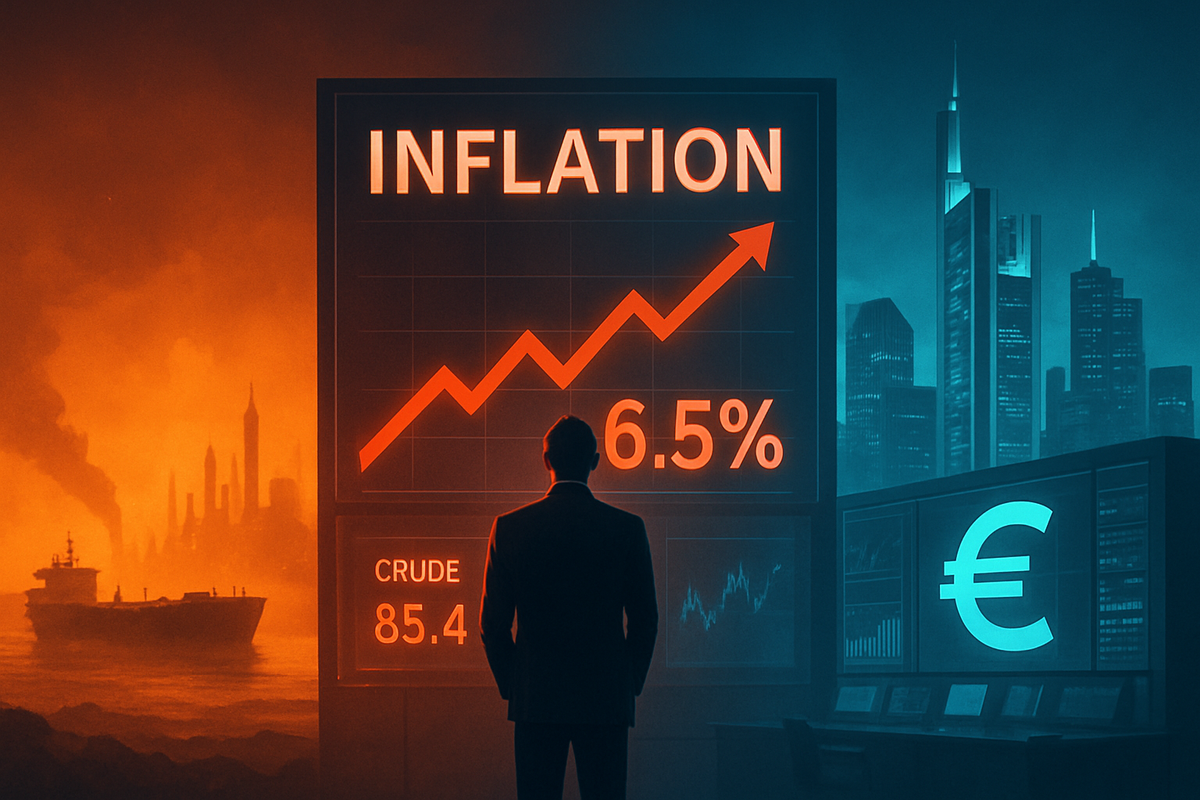
The current crisis traces back to February 28, 2026, when a joint military operation titled "Operation Epic Fury" was launched against Iranian nuclear and military infrastructure. The fallout was immediate and devastating: Iran responded by closing the Strait of Hormuz, a move that effectively choked off 20% of the world’s daily oil supply. This unprecedented blockade sent Brent crude prices skyrocketing from a stable $74 per barrel in early February to a staggering peak of $120 within weeks.
By the time Lagarde took the podium today, oil had slightly retraced to approximately $104 per barrel on rumors of back-channel ceasefire negotiations, but the damage to economic sentiment was already done. Lagarde highlighted that this "external shock" is occurring at a time when European businesses and labor unions still hold "bitter memories" of the 2022 inflation surge following the invasion of Ukraine. This psychological scarring, she argued, makes the economy more susceptible to a "price-wage spiral," as firms are now quicker to pass on costs to consumers and workers are more aggressive in demanding cost-of-living adjustments.
Initial market reactions have been chaotic. While the ECB held its benchmark rate steady at 2.0% during its mid-March meeting, Lagarde’s rhetoric today suggests that a "measured" tightening cycle could begin as early as the next governing council meeting. Financial markets, which had previously priced in rate cuts for the latter half of 2026, are now rapidly repricing for a series of 25-basis-point hikes if inflation exceeds the ECB’s newly projected "adverse scenario" of 4% by year-end.
Market Winners and Losers: A Tale of Two Continents
The volatility of early 2026 has created a sharp divide between corporate winners and losers, with energy and defense giants standing out as the primary beneficiaries of the "war shock." European defense contractor Rheinmetall (ETR:RHM) and aerospace leader Airbus (EPA:AIR) have seen their share prices surge as EU member states accelerate military spending in response to the regional instability. Similarly, "Supermajors" like Shell (NYSE: SHEL), BP (NYSE: BP), and TotalEnergies (NYSE: TTE) have capitalized on the supply crunch, with their refining margins expanding even as volume risks persist.
Conversely, the European technology and manufacturing sectors are bearing the brunt of the crisis. High energy costs are eating into the margins of industrial heavyweights, while the threat of higher interest rates has dampened the valuation of growth-oriented firms like ASML (NASDAQ: ASML) and SAP (NYSE: SAP). These companies, which are sensitive to both capital costs and global trade stability, have seen their year-to-date gains erased as investors rotate into "defensive" energy and commodity plays.
The contrast with the U.S. market is stark. While the S&P 500 and tech-heavy Nasdaq 100 have not been immune to the global jitters, they have shown greater resilience than their European counterparts. U.S. domestic energy independence and the continued dominance of AI-driven giants like NVIDIA (NASDAQ: NVDA) have provided a buffer that the Eurozone lacks. While the DAX in Germany suffered a 10% correction in the weeks following the start of the conflict, the U.S. indices have managed to avoid a full-scale bear market, buoyed by a "flight to quality" into the U.S. dollar and American equities.
Broader Implications: The End of Easy Disinflation
Lagarde’s "real shock" warning underscores a broader shift in the global economic order. The conflict represents a move away from the era of "just-in-time" globalization toward a "just-in-case" economy defined by geopolitical fragmentation. The ECB’s fear is that these supply-side shocks are becoming a permanent feature of the mid-2020s, making the 2% inflation target increasingly difficult to maintain without stifling growth.
This event also highlights a growing policy divergence between the ECB and the U.S. Federal Reserve. While the Fed remains cautious, it benefits from a U.S. economy that is less sensitive to Middle Eastern energy disruptions. The ECB, however, is forced to operate on the front lines of the energy crisis, making its policy path far more treacherous. Historically, such shocks—like the 1973 oil embargo—led to years of economic malaise; the ECB is desperate to avoid a 21st-century repeat of that "lost decade."
Furthermore, the "Iran shock" is expected to accelerate the European Union's regulatory push for energy sovereignty. Policy analysts suggest that the current crisis will provide the political capital necessary to fast-track the "Green Deal" initiatives, shifting capital away from fossil fuels and toward hydrogen and nuclear energy. However, these transitions take years, leaving a dangerous "energy gap" that the ECB must manage through monetary policy in the interim.
The Road Ahead: Strategic Pivots and Scenarios
In the short term, all eyes remain on the Strait of Hormuz. If the blockade persists, oil prices could feasibly reach the $150-per-barrel mark, a scenario that Lagarde warned would lead to "severe" inflation exceeding 6% in 2027. Investors should expect heightened volatility in the Euro (€) as it fluctuates against the dollar based on ceasefire rumors and ECB rhetoric.
Strategic pivots are already underway within the corporate world. European manufacturers are likely to accelerate "friend-shoring"—moving supply chains to more stable, allied nations—to mitigate the risks of future geopolitical shocks. For the ECB, the coming months will be a test of credibility. If they raise rates too slowly, inflation may become entrenched; if they raise them too aggressively, they risk a deep recession in the Eurozone’s largest economies, including Germany and France.
Market opportunities may emerge in the renewable energy sector and in companies specializing in logistics and supply chain resilience. However, the overarching challenge will be navigating a high-interest-rate environment that many investors and companies had hoped was a thing of the past.
Summary and Outlook
The "real shock" of March 2026 serves as a definitive end to the hopes of a smooth post-pandemic economic landing. Christine Lagarde’s warning has set the stage for a period of defensive monetary policy, where the primary goal is no longer growth, but the containment of geopolitical-driven inflation. The divergence between a more resilient U.S. market and a vulnerable Europe has rarely been more pronounced.
As we move forward, the key takeaways are clear: energy security is now synonymous with economic security, and central banks are no longer willing to "look through" supply-side shocks. Investors must remain vigilant, watching for the next round of Eurozone inflation prints and any signs of de-escalation in the Middle East. The coming months will determine whether the ECB can navigate this "real shock" without breaking the European economy, or if 2026 will be remembered as the year the "bitter memories" of inflation became a permanent reality.
This content is intended for informational purposes only and is not financial advice.